

Last Updated on July 31, 2026
Podiatry claim denials often begin with small but costly gaps. A missing Q modifier, incomplete class findings, incorrect diagnosis linkage, or an unsupported same-day evaluation and management service can delay payment for care that was properly delivered.
CMS data shows why denial prevention deserves attention. During the 2024 Medicare Fee for Service reporting period, podiatry care had an improper payment rate of 11.2 percent, representing a projected $216.9 million. Insufficient documentation accounted for 76.4 percent of podiatry improper payments, while incorrect coding contributed another 11.5 percent.
Improving first pass acceptance requires more than claim scrubbing. It depends on accurate patient information, service-specific benefit checks, complete documentation, precise coding, and payer-focused claim review.
Not sure where your podiatry denials begin?
AnnexMed can review your billing workflow and identify where clean claims are being lost.
Schedule a Podiatry Billing ReviewTable of contents
Why Podiatry Claims Are Frequently Denied
Podiatry billing covers routine foot care, wound care, injections, imaging, orthotics, durable medical equipment, and surgery. Each service may carry different medical necessity rules, frequency limits, authorization requirements, modifier logic, and coverage policies.
Common sources of podiatry claim denials include:
- Eligibility and benefit errors
- Missing referrals or authorizations
- Insufficient medical necessity documentation
- Incorrect CPT and ICD-10 linkage
- Missing laterality or toe modifiers
- Unsupported Q modifiers
- Same-day E and M bundling
- Frequency or global period conflicts
Practices should also separate claim rejections from claim denials. A rejection usually occurs before payer adjudication because information is missing, invalid, or incorrectly formatted. A denial occurs after payer review and often requires a corrected claim, supporting documentation, or an appeal.
This distinction matters because a front-end eligibility rejection requires a different corrective action than a denial caused by medical necessity or modifier use.
Where First Pass Acceptance Breaks Down
A preventable podiatry billing error may move through several teams before it reaches the payer. Looking at the complete claim path helps practices determine where controls are needed.
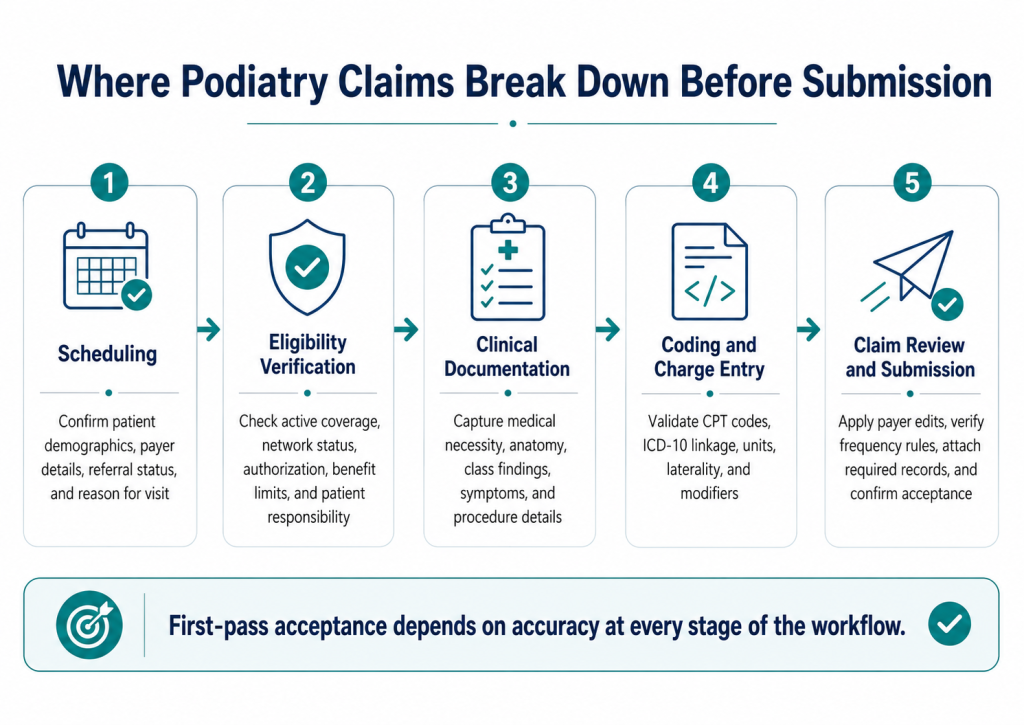
A final claim scrub cannot correct clinical information that was never documented or an authorization that was never obtained. First pass acceptance must therefore be protected throughout the patient and claim workflow.
6 Revenue Cycle Best Practices to Prevent Podiatry Denials
Verify Coverage Before the Patient Visit
Eligibility verification should confirm more than whether a policy is active. Staff should review network status, referral requirements, available benefits, deductibles, copayments, and prior authorization rules.
For wound products, injections, imaging, surgery, orthotics, and DME, verification should address the planned service. A patient can have active coverage while a specific service is excluded, limited, or subject to medical review.
Payer requirements should be maintained in a central reference that includes:
- Covered and noncovered services
- Authorization requirements
- Frequency limitations
- Required diagnosis codes
- Documentation expectations
- Payer-specific modifiers
- Claim submission instructions
A structured eligibility and benefit verification process reduces avoidable front-end denials and gives patients clearer information about their financial responsibility before treatment.
Strengthen Routine Foot Care Documentation
Routine foot care is a high-risk area because coverage depends heavily on the patient’s condition and supporting medical record. A diagnosis code by itself does not prove that a service was reasonable and necessary.
The documentation should explain why professional foot care was required, which clinical findings were present, what service was performed, and how the findings support the procedure. When Q7, Q8, or Q9 is reported, the record must support the applicable class findings and complicating condition. CMS applies the coverage presumption when the record supports one Class A finding, two Class B findings, or one Class B and two Class C findings.
Routine Foot Care Documentation Checklist
- Qualifying systemic condition documented
- Relevant class findings clearly recorded
- Symptoms and clinical risks described
- Nails or lesions identified by number and location
- Procedure details completed
- Diagnosis linked to the correct service
- Treating provider information included when required
- Medical record signed and dated
Templates can prompt providers to record the required information, but the documentation must remain specific to the patient. Repeated language that does not reflect the actual encounter can weaken an appeal or audit response.
Practices should also review current podiatry billing guidelines and the coverage policies issued by their Medicare Administrative Contractor. A rule followed by one payer or jurisdiction may not automatically apply to every claim.
Spending too much time reworking denied podiatry claims?
AnnexMed combines denial prevention, root cause analysis, and recovery support to improve first pass reimbursement.
Talk to a Denial Management ExpertApply Podiatry Codes and Modifiers Correctly
Podiatry coding requires consistency between the medical record, procedure, diagnosis, anatomy, modifier, and billed units. The following modifiers deserve added attention because they frequently affect payment.
| Modifier | Common Use | Frequent Denial Risk |
|---|---|---|
| Q7 | One Class A finding | Supporting finding is absent or unclear |
| Q8 | Two Class B findings | Both findings are not documented |
| Q9 | One Class B and two Class C findings | Required combination is incomplete |
| LT and RT | Left or right side | Laterality conflicts with the note |
| TA to T9 | Specific toe identification | Incorrect or missing toe detail |
| 25 | Separate same-day E and M service | Visit is not separately identifiable |
| 59 | Distinct procedural service | Used only to bypass a bundling edit |
Modifiers should not be added simply because a claim edit appears. They must be supported by the service performed and the clinical documentation.
Diagnosis pointers also require line-level review. A claim may contain the correct podiatry CPT codes and ICD-10 codes but still be denied when the diagnosis is linked to the wrong procedure. Nail counts, lesion counts, units, and laterality should agree across the note and claim.
Prevent Same Day Evaluation and Management Denials
A same-day E and M service may be reported with a podiatry procedure when the visit is significant, separately identifiable, medically necessary, and supported beyond the work normally included in the procedure.
Modifier 25 should not be used automatically whenever an office visit and procedure appear together. The documentation should show a separate complaint, additional assessment, or medical decision-making beyond confirming and performing the procedure.
Evaluating a new condition, changing a treatment plan, or managing a separate chronic problem may support the E and M service. A brief assessment performed only to complete a planned nail or lesion procedure may be considered part of the procedure.
Providers and coders should therefore review what was evaluated, what decisions were made, and whether the documentation clearly separates the visit from the procedure.
Review High Risk Claims Before Submission
Not every podiatry claim requires the same level of review. A targeted process allows the billing team to focus additional attention on routine foot care, wound debridement, same-day E and M services, surgery, injections, orthotics, and DME.
Before submission, reviewers should confirm:
- Eligibility and authorization
- Provider enrollment and place of service
- CPT and ICD-10 linkage
- Q modifiers and supporting class findings
- Laterality and toe modifiers
- Units, lesion counts, and nail counts
- Frequency and global period limits
- Required attachments or operative records
Claim edits should reflect the practice’s payer mix and actual denial history. Standard clearinghouse edits are useful, but they may not identify every local coverage policy, medical necessity rule, or payer-specific requirement.
Use Denial Data to Correct Root Causes
Denial management should not end with claim correction and appeal. Each denial should be categorized by payer, procedure, provider, reason code, dollar value, and root cause.
Practices should track:
- First pass acceptance rate
- Claim rejection rate
- Initial denial rate
- Appeal success rate
- Average days to resolution
- Denial-related write-offs
- Repeat denials after corrective action
Results should also be reviewed by payer and service type. A stable practice-wide denial rate can hide a serious issue affecting routine foot care, wound services, or one Medicare Advantage plan.
Root cause analysis should show whether the error began in scheduling, eligibility, authorization, documentation, coding, charge entry, or submission. When the same denial continues after training or workflow changes, the source of the problem has not been corrected.
Preventing podiatry claim denials requires coordination across patient access, clinical documentation, coding, billing, and denial management. Each team contributes information that determines whether a claim is accepted or returned for correction.
The strongest approach is preventive. Verify service-specific benefits before the visit, capture medical necessity during the encounter, validate codes and modifiers, review high-risk claims, and feed denial findings back into the workflow.
When these controls work together, podiatry practices can improve first pass acceptance, reduce appeal volume, shorten payment cycles, and protect revenue without increasing patient volume.
Two Decades of Podiatry Billing Expertise Behind Every Claim
- 20 Plus Years Proven
- 1300 Plus RCM Experts
- 100 Plus Healthcare Clients
- 40 Plus EHR Integrations
- 24 by 7 Support
- Results That Protect Revenue
FAQs
A strong first pass acceptance rate is generally above 90 percent, although the right benchmark depends on payer mix, service complexity, and claim volume. Practices should also track the rate by payer and procedure type instead of relying only on one overall percentage.
High-risk claims should be reviewed regularly, while broader coding and documentation audits can be conducted monthly or quarterly. More frequent audits may be necessary when denial rates rise, new providers join, or payer policies change.
Routine foot care, wound debridement, same-day E and M services, surgical procedures, injections, orthotics, and durable medical equipment usually require closer review because they involve added documentation, modifier, or coverage requirements.
An appeal is appropriate when the service was covered, medically necessary, correctly coded, and supported by complete documentation. Claims caused by data-entry or coding mistakes may be better handled through correction and resubmission.
Outsourcing can help when the billing partner has podiatry-specific coding knowledge, payer rule expertise, denial analytics, and pre-submission review controls. General billing support without specialty knowledge may not address the root causes of denials.
Practices should evaluate specialty experience, coding expertise, denial prevention processes, reporting capabilities, payer follow-up, EHR compatibility, compliance standards, and the ability to identify workflow issues before they affect reimbursement.