

Last Updated on October 9, 2026
Hospital price transparency is entering another period of regulatory scrutiny. While hospitals are already responsible for meeting strengthened requirements that took effect in 2026, CMS is considering additional changes that could shape how pricing information is reported and compared in the future.
For revenue cycle leaders, the distinction matters. The 2026 requirements are finalized and enforceable, while potential changes discussed in the CY 2027 OPPS/ASC proposed rule remain under consideration.
Hospitals therefore have two priorities: validate compliance with current requirements and strengthen the pricing data, reimbursement records, and governance processes that may need to support future changes.
The challenge is no longer simply whether a hospital has published its required pricing information. It is whether that information can be reliably traced to negotiated contracts, reimbursement methodologies, and the underlying systems that maintain it.
2026: Finalized Price Transparency Requirements Now in Effect
The CY 2026 Hospital Outpatient Prospective Payment System (OPPS) final rule introduced significant hospital price transparency changes. These requirements became effective January 1, 2026, with CMS beginning enforcement of the new provisions on April 1, 2026.
Several requirements deserve particular attention:
- Actual allowed amounts: For applicable percentage-based or algorithm-based negotiated charges, hospitals must report the median, 10th percentile, and 90th percentile allowed amounts, along with the number of allowed amounts used.
- Remittance-based calculations: Hospitals must use 835 electronic remittance advice or equivalent remittance data, with a lookback period of at least 12 months and no more than 15 months.
- Data attestation: Hospitals must attest that applicable standard charge information is true, accurate, and complete to the best of their knowledge and belief.
- Executive accountability: The machine-readable file must identify the CEO, president, or designated senior official overseeing the accuracy and completeness of the encoded data.
- Organizational identifiers: Applicable Type 2 National Provider Identifiers must be included to improve data identification and comparability.
As of October 2026, these are current compliance obligations, not upcoming changes. Hospitals should be reviewing the accuracy and completeness of their published information and validating the processes used to maintain it.
Hospital Price Transparency, 2026 vs. 2027
Enforcement began April 1, 2026
What’s required
- Actual allowed amount reporting
- Remittance-based calculations
- Data accuracy attestation
- Executive identification
- Applicable Type 2 NPIs
Validate current compliance and published data accuracy.
CY 2027 OPPS/ASC proposed rule RFI
What’s being explored
- Greater file standardization
- Fewer free-text inconsistencies
- Complex contract reporting
- Improved data completeness
- Consumer-facing usability
Monitor CMS rulemaking and assess potential impact
RCM EXPERT INSIGHT | Compliance Is Not the Same as Data Accuracy
A machine-readable file can pass formatting checks and still contain outdated negotiated rates or incorrect service mappings. Hospitals should validate published values against underlying contract and reimbursement data, not just the file structure.
2027: Potential Changes to Data Standardization and Comparability
In July 2026, CMS issued the CY 2027 OPPS/ASC proposed rule, which included a Request for Information (RFI) on further strengthening hospital price transparency.
Unlike the finalized 2026 requirements, this RFI seeks public feedback rather than establishing new mandatory reporting obligations.
CMS is exploring ways to improve machine-readable file standardization, reduce inconsistencies in free-text fields, and strengthen reporting of complex contracting arrangements, including outlier payments, stop-loss provisions, rate tiers, and carve-outs.
The agency is also considering how consumer-facing pricing information could become more comparable and useful, including possible changes involving price estimator tools and shoppable services.
These potential changes should not be treated as finalized 2027 requirements. Hospitals should monitor subsequent CMS rulemaking before changing compliance processes based solely on the RFI.
However, the areas being examined provide a useful indication of where pricing-data governance may need to become stronger.
Why Price Transparency Is Becoming a Data Governance Issue
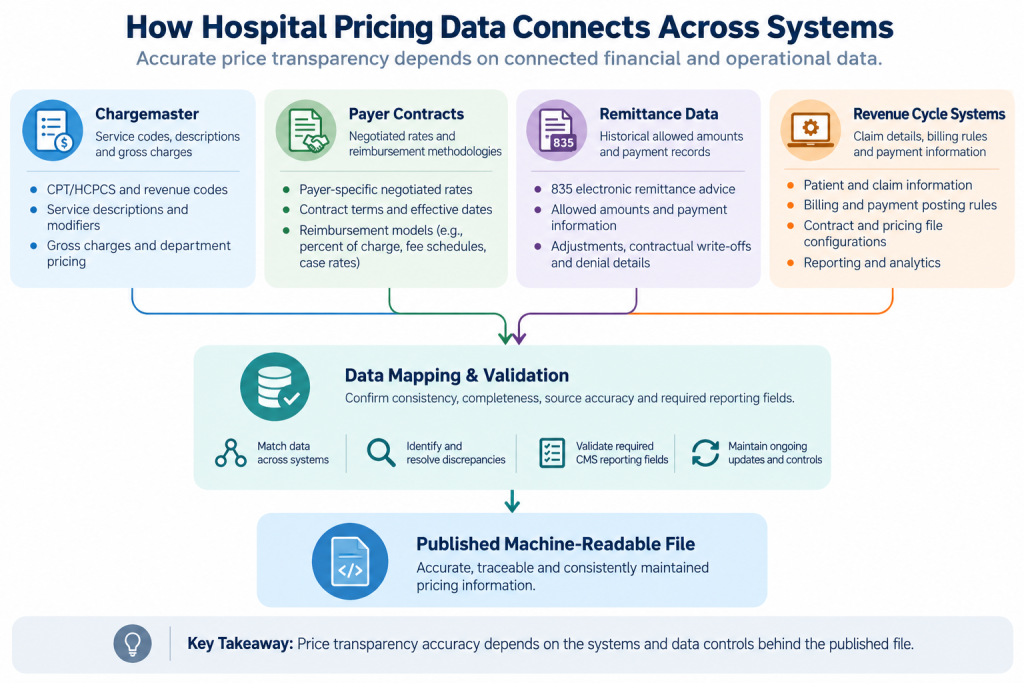
A hospital’s published prices do not originate from one system. They may depend on chargemaster records, payer contracts, reimbursement methodologies, remittance information, and other financial data.
These sources are often maintained by different departments, with different update cycles and responsibilities.
A payer contract amendment may change a negotiated rate while the published machine-readable file continues reflecting outdated information. Similarly, a chargemaster revision may alter service descriptions or codes without corresponding updates elsewhere.
The problem is not always an incorrect calculation. Sometimes the organization lacks a reliable process for keeping related data synchronized.
WHAT RCM TEAMS SHOULD DO | Prioritize High-Impact Data
Start with high-volume services, frequently amended payer contracts, and complex reimbursement arrangements. These areas can expose discrepancies between published charges and operational data.
The Revenue Integrity Connection Hospitals Should Not Overlook
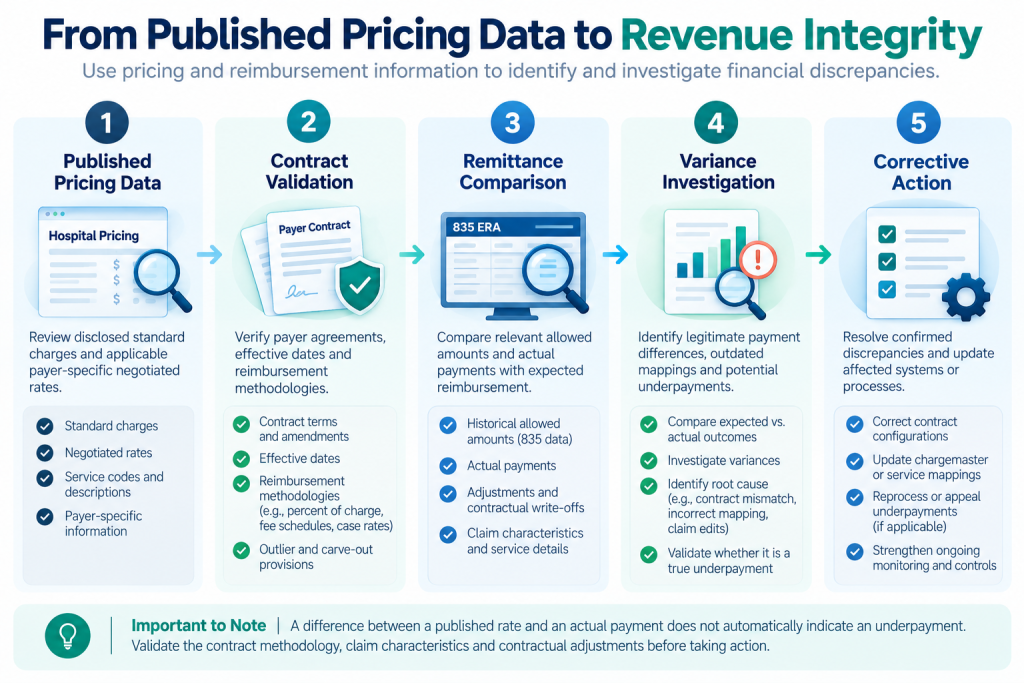
Price transparency data can also support internal reimbursement analysis.
When hospitals maintain reliable connections between contracted rates, allowed amounts, and payment records, they have a stronger foundation for identifying discrepancies and investigating unexpected reimbursement.
Consider a service where the published negotiated charge, contract configuration, and actual allowed amount do not align. The difference may have a legitimate explanation, such as a contractual adjustment, service-specific methodology, or claim characteristic.
However, unexplained differences deserve investigation because they may indicate outdated contract terms, incorrect mappings, or reimbursement-modeling gaps.
REVENUE INTEGRITY PERSPECTIVE | Not Every Difference Is an Underpayment
Published negotiated charges, historical allowed amounts, and actual claim payments are not interchangeable measures. Before flagging a variance, confirm the reimbursement methodology, claim characteristics, and contractual adjustments.
Are Your Payer Contracts and Actual Payments Telling the Same Story?
Outdated contract configurations and unexplained payment variances can make revenue gaps difficult to identify. Strengthen reimbursement accuracy with AnnexMed’s revenue cycle expertise.
Get a free reviewExecutive Oversight Is Becoming More Important
The updated attestation requirements create a clearer connection between the accuracy of published pricing information and senior leadership responsibility.
That does not mean the CEO should personally validate every service-level charge. It means hospitals need a defensible process through which responsible teams can confirm that published information is complete and accurate.
For CFOs and revenue cycle executives, this requires clarity around data ownership, validation procedures, change approvals, and escalation of unresolved discrepancies.
A hospital should be able to explain where its pricing information originated, when it was last updated, and how material differences were investigated.
LEADERSHIP ACTION | Make Data Ownership Explicit
Assign accountable owners for contract data, chargemaster updates, remittance-based calculations, file publication, and final validation. Documented approvals make discrepancies easier to trace and resolve.
What Hospitals Should Review Before the Next Phase
Hospitals should use current requirements to strengthen their underlying processes rather than waiting for another regulatory deadline.
Four areas deserve immediate attention:
1. Data accuracy and completeness: Validate machine-readable files against current CMS specifications and confirm that required fields are populated appropriately.
2. Contract and reimbursement alignment: Review how negotiated charges and remittance-based allowed amounts are sourced, calculated, and maintained.
3. Change management: Establish clear responsibilities for updating published information when contracts, chargemaster records, or reimbursement methodologies change.
4. Executive reporting: Provide leadership with visibility into file validation results, unresolved discrepancies, corrective actions, and compliance status.
Post-Publication Review
1 Data Accuracy & Completeness
2 Contract & Reimbursement Alignment
3 Change Management
4 Executive Oversight
5 Regulatory Monitoring
These reviews should become part of ongoing financial data governance rather than a one-time exercise before publication.
The Real Shift Is Happening Behind the File
Hospital price transparency is entering a more demanding phase. The emphasis is shifting from making pricing information available to ensuring that it is accurate, consistent, comparable, and supported by reliable operational data.
For hospital revenue cycle leaders, this creates an opportunity to improve more than regulatory compliance. Stronger pricing-data governance can also support contract management, reimbursement validation, and financial oversight.
Hospitals that treat price transparency as an ongoing enterprise data responsibility will be better positioned to meet evolving requirements while strengthening revenue integrity.
The next phase of hospital price transparency will not be defined by the file alone. It will be defined by how confidently hospitals can explain, validate, and govern the information behind it.
Stronger Price Transparency Starts With Better Revenue Cycle Controls
Accurate pricing data depends on reliable processes across contracts, billing, and reimbursement. AnnexMed helps hospitals identify operational gaps, investigate payment discrepancies, and strengthen revenue integrity.
Connect With Our Experts