

Last Updated on August 31, 2026
Most denied claims don’t become revenue losses because they were denied. They become revenue losses because they were never recovered. Every unresolved denial delays reimbursement, weakens cash flow, and increases the risk of avoidable write-offs. As payer requirements become more complex, hospitals need a coordinated strategy that not only overturns denials but also supports long-term financial recovery.
As payer policies become more complex and denial rates continue to rise, appeals management has evolved from an administrative task into a strategic component of revenue cycle performance. Hospitals that treat appeals as an extension of their revenue recovery strategy are better positioned to improve cash flow, reduce avoidable write-offs, and maximize reimbursement for the care they provide.
Successful appeals management depends on accurate clinical documentation, coding expertise, payer-specific knowledge, standardized workflows, and timely follow-up to maximize reimbursement recovery.
Table of contents
- What Is Hospital Appeals Management?
- Appeals Management vs. Denial Management
- Common Reasons Hospital Claims Are Denied
- Hospital Appeals Management Workflow
- Common Challenges in Hospital Appeals Management
- Best Practices for Recovering Denied Claims
- Hospital Appeal Management KPIs Every Hospital Should Track
- FAQs
Your Partner in Hospital Appeals Management
AnnexMed partners with hospitals and health systems to improve appeal success rates, recover denied revenue, and strengthen reimbursement performance through standardized processes, payer expertise, and data-driven insights.
Connect with Our Revenue Cycle ExpertsWhat Is Hospital Appeals Management?
Hospital appeals management is the structured process of recovering reimbursement for claims that have been denied or underpaid by insurance payers. The process begins after a payer issues a denial or partial payment. Revenue cycle teams review the denial reason, validate the supporting documentation and coding, prepare the required appeal, submit it within payer deadlines, and monitor the claim until a final payment decision is reached.
Effective appeals management extends beyond overturning individual denials. Every appeal generates valuable insight into payer behavior, documentation quality, coding accuracy, and operational gaps that contribute to recurring reimbursement issues. Organizations that analyze appeal outcomes alongside denial trends can strengthen revenue recovery while reducing future denials.
For healthcare executives, appeals management is not simply about winning appeals. It is a financial strategy that protects earned revenue, improves reimbursement predictability, and supports long-term financial performance.
Appeals Management vs. Denial Management
Denial management focuses on reducing the number of claims that are denied. Appeals management focuses on recovering reimbursement after a denial has occurred. High-performing organizations invest in both disciplines because preventing denials and recovering valid claims together deliver stronger financial results than either strategy alone.
The most effective hospitals don’t choose between denial prevention and appeals recovery. They integrate both into a comprehensive reimbursement strategy that strengthens cash flow, reduces revenue leakage, and improves financial performance across the revenue cycle.
Common Reasons Hospital Claims Are Denied
Most hospital claim denials originate from operational, clinical, or payer-related issues that can often be identified and addressed before they result in unnecessary revenue loss.
Every denied claim tells a story about where the reimbursement process broke down. In some cases, the issue begins during patient registration or insurance verification. In others, it stems from incomplete clinical documentation, inaccurate coding, missing prior authorization, or differences in payer reimbursement policies.
While the reasons for denial vary across specialties and payers, a relatively small number of denial categories account for the majority of ongoing reimbursement challenges faced by hospitals.
The following table outlines the most common denial categories, their typical causes, and whether they generally present an opportunity for appeal.
| Denial Category | Typical Cause | Appealable |
|---|---|---|
| Medical Necessity | Clinical documentation does not sufficiently support the medical necessity of the service provided. | Yes |
| Prior Authorization | Missing, expired, or incomplete authorization before treatment. | Often |
| Clinical Documentation | Documentation lacks specificity or supporting evidence required for reimbursement. | Yes |
| Coding Errors | Incorrect CPT, HCPCS, ICD-10-CM codes, modifiers, or DRG assignment. | Yes |
| Eligibility & Benefits | Patient coverage was inactive or insurance information was inaccurate. | Sometimes |
| Timely Filing | Claim submitted after the payer’s filing deadline. | Rarely |
| Duplicate Claims | Claim identified as a duplicate submission by the payer. | Yes |
| Coordination of Benefits | Incorrect primary or secondary payer information resulted in claim rejection. | Yes |
| Bundling & NCCI Edits | Services considered inclusive or incorrectly reported according to payer edits. | Yes |
| Contractual Payment Variance | Reimbursement does not align with contracted payment terms. | Yes |
Although many of these denials are recoverable, successful recovery depends on timely action, accurate documentation, and a well-structured appeals process. Equally important is knowing which denials deserve immediate attention based on their financial impact and likelihood of recovery.
Which Denials Should Hospitals Prioritize?
Appealing every denied claim may seem like the safest approach, but prioritizing appeals based on financial impact often delivers greater financial recovery.
Revenue cycle teams frequently operate with limited resources, making it impractical to pursue every denial with the same level of effort. High-performing hospitals instead evaluate denied claims based on factors such as reimbursement value, clinical support, payer requirements, and the probability of overturning the denial.
This risk-based approach enables organizations to recover a greater percentage of earned revenue while making better use of available resources and reducing unnecessary administrative effort.
High-Priority Appeals
These denials typically represent significant reimbursement opportunities and should receive immediate attention.
- High-dollar inpatient admissions
- Surgical and procedural claims
- Medical necessity denials supported by strong clinical documentation
- DRG validation and coding disputes
- Contractual underpayments and reimbursement variances
- High-value specialty claims such as cardiology, oncology, orthopedics, and neurosurgery
Lower-Priority Appeals
These denials often provide limited recovery potential or may require disproportionate effort relative to reimbursement value.
- Low-dollar outpatient claims
- Timely filing denials beyond payer appeal deadlines
- Patient responsibility balances
- Eligibility issues that cannot be corrected
- Contractual adjustments that comply with payer agreements
Prioritization should not rely solely on claim value. Hospitals should also consider payer appeal timelines, documentation availability, historical appeal success rates, and the resources required to prepare each appeal. A structured prioritization framework helps organizations maximize reimbursement while ensuring high-value claims are addressed before filing deadlines expire.
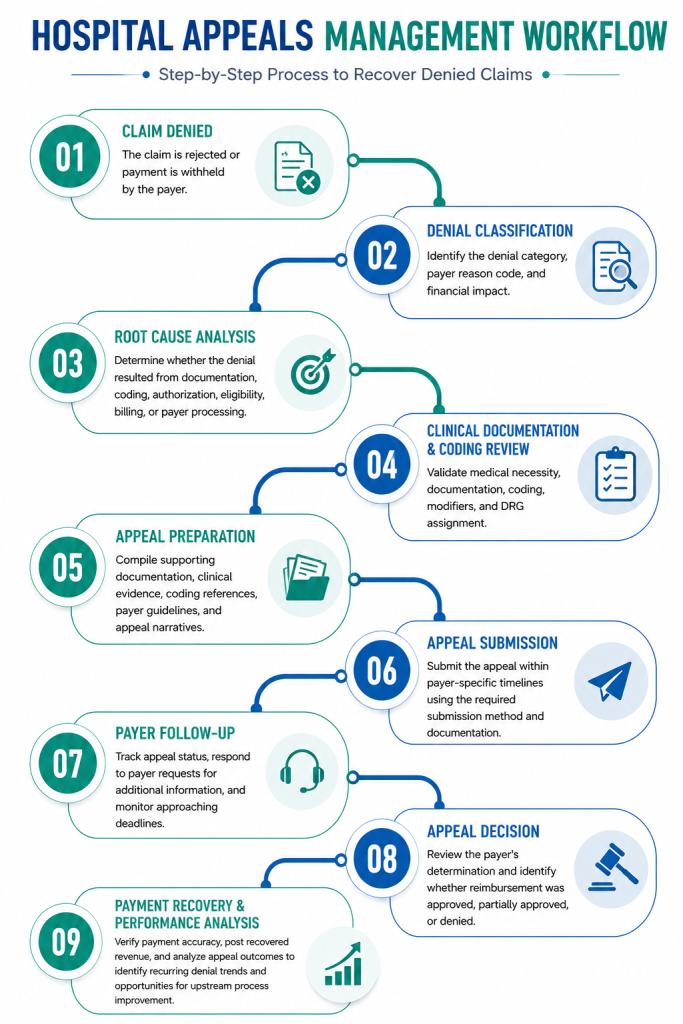
Hospital Appeals Management Workflow
Successful appeals are built on standardized processes that combine clinical validation, coding accuracy, and timely payer engagement. An effective appeals program follows a structured workflow that ensures every denied claim is reviewed, validated, documented, and submitted within payer-specific deadlines. Standardized workflows reduce variability, improves accountability, and increases the likelihood of recovering earned reimbursement.
Rather than viewing appeals as isolated administrative tasks, leading hospitals treat them as coordinated reimbursement recovery efforts involving revenue cycle teams, coding professionals, CDI specialists, physicians, and utilization review staff.
Every appeal should deliver two outcomes: recovered reimbursement and actionable insight. Appeal results should continuously strengthen documentation quality, coding practices, payer strategies, and denial prevention efforts.
Common Challenges in Hospital Appeals Management
Many hospitals dedicate significant resources to appeals management yet continue to experience low recovery rates, growing appeal backlogs, and increasing administrative costs. In most cases, the problem is not the lack of clinical justification for payment. Instead, operational inefficiencies throughout the appeals process prevent organizations from recovering revenue that has already been earned.
Fragmented workflows, inconsistent documentation, limited payer intelligence, and inadequate performance measurement often reduce the effectiveness of appeals programs. Addressing these challenges is essential for increasing revenue recovery while reducing the cost and effort required to recover denied claims.
Fragmented Appeal Workflows
Appeals frequently require coordination between revenue cycle teams, coding professionals, CDI specialists, utilization review, physicians, and case management. When responsibilities are unclear or workflows vary across departments, appeals may be delayed, duplicated, or submitted without complete supporting documentation.
The absence of standardized ownership also makes it difficult to monitor progress, measure productivity, or ensure payer deadlines are consistently met.
Incomplete Clinical Documentation
Medical necessity remains one of the most common reasons appeals are unsuccessful. Even when the care provided meets clinical standards, incomplete physician documentation may fail to demonstrate why the service qualified for reimbursement under payer guidelines.
Appeal teams often spend valuable time requesting additional documentation after a denial has already occurred, delaying reimbursement and reducing recovery opportunities.
Limited Denial Intelligence
Many hospitals monitor denial volumes but have limited visibility into denial patterns, payer behavior, or appeal outcomes. Without meaningful analytics, organizations struggle to identify recurring operational issues or determine which denials generate the greatest recovery opportunities.
Appeals become reactive rather than strategic when decisions are based on individual claims instead of broader reimbursement trends.
Manual Appeal Tracking
Tracking appeals through spreadsheets, email chains, or disconnected systems limits visibility across the appeals lifecycle. Missed filing deadlines, inconsistent follow-up, and incomplete status reporting can significantly reduce recovery rates while increasing administrative effort.
A centralized approach to appeal tracking strengthen accountability and helps organizations maintain greater control over reimbursement recovery.
Inconsistent Payer-Specific Strategies
Every payer has unique documentation requirements, appeal timelines, and medical necessity criteria. Applying the same appeal approach across all payers often results in incomplete submissions or preventable appeal denials.
Organizations that incorporate payer-specific knowledge into their appeals process are better positioned to improve recovery rates while reducing unnecessary rework.
Limited Prioritization of High-Value Claims
Not every denied claim represents the same financial opportunity. When revenue cycle teams devote equal effort to every denial, high-value reimbursement opportunities may receive insufficient attention while lower-value claims consume valuable resources.
A structured prioritization strategy helps maximize financial recovery while improve resource utilization.
Improve Your Hospital Appeals Performance
Discover how a standardized appeals process can strengthen reimbursement recovery, reduce appeal backlogs, and improve financial outcomes.
Talk to an Appeals Management ExpertBest Practices for Recovering Denied Claims
Effective appeals programs are measured by recovered revenue, process efficiency, and their ability to reduce future denials. The following best practices help hospitals improve both workflow performance and financial results.
1. Prioritize Appeals Based on Financial Impact
Recovering the highest-value revenue should always take precedence over appealing the highest number of claims.
Revenue cycle teams should evaluate denied claims based on reimbursement value, clinical complexity, payer deadlines, and the likelihood of a successful appeal. This allows organizations to focus resources where they can generate the greatest recovery potential.
Hospitals that implement structured prioritization models often increase recovery rates while reducing unnecessary administrative effort.
Priority factors may include:
- High-dollar inpatient admissions
- Surgical and specialty procedures
- Medical necessity denials with strong clinical evidence
- DRG validation disputes
- Contractual payment variances
- High-value underpayments
2. Strengthen Clinical Documentation Before Submission
Comprehensive clinical documentation significantly increases the likelihood of a successful appeal.
Complete physician documentation, accurate diagnosis coding, and clearly documented medical necessity strengthen every appeal submission.
Close collaboration between physicians, CDI specialists, coders, and appeal teams helps ensure that every submission presents a complete and well-supported clinical case.
Documentation should clearly support:
- Medical necessity
- Severity of illness
- Physician decision-making
- Diagnosis specificity
- Procedure details
- Length of stay
- Supporting diagnostic findings
3. Standardize Appeal Workflows Across Departments
Consistency enhance appeal quality, turnaround time, and revenue recovery.
Standardized workflows establish clear ownership, reduce variability, and ensure every appeal follows a consistent review and submission process. They also strengthen accountability by defining responsibilities at each stage of the appeals lifecycle.
Key workflow elements should include:
- Appeal ownership
- Documentation checklist
- Clinical review process
- Coding validation
- Submission timelines
- Payer follow-up schedule
- Payment verification
Organizations with standardized workflows are better equipped to monitor productivity, identify bottlenecks, and optimize workflow performance over time.
4. Use Appeal Outcomes to Reduce Future Denials
Appeal outcomes provide valuable insight that helps reduce future denials.
Recovery should mark the beginning of continuous improvement rather than the end of the appeals process. Each outcome reveals payer expectations, documentation quality, coding practices, and process gaps that contributed to the original denial.
Hospitals that regularly analyze appeal outcomes can identify recurring denial patterns, implement corrective actions, and reduce the volume of preventable denials entering the appeals process.
Organizations should routinely evaluate:
- Denial trends by payer
- Medical necessity denial patterns
- Documentation deficiencies
- Coding-related appeal outcomes
- Department or specialty-specific denial trends
- High-frequency denial reasons
Using appeal intelligence to improve upstream processes transforms appeals management from a reactive recovery function into a proactive denial prevention strategy.
Follow a 90-Day Plan to Recover Revenue From Aging AR
Hospital Appeal Management KPIs Every Hospital Should Track
An effective appeals program is evaluated by the revenue it recovers, the efficiency with which it operates, and the insights it generates to reduce future denials.
Many healthcare organizations evaluate appeals activity by the number of claims submitted or overturned. While these metrics are useful, they offer only part of the picture. Executive leaders need financial and operational indicators that demonstrate how appeals contribute to cash flow, reimbursement accuracy, and long-term revenue cycle improvement.
Tracking the right KPIs helps hospitals identify bottlenecks, measure the return on appeal efforts, benchmark payer performance, and uncover opportunities to strengthen denial prevention initiatives.
Evaluating these KPIs together provides a complete view of appeals performance, enabling healthcare leaders to make informed decisions that improve revenue recovery while optimizing workflow efficiency.
Build a More Effective Hospital Appeals Program
Recovering denied claims requires more than experienced appeal specialists. It requires clinical expertise, payer knowledge, standardized workflows, and actionable reimbursement insights that improve recovery while reducing preventable revenue leakage.
AnnexMed partners with hospitals, health systems, physician groups, and specialty practices to strengthen appeals management through comprehensive revenue cycle solutions that improve recovery rates, reduce preventable denials, and support long-term financial performance.
Core Capabilities
Appeals & Revenue Recovery
- Clinical Appeals Management
- Medical Necessity Appeals
- Coding and DRG Validation
- Prior Authorization Appeals
- Underpayment Analysis and Recovery
- Contractual Payment Variance Review
Denial Intelligence
- Root Cause Analysis
- Payer-Specific Denial Trend Analysis
- Appeal Prioritization Frameworks
- Revenue Recovery Analytics
- Executive Performance Reporting
Revenue Cycle Performance
- Clinical Documentation Improvement (CDI)
- Medical Coding Support
- Denial Management
- Revenue Integrity Audits
- Revenue Cycle Analytics
Backed by experienced revenue cycle professionals, standardized processes, and data-driven insights, AnnexMed helps healthcare organizations improve appeal success rates, strengthen reimbursement accuracy, maximize earned revenue, and build a more resilient revenue cycle.
Turn Denied Claims into Recovered Revenue
From denial prioritization to payer-specific appeals and performance analytics, AnnexMed helps hospitals improve recovery rates and reduce avoidable revenue leakage.
Talk to UsFAQs
Hospital appeals management is the process of reviewing, preparing, submitting, and tracking appeals for medical claims that have been denied or underpaid by insurance payers. The objective is to recover earned reimbursement while improving documentation, coding accuracy, and overall revenue cycle performance.
Denial management focuses on preventing, identifying, and resolving claim denials throughout the revenue cycle. Appeals management begins after a denial occurs and focuses specifically on recovering reimbursement through payer appeals supported by clinical documentation, coding validation, and medical necessity evidence.
Hospitals should prioritize appeals that offer the greatest opportunity for financial recovery. These often include high-dollar inpatient claims, medical necessity denials, coding disputes, DRG validation issues, contractual underpayments, and specialty procedures supported by strong clinical documentation.
Hospitals can improve appeal success rates by strengthening clinical documentation, standardizing appeal workflows, prioritizing high-value claims, submitting appeals within payer deadlines, and using denial analytics to identify recurring reimbursement issues and operational improvement opportunities.
Key appeals management KPIs include appeal success rate, appeal recovery rate, recovered revenue, average appeal turnaround time, days to payment after appeal, cost per appeal, repeat denial rate, payer-specific appeal success rate, and high-value claim recovery rate.