

Last Updated on October 13, 2026
Pharmacy billing outsourcing can be worth it when reimbursement complexity, staffing constraints, growing AR, authorization workload, or recurring denials are putting more pressure on the internal team than it can sustainably manage.
But outsourcing is not automatically the right answer for every pharmacy.
The decision should depend on whether an external partner can improve capacity, pharmacy-specific expertise, reimbursement performance, and accountability without reducing leadership’s visibility or control.
For specialty, infusion, long-term care, hospital outpatient, and other complex pharmacy models, the bigger question is not simply whether billing can be outsourced. It is which responsibilities should move outside the organization, which should remain internal, and whether the change produces a better operating model.
Table of contents
- When Does Pharmacy Billing Outsourcing Make Sense?
- Pharmacy Billing Functions That Can Be Outsourced
- What Changes When Pharmacy Billing Is Outsourced?
- When Pharmacy Billing Outsourcing May Not Be Worth It
- Pharmacy Billing Outsourcing Cost vs Internal Billing
- Full vs. Selective vs. Hybrid Pharmacy Billing Outsourcing
- What Should Pharmacies Keep Under Internal Control?
- How to Decide if Pharmacy Billing Outsourcing Is Right
- Build the Right Pharmacy Billing Model for Sustainable Performance
- FAQs
When Does Pharmacy Billing Outsourcing Make Sense?
The need to outsource often becomes visible before leadership formally considers it.
Common signals include:
- Billing volume is growing faster than internal capacity
- Open positions or turnover are creating workflow gaps
- AR is aging because follow-up cannot keep pace
- Denial inventory continues to require manual intervention
- Prior authorization workload is delaying therapy or billing
- Medical and pharmacy benefit workflows require more specialized expertise
- New therapies, payers, facilities, or states are increasing reimbursement complexity
- Leadership cannot easily see where claims or payments are getting stuck
- Payment posting and reconciliation cannot reliably confirm whether reimbursement matches expected payer or contract terms
One isolated problem may not justify full outsourcing, but it may justify a targeted audit or project-based engagement. Several occurring together can indicate that the existing operating model is reaching its limits.
This is particularly important in specialty and infusion pharmacy revenue cycles, where benefit investigation, prior authorization, medical and pharmacy benefit billing, high-cost therapies, payer follow-up, and reimbursement need to remain connected.
Specialty and infusion revenue cycles depend on benefit investigation, prior authorization, and connected medical-benefit billing. AnnexMed’s guide to common 340B billing challenges and solutions is also useful for hospital outpatient pharmacies where eligibility, modifiers, and Medicaid status add another layer of reimbursement risk.
Is your billing model keeping up with the workload?
Identify where capacity, reimbursement complexity, or unresolved revenue is putting the greatest pressure on your pharmacy operation.
Assess Your Current Billing WorkflowPharmacy Billing Functions That Can Be Outsourced
Pharmacy billing outsourcing does not have to mean handing over the entire revenue cycle. External support can be structured around selected functions or the broader revenue cycle, depending on which responsibilities the pharmacy intends to retain.
Functions that are commonly considered for external support include
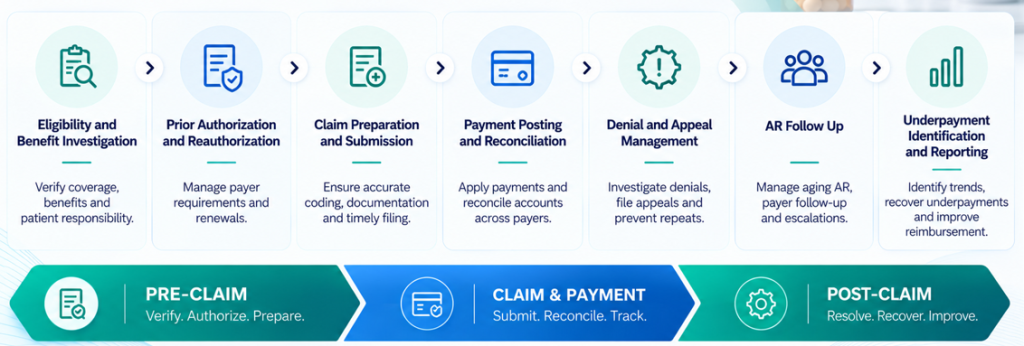
When denial volume is the main pressure point, external support is most useful if it includes root-cause work rather than claim rework alone. AnnexMed’s Denial Management and Prevention Services focus on identifying whether recurring issues start in eligibility, authorization, documentation, or payer processing.
Example
A pharmacy with an experienced billing team may need additional support only for prior authorization, denial follow-up, or aging AR. Another organization may need a partner to manage most of the revenue cycle.
The important decision is not how much can be outsourced. It is where external capacity or expertise can materially improve the current process.
When problems extend across eligibility, authorization, billing, denials, and collections, leadership should also evaluate how those functions connect within an end-to-end revenue cycle management model, rather than reviewing each function in isolation.
What Changes When Pharmacy Billing Is Outsourced?
The biggest change should not simply be where the work is performed. It should be how responsibility is structured.
Outsourcing does not transfer ultimate responsibility for pharmacy revenue performance. Leadership still needs visibility into AR, denials, reimbursement, payer trends, escalations, and partner performance.
Before outsourcing, identify where the problem starts. A billing backlog or denial problem does not always originate in billing. Eligibility errors, authorization gaps, incomplete documentation, incorrect benefit routing, and disconnected handoffs can surface later as rejected claims, denials, or delayed payment.
Many claim problems are visible only after submission even though they began earlier in eligibility, authorization, or documentation. AnnexMed’s discussion of the invisible architecture of revenue explains how those upstream gaps move downstream into denials and delayed cash.
When Pharmacy Billing Outsourcing May Not Be Worth It
A credible outsourcing decision should also consider when staying internal makes more sense.
Outsourcing May Not Solve the Problem If
01 Internal performance is already strong
The pharmacy has sufficient expertise, capacity, stable staffing, and healthy reimbursement performance.
02 The outsourced scope misses the actual bottleneck
Moving claim submission externally will not solve an authorization, eligibility, documentation, or benefit-routing problem occurring upstream.
03 Internal and external ownership is unclear
Poorly defined responsibilities can create another handoff instead of eliminating one.
04 The partner lacks pharmacy-specific expertise
General medical billing experience may not translate to specialty therapies, infusion, LTC, pharmacy benefit transactions, or other pharmacy reimbursement models.
05 Systems and workflows cannot integrate effectively
An external team without appropriate access to systems, data, workflows, and escalation paths can increase manual work.
06 Leadership loses visibility
A lower operating cost is not a meaningful improvement if the pharmacy cannot see what is happening to its revenue.
Outsourcing a broken process does not automatically fix the process.
Pharmacy Billing Outsourcing Cost vs Internal Billing
Comparing a pharmacy billing company’s fee with employee salaries alone gives an incomplete picture. The real comparison is between the total cost and performance of each operating model.
The financial question is not simply: Is outsourcing cheaper?
A more useful question is: Which model can deliver the required revenue cycle performance at a sustainable total cost?
That distinction becomes particularly important as pharmacy operations become more specialized. Hospital-based infusion operations may involve drug billing, prior authorization, J-code and NDC requirements, charge reconciliation, and payer-specific workflows. Pharmacies supporting these services can explore infusion center billing and RCM for a closer look at those requirements.
Full vs. Selective vs. Hybrid Pharmacy Billing Outsourcing
Pharmacy billing outsourcing is not an all-or-nothing decision.
For many organizations, selective or hybrid outsourcing may be the more practical starting point. A pharmacy can retain workflows that are performing well and add external support where backlogs, specialist requirements, or reimbursement pressure are greatest.
Collections
In a Flexible RCM engagement, targeted support was added to billing, denials, AR, eligibility exceptions, and coding overflow without replacing workflows that were already performing well.
Read the Case StudyWhat Should Pharmacies Keep Under Internal Control?
Even when operational work is outsourced, pharmacy leadership should retain control over the decisions that govern revenue performance.
That includes:
- Revenue-cycle strategy
- Financial oversight
- Performance expectations and KPIs
- Vendor governance
- Escalation policies
- Compliance oversight
- Decisions affecting pharmacy operations and patient care
- Approval of significant process changes
A strong outsourcing model should therefore provide more operational visibility, not less. Leadership should know what the external team owns, what remains internal, how performance is measured, when issues escalate, and how recurring problems are corrected.
How to Decide if Pharmacy Billing Outsourcing Is Right
Use five questions to test whether the current operating model needs to change:
- Is capacity the main constraint, or is process design the main constraint?
- Which functions are under the most sustained pressure right now?
- Does the gap require pharmacy-specific expertise the internal team does not have?
- Will outsourcing improve visibility and accountability, or reduce them?
- Which total-cost and performance model is more sustainable over the next 12 months?
If several of these areas are under pressure, pharmacy billing outsourcing deserves a closer operational and financial assessment.
The answer may still be full outsourcing, selective support, a hybrid model, or strengthening the internal operation. The goal is not to outsource more. It is to build the model that gives the pharmacy the right expertise, capacity, control, and accountability for its reimbursement environment.
Build the Right Pharmacy Billing Model for Sustainable Performance
The right pharmacy billing model is not defined by how much work is outsourced. It is defined by whether the operation has the capacity, pharmacy-specific expertise, accountability, and visibility required to protect reimbursement and keep revenue moving.
AnnexMed supports specialty and infusion pharmacies, LTC, outpatient, and other pharmacy organizations across benefit investigation, prior authorization, billing, denials, AR follow-up, reconciliation, and reimbursement. Support can be focused on a specific operational gap or extended across a broader portion of the revenue cycle based on where additional capacity and expertise are needed.
Not Sure What Should Stay Internal
Bring your current billing structure, workload pressures, payer requirements, and reimbursement priorities to AnnexMed to identify where external support could make the greatest operational difference.
Discuss Your Billing PrioritiesFAQs
Pharmacy billing outsourcing involves assigning defined billing or revenue-cycle functions to an external partner. Scope can range from specific functions such as prior authorization, denial management, or AR follow-up to broader end-to-end pharmacy revenue-cycle support.
It can be when staffing constraints, reimbursement complexity, backlogs, denials, aging AR, or specialist knowledge gaps are affecting performance. The decision should compare the total cost, capabilities, accountability, and expected performance of internal and outsourced models.
No. Pharmacies can use full, selective, or hybrid outsourcing. Functions that perform well internally can remain with the pharmacy while external support is added where capacity or specialized expertise is needed.
Depending on the operating model, pharmacies may outsource eligibility and benefit investigation, prior authorization, claim submission, payment posting, denial management, appeals, AR follow-up, underpayment analysis, reporting, or combinations of these functions.
Risks can include unclear ownership, weak system integration, loss of visibility, poor communication, and working with a vendor that lacks pharmacy-specific expertise. Defined responsibilities, performance measures, escalation paths, and governance help reduce these risks.