
Last Updated on August 26, 2026
The 340B Drug Pricing Program has become financially significant for hospitals, but its billing requirements leave little room for disconnected workflows. A drug may qualify for 340B pricing, yet reimbursement and compliance still depend on the hospital correctly identifying the patient, drug, location, payer, acquisition status, Medicaid treatment, and claim reporting requirements.
The financial scale makes those controls increasingly important. According to HRSA 2025 340B purchase data, covered entities purchased approximately $100.01 billion in covered outpatient drugs in 2025, up from $81.4 billion in 2024. Disproportionate Share Hospitals accounted for about $79.2 billion of the 2025 total. High cost specialty drugs represented 38.1% of 340B units but accounted for 61.9% of purchases.
As 340B volume grows, many hospitals still discover billing problems through denials, reconciliation variances, or audits. By then, billing is exposing a workflow that failed much earlier. A qualifying drug may already have missed program value, reimbursement accuracy, or compliance safeguards before the claim reaches the payer.
That is why 340B has become more than a billing process. It has become a hospital-wide data alignment challenge with direct financial and compliance consequences.
340B Billing Risk Often Starts Before the Claim
See where eligibility, drug data, Medicaid status, and billing rules may be falling out of alignment.
Request a 340B Billing ReviewTable of contents
340B Billing Complexity Across Hospital Workflows
340B pharmacy billing is difficult because a single drug transaction can move through several systems before the claim reaches a payer.
Pharmacy systems identify the drug and acquisition source. Clinical documentation supports administration. The charge description master translates the service into billing data. Split billing technology determines 340B eligibility. Claims systems apply payer requirements. Medicaid billing adds another set of rules.
A failure at any handoff can change the outcome. CMS’s January 2026 guidance requires 340B-covered entities to report the TB modifier on applicable separately payable Medicare Part B drug claim lines. Entities that previously reported the JG modifier were directed to transition to TB beginning January 1, 2025.
Across hospital outpatient pharmacy workflows, AnnexMed sees 340B problems frequently develop before the claim itself is created. Differences between pharmacy inventory, patient eligibility, NDC data, HCPCS mapping, payer rules, and Medicaid carve status can travel downstream until billing teams discover them through an edit, denial, or reconciliation variance.
That makes 340B a data alignment problem as much as a billing problem.
Executive Insight:
Repeated reconciliation exceptions often signal an upstream alignment problem across pharmacy, eligibility, and billing rather than an isolated claim error.
Core 340B Billing Challenges Across Hospital Operations
The most common 340B billing challenges involve identification, modifier reporting, Medicaid coordination, drug data accuracy, and reconciliation between pharmacy and billing systems.
Modifier and Split Billing Errors
Modifier errors are rarely isolated billing mistakes. When JG or TB reporting repeatedly fails, it often indicates that pharmacy acquisition data, accumulator logic, and billing workflows are no longer making the same decision about the transaction. The claim may still be processed, but operational alignment has already started breaking down.
Recurring 340B modifier errors often indicate that pharmacy acquisition data, accumulator logic, and billing workflows are no longer making the same decision about a transaction. Common issues include:
- Incorrect JG or TB modifier reporting
- 340B status not reaching the billing system
- A non 340B drug incorrectly identified as 340B
- Payer specific modifier rules not maintained
- Drug lines excluded from reconciliation
- Accumulator and charge data falling out of sync
For Example, consider an outpatient infusion claim where the pharmacy system identifies a drug as 340B acquired, but the billing interface fails to carry the correct indicator to the claim. The claim may still be processed, but the hospital now has a difference between acquisition records and submitted billing data. The financial and compliance exposure increases when the same interface issue repeats across drug claims.
Medicaid Duplicate Discount Risk
Federal law prohibits manufacturers from being responsible for both a 340B discount and a Medicaid rebate on the same drug. For Medicaid fee for service, covered entities must decide whether to carve in, meaning they use 340B drugs for Medicaid patients, or carve out and purchase those drugs outside 340B. Hospitals that carve in must maintain accurate billing identifiers in HRSA’s Medicaid Exclusion File.
HRSA states that covered entities are responsible for ensuring this information remains accurate. Changes generally become effective with the next quarterly file, making timing important when a hospital changes its Medicaid billing approach.
This remains a real compliance issue. Current HRSA audit results continue to include findings involving inaccurate Medicaid Exclusion File information and duplicate discounts, with some findings requiring repayment to manufacturers.
A hospital may have a sound organization level policy but still face risk if a child site, NPI, Medicaid number, or state billing configuration does not match the information reflected in HRSA records.
Drug Coding and Charge Data Mismatches
Drug billing depends on several pieces of information matching correctly. The NDC identifies the drug product while the HCPCS code supports payer billing. Units administered, package size, wastage, revenue codes, and charge quantities may also affect the claim.
A mismatch can create:
- Incorrect claim units
- Missing drug charges
- NDC and HCPCS inconsistencies
- Denials for invalid drug information
- Payment below expected reimbursement
- Differences between inventory usage and billed units
These problems become financially significant for oncology drugs, biologics, and other specialty medications.
Executive Insight:
High-cost specialty drugs amplify small data inconsistencies. When expensive therapies rely on multiple systems agreeing on the same transaction, even minor mapping differences can quietly increase revenue exposure long before leadership sees a reimbursement variance.
Revenue and Compliance Impact of 340B Billing Errors
340B billing errors affect hospitals through lost reimbursement, missed 340B opportunities, rework, repayment exposure, and weaker confidence in program performance.
Revenue Loss Is Not Always a Denial
Some 340B errors produce obvious claim denials. Others remain hidden.
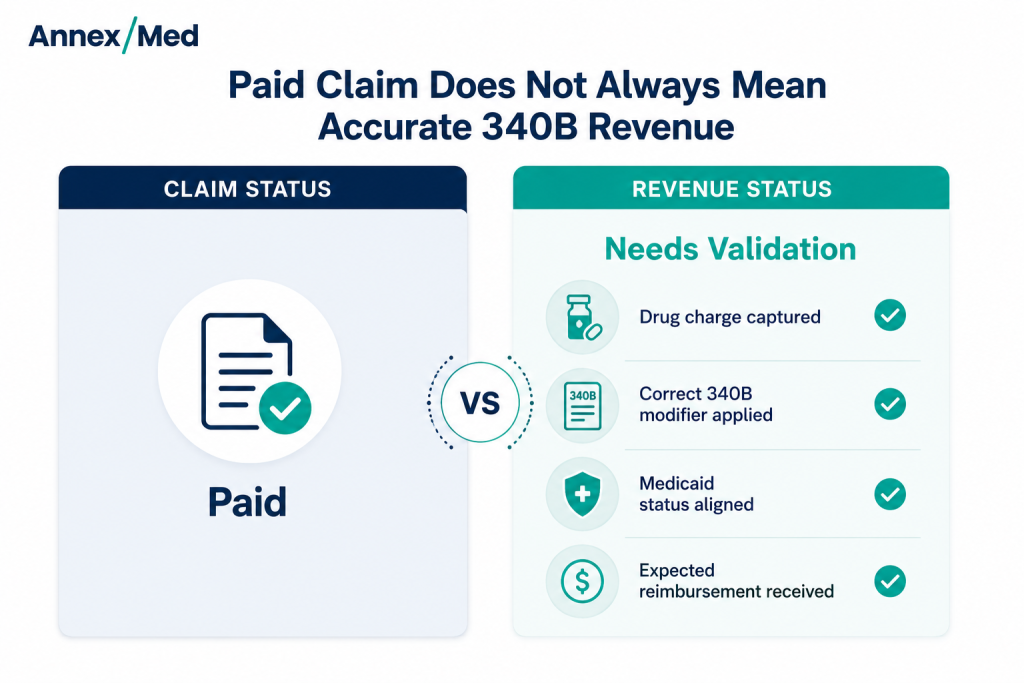
A correctly administered drug may never reach the claim because of a charge interface problem. A claim may pay even though units were reported incorrectly. A qualifying transaction may be purchased outside 340B because eligibility was not identified. A payer may reimburse less than expected without generating a denial.
This is why denial rate alone does not measure 340B billing performance. Some 340B losses appear as denials. Others remain hidden inside paid claims, missed capture opportunities, or reimbursement variances. A claim can look financially complete while the transaction behind it tells a different story.
Hospitals should monitor modifier accuracy, charge capture, drug data, Medicaid status, payment variance, and reconciliation between pharmacy purchase activity and submitted claims.
| Area | What to Review |
|---|---|
| Modifier Accuracy | JG and TB reporting |
| Charge Capture | Drugs administered vs. billed |
| Drug Data | NDC HCPCS and units |
| Medicaid | Carve status and billing identifiers |
| Payment | Expected vs. actual reimbursement |
| Reconciliation | Pharmacy purchase vs. claim activity |
These metrics become more valuable when leaders treat them as operating signals rather than isolated billing KPIs. A recurring reconciliation variance, modifier exception, or payment difference often points to a process that is recreating the same problem across multiple transactions.
Example: An oncology department may report stable reimbursement while reconciliation repeatedly finds specialty drug transactions purchased outside 340B eligibility. Collections appear healthy, but the hospital quietly loses program value because eligibility decisions failed earlier in the workflow.
Compliance Errors Can Become Financial Liabilities
340B compliance requirements include preventing duplicate discounts, preventing diversion, keeping OPAIS information current, and maintaining auditable records. HRSA notes that noncompliance can make covered entities liable to manufacturers for refunds of discounts received.
That changes the financial question from simply
“Was the claim paid?”
To
“Can the hospital demonstrate that the transaction was eligible and billed correctly?”
Find the Mismatch Before It Becomes a Compliance Issue
Review modifier reporting, Medicaid configuration, drug mapping, and claim data across the 340B workflow.
Request a 340B Billing ReviewOperational Controls for Accurate 340B Billing
Hospitals can improve 340B billing by moving from claim correction to transaction level control.
Build a Reconciliation Process Across Systems
A strong workflow should connect:
- Patient and encounter eligibility
- Covered entity and location eligibility
- Drug acquisition status
- NDC and HCPCS mapping
- Units administered and charged
- JG or TB modifier reporting
- Medicaid carve status
- Claim payment and reconciliation
Exceptions should move into a defined work queue rather than being discovered during an audit or aged account review.
Hospitals with multiple outpatient departments, infusion centers, child sites, and contract pharmacy relationships should also apply controls at the location level. One facility may operate correctly while another uses outdated mappings or payer rules.
AnnexMed’s hospital outpatient pharmacy and 340B services are designed around this type of split billing, modifier, Medicaid, and pharmacy revenue complexity.
Use Billing Data for Root Cause Analysis
The most valuable billing data is not the exception itself. It is the pattern behind it. When recurring errors are grouped by operational cause instead of corrected one claim at a time, hospitals gain visibility into the workflows that continue recreating revenue and compliance risk.
For example:
- Modifier errors may indicate interface or rule configuration problems.
- NDC mismatches may point to drug master maintenance.
- Missing charges may indicate pharmacy to billing interface gaps.
- Duplicate discount risk may trace back to Medicaid configuration.
- Underpayments may require payer contract or payment analysis.
A focused scorecard can track modifier accuracy, unresolved reconciliation exceptions, Medicaid discrepancies, drug related denials, missed charges, and payment variance.
Hospitals can also connect these controls with broader revenue integrity services so pharmacy billing is reviewed as part of the hospital’s overall charge capture and reimbursement framework.
Current policy developments also make flexible controls important. In July 2026, HRSA announced a revised voluntary 340B Rebate Model Pilot Program for a limited set of drugs, with approved plans scheduled to take effect January 1, 2027. The pilot emphasizes transaction level verification and duplicate discount prevention, reinforcing the importance of accurate claims and pharmacy data.
Building Stronger 340B Revenue Integrity and Compliance
340B billing requires hospitals to protect two outcomes at the same time: legitimate program value and reliable compliance. A specialized RCM partner can help connect pharmacy data, drug billing, modifier reporting, Medicaid coordination, charge capture, claim reconciliation, and payment analysis when those functions sit across different internal teams and systems.
AnnexMed supports hospitals through 340B split billing workflows, billing compliance monitoring, Medicaid duplicate discount prevention, specialty pharmacy authorization support, claim reconciliation, and revenue integrity controls. Its broader hospital billing services also connect pharmacy billing with institutional claims, denials, payment, and revenue cycle operations.
The strongest 340B programs do more than recover eligible revenue after claims are billed. They create governance that identifies exceptions before pharmacy operations, reimbursement, and compliance drift out of alignment.
When hospitals use downstream billing signals to strengthen upstream workflows, 340B becomes more than a pharmacy initiative. It becomes a financial control that protects revenue, compliance, and long-term program performance.
Strengthen Control Across the 340B Revenue Cycle
AnnexMed helps hospitals connect 340B billing, modifier accuracy, Medicaid coordination, reconciliation, and revenue integrity across complex pharmacy workflows.
Talk to Our RCM ExpertsFAQs
Common challenges include incorrect JG or TB modifier reporting, split billing errors, Medicaid duplicate discounts, inaccurate NDC or HCPCS mapping, missing drug charges, eligibility mismatches, and weak reconciliation between pharmacy and claims systems.
A duplicate discount occurs when a manufacturer provides a 340B discount and is also required to provide a Medicaid rebate for the same drug. Covered entities must have controls to prevent this situation.
Reconciliation helps hospitals confirm that pharmacy acquisition data, drug utilization, charge capture, modifier reporting, and claims agree. It can reveal errors that do not appear as payer denials.
Hospitals should maintain current drug mappings, validate Medicaid carve status, apply payer specific billing rules, reconcile high value drug transactions, audit modifier accuracy, and use recurring exceptions to correct upstream workflows.
AnnexMed supports 340B pharmacy billing through split billing workflows, modifier validation, Medicaid coordination, specialty pharmacy support, billing compliance monitoring, reconciliation, and broader hospital revenue integrity services.