

Last Updated on July 28, 2026
Looking for a Home Health Billing Partner?
From eligibility verification to denial management and A/R follow-up, AnnexMed helps home health agencies improve every stage of the revenue cycle with structured processes and specialty expertise.
Talk to UsMeasuring billing performance has become just as important as delivering quality patient care in today’s home health environment. While agencies invest significant effort in documentation, coding, and claim submission, many reimbursement challenges begin much earlier in the billing process and often go unnoticed until they affect cash flow.
Home health agencies operate within a complex reimbursement landscape shaped by evolving payer requirements, PDGM regulations, Notice of Admission (NOA) timelines, documentation standards, coding accuracy, and claim processing rules. Even a small delay in documentation completion, an eligibility issue, or a coding inconsistency can interrupt reimbursement and increase administrative workload.
Beyond measuring billing activity, home health billing metrics and KPIs help agencies evaluate the health of their billing operations, uncover operational inefficiencies, monitor reimbursement trends, and make informed decisions that support long-term financial performance.
Whether you’re looking to improve collections, accelerate reimbursement, or gain greater visibility into billing operations, understanding the right home health revenue cycle metrics provides the foundation for continuous operational and financial improvement.
Table of contents
- Why Home Health Billing Metrics Matter
- The Most Important Home Health Billing Metrics and KPIs
- Financial KPIs Every Home Health Agency Should Monitor
- Operational KPIs That Improve Billing Performance
- Denial and Revenue Recovery KPIs
- Benchmarking Home Health Billing Performance
- Common Mistakes When Tracking Home Health KPIs
- Strengthen Home Health Billing Performance with AnnexMed
- FAQs
Why Home Health Billing Metrics Matter
Home Health Billing Metrics provide a structured way to evaluate billing performance across the entire reimbursement lifecycle. They help agencies measure claim quality, reimbursement efficiency, cash flow, and operational effectiveness, giving executives and revenue cycle leaders greater visibility into the health of their billing operations.
Consistently monitoring these metrics allows agencies to move beyond reactive billing management. Rather than waiting for denials to increase or accounts receivable to grow, organizations can detect performance gaps, monitor performance trends, and evaluate whether operational changes are producing measurable results.
Billing metrics also promote accountability across the revenue cycle. Clinical documentation, coding, billing, payment posting, and accounts receivable follow-up all influence reimbursement outcomes. Monitoring performance across these functions helps agencies understand where delays occur, which workflows require attention, and how stronger billing workflows contribute to better reimbursement outcomes.
Equally important, KPIs establish a common performance framework for executives, revenue cycle leaders, billing managers, and operational teams. When everyone measures the same outcomes, organizations can prioritize improvement initiatives more effectively, monitor progress consistently, and build a more predictable reimbursement process.
The Most Important Home Health Billing Metrics and KPIs
Not every billing metric provides the same level of insight into billing performance. Grouping these home health billing Metrics and KPIs into practical categories helps agencies recognize where performance can be strengthened and determine which operational changes will have the greatest impact on reimbursement.
Monitoring these metrics collectively, rather than in isolation, delivers a broader view of billing performance. For example, improving collections without reducing denial rates may produce only short-term gains, while tracking clean claims alongside Days in A/R and payment turnaround provides a more accurate understanding of overall reimbursement performance.
Revenue Collection Metrics
Revenue collection metrics offer visibility into how efficiently submitted claims are converted into cash. These KPIs help agencies monitor payment cycles, identify collection delays, and evaluate the overall efficiency of their reimbursement process.
Together, these metrics provide leadership with a comprehensive view of cash flow performance, outstanding receivables, and reimbursement efficiency. Instead of waiting until month-end financial reports reveal declining collections, agencies can use these indicators to track reimbursement performance continuously and respond proactively to billing issues.
| Metric | Why it Matters |
|---|---|
| Days in Accounts Receivable (A/R) | Measures how quickly outstanding claims are converted into payments and highlights overall cash flow efficiency. |
| Net Collection Rate | Indicates the percentage of collectible revenue successfully recovered after contractual adjustments. |
| Gross Collection Rate | Evaluates billing effectiveness before contractual write-offs and payer adjustments are applied. |
| Average Payment Turnaround Time | Tracks the average time between claim submission and reimbursement, helping agencies identify payment delays. |
These metrics establish the financial foundation of the revenue cycle and should be reviewed regularly to ensure reimbursement remains timely and predictable.
Claim Quality Metrics
Submitting a high volume of claims does not necessarily translate into stronger reimbursement outcomes. Claim quality metrics measure how accurately claims are prepared before submission and how effectively front-end billing processes support reimbursement.
Unlike revenue collection metrics, which evaluate financial outcomes, claim quality metrics focus on the effectiveness of front-end billing operations. Improvements in these KPIs often lead to faster payments, fewer downstream billing issues, and more consistent reimbursement.
Clean Claim Rate
Measures the percentage of claims accepted and processed without edits, corrections, or additional documentation requests. A consistently high clean claim rate reflects strong documentation, coding accuracy, and effective billing workflows.
First-Pass Resolution Rate
Indicates how often claims are paid on the initial submission without resubmissions, appeals, or manual intervention. Improving first-pass resolution reduces administrative workload while accelerating reimbursement.
Claim Rejection Rate
Tracks claims rejected before payer adjudication due to eligibility issues, missing information, formatting errors, or billing inaccuracies. Monitoring rejection trends helps agencies identify opportunities to strengthen front-end billing processes.
Coding Accuracy Rate
Measures the accuracy of diagnosis and procedure coding based on clinical documentation and payer requirements. Consistent coding accuracy supports stronger claim quality, minimizes reimbursement delays, and lower denial rates.
Viewed together, these claim quality metrics provide a clear picture of front-end billing performance, helping agencies strengthen claim accuracy before submission and improve long-term reimbursement outcomes.
Are Your Home Health Billing KPIs Driving Better Results?
AnnexMed helps agencies improve billing workflows, optimize reimbursement, and strengthen revenue cycle performance.
Talk to a Billing ExpertFinancial KPIs Every Home Health Agency Should Monitor
While claim quality and collection metrics evaluate operational performance, financial KPIs measure the financial performance of home health billing operations . These indicators help agencies understand whether billing operations are generating sustainable financial results while protecting long-term profitability.
Monitoring financial KPIs regularly also helps leadership monitor reimbursement patterns, measure process improvements, and make more informed budgeting and resource allocation decisions.
| Financial KPI | Business Impact |
|---|---|
| Revenue per Episode | Measures the average reimbursement generated for each completed episode of care, providing visibility into financial performance. |
| Cost to Collect | Calculates the operational expense required to recover every dollar of revenue collected, helping agencies evaluate billing efficiency. |
| Write-off Rate | Identifies revenue lost due to contractual adjustments, bad debt, or preventable billing issues. |
| Underpayment Rate | Measures how frequently reimbursements fall below contracted payer rates, helping agencies identify revenue recovery opportunities. |
| Cash Collection Trend | Monitors month-over-month payment performance to evaluate collection consistency and overall cash flow stability. |
Collectively, these financial KPIs help agencies understand how billing performance influences long-term financial stability and where additional revenue opportunities exist.
Operational KPIs That Improve Billing Performance
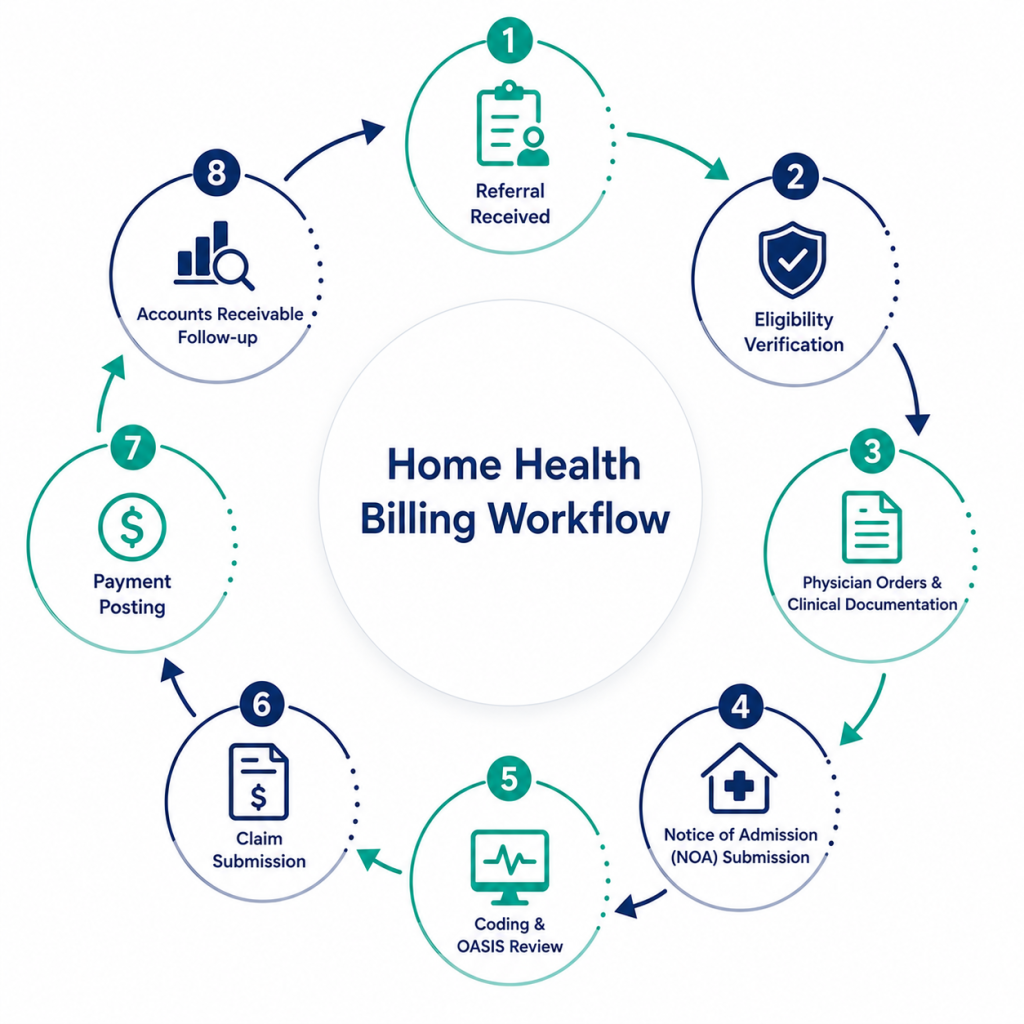
Efficient billing operations form the foundation for timely reimbursement. Every stage of the billing process, from patient referral through payment posting, influences how quickly claims move toward reimbursement. Operational KPIs help agencies monitor workflow performance, uncover bottlenecks, and strengthen coordination across clinical, coding, and billing teams before delays affect cash flow.
The following workflow illustrates the major stages that influence billing performance and reimbursement outcomes.
Key Operational KPIs to Monitor
- Eligibility Verification Turnaround – Helps prevent front-end billing errors caused by inaccurate insurance verification.
- NOA Submission Timeliness – Helps prevent reimbursement delays associated with late Notice of Admission submissions.
- Documentation Completion Time – Tracks how quickly clinical documentation becomes available for billing.
- Coding Turnaround Time – Monitors the efficiency of coding workflows before claim submission.
- Claim Submission Lag – Tracks the time between completed documentation and claim submission.
- Payment Posting Turnaround – Measures how quickly received payments are accurately recorded.
- Accounts Receivable Follow-up Time – Measures how efficiently billing teams resolve outstanding claims and unpaid balances.
Collectively, these operational KPIs help agencies streamline billing workflows, reduce avoidable delays, and support more predictable reimbursement outcomes.
Denial and Revenue Recovery KPIs
Even agencies with efficient billing operations will encounter claim denials and payment delays. One of the biggest differences between high-performing and underperforming home health agencies lies in how quickly they detect, resolve, and recover denied or underpaid claims. Tracking denial and revenue recovery KPIs helps agencies evaluate the effectiveness of their follow-up processes while uncovering recurring patterns that affect reimbursement.
Rather than viewing denials as isolated billing events, agencies should use these metrics to recognize trends related to documentation, coding, eligibility verification, prior authorization, or payer-specific billing requirements. Addressing these root causes helps reduce repeat denials and strengthen long-term reimbursement performance.
Denial Rate
Why it matters
Measures the percentage of submitted claims that are denied by payers.
Operational Impact
A consistently high denial rate often indicates recurring issues with documentation, coding accuracy, eligibility verification, or payer compliance. Monitoring denial trends helps agencies prioritize targeted corrective actions before revenue is affected.
Appeal Success Rate
Why it matters
Measures the percentage of denied claims successfully overturned through the appeals process.
Operational Impact
A strong appeal success rate demonstrates effective denial management and helps recover revenue that might otherwise be written off.
Denial Turnaround Time
Why it matters
Tracks the average time required to investigate, appeal, and resolve denied claims.
Operational Impact
Faster resolution shortens reimbursement cycles, accelerates cash collections, and reduces the administrative burden associated with prolonged follow-up activities.
Revenue Recovery Rate
Why it matters
Measures the percentage of denied or underpaid revenue successfully recovered through appeals and accounts receivable follow-up.
Operational Impact
Monitoring recovery performance helps agencies evaluate the effectiveness of their billing teams while highlighting opportunities to improve reimbursement.
Preventable Denial Rate
Why it matters
Measures denials caused by avoidable issues such as coding errors, missing documentation, eligibility problems, or billing inaccuracies.
Operational Impact
Reducing preventable denials strengthens clean claim performance, lowers administrative costs, and accelerates reimbursement across the revenue cycle.
Improve the KPIs That Matter Most
Whether you’re focused on reducing Days in A/R, improving clean claim rates, or strengthening collections, AnnexMed helps home health agencies achieve measurable revenue cycle improvements.
Book a Complimentary Billing AssessmentBenchmarking Home Health Billing Performance
Measuring billing performance becomes meaningful only when agencies understand how their performance compares with accepted industry benchmarks. Benchmarking helps leadership evaluate how billing operations compare against industry expectations or whether targeted improvements are needed to strengthen reimbursement.
While benchmark values vary based on payer mix, agency size, patient population, and reimbursement models, monitoring these targets offers a useful reference framework for evaluating overall billing performance.
| KPI | Target Benchmark |
|---|---|
| Clean Claim Rate | Greater than 95% |
| First-Pass Resolution Rate | Greater than 90% |
| Days in Accounts Receivable | Less than 40 Days |
| Denial Rate | Less than 5-8% |
| Net Collection Rate | Greater than 95% |
Note: These benchmarks serve as general performance indicators. Individual targets may vary depending on agency size, payer contracts, service mix, and reimbursement models.
Benchmarking is most effective when performed consistently. Comparing internal results against established targets helps agencies evaluate operational progress, prioritize improvement initiatives, and maintain long-term reimbursement stability.
Common Mistakes When Tracking Home Health KPIs
Tracking metrics alone does not improve revenue cycle performance. The real value comes from understanding what the numbers reveal and using those insights to strengthen billing operations. Many agencies collect large amounts of billing data but struggle to convert that information into meaningful actions.
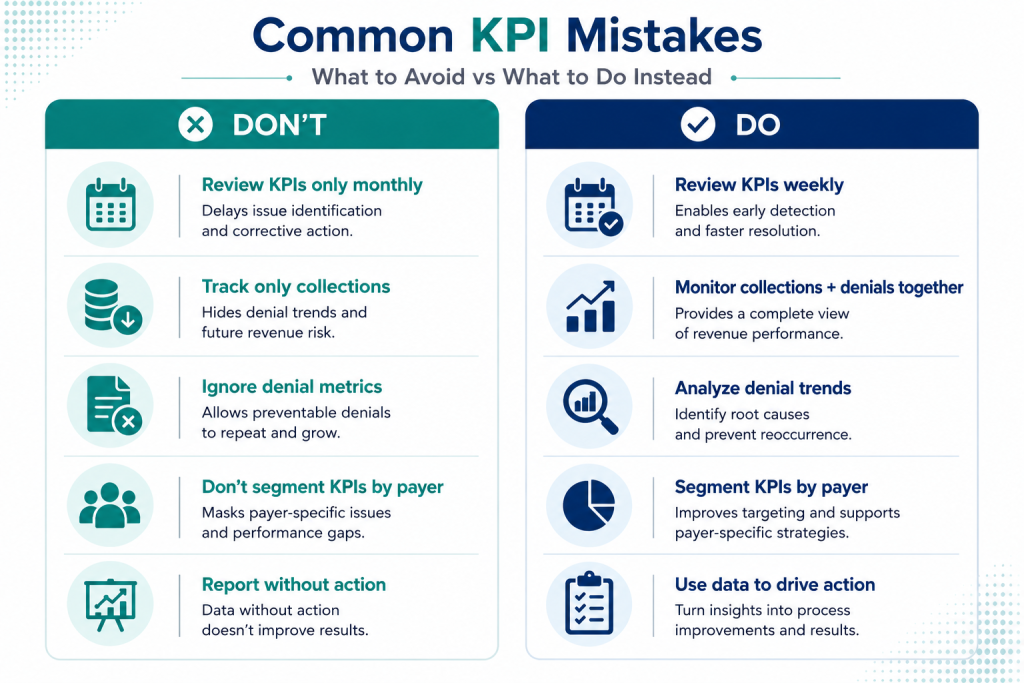
Below are some of the most common mistakes that limit the effectiveness of Home Health Billing Metrics and KPIs.
Tracking Collections Without Monitoring Denials
Strong collections may create the impression that billing performance is healthy, while unresolved denials continue to accumulate in the background. Reviewing both collections and denial trends provides a more complete view of revenue cycle performance.
Monitoring Days in A/R Without Reviewing Aging Buckets
Overall A/R days provide a high-level view of outstanding receivables, but aging buckets reveal where reimbursement delays are occurring. Analyzing balances by aging category helps agencies prioritize follow-up efforts more effectively.
Measuring Billing Volume Instead of Claim Quality
Submitting more claims does not necessarily improve financial performance. Agencies should prioritize clean claim rates, coding accuracy, and first-pass resolution to reduce rework and accelerate reimbursement.
Failing to Segment KPIs by Payer
Performance often varies significantly between Medicare, Medicaid, commercial insurers, and managed care organizations. Reviewing KPIs by payer helps uncover payer-specific billing challenges and reimbursement trends.
Reviewing KPIs Only at Month-End
Waiting until month-end to review billing performance delays corrective action. Monitoring key metrics weekly or even daily for critical workflows helps agencies respond to emerging issues .
Collecting Data Without Acting on It
KPIs should support operational decision-making rather than simply populate management reports. Agencies that regularly analyze trends, investigate root causes, and implement operational improvements gain greater value from their billing performance data.
Effective KPI management is not about tracking more metrics. It’s about consistently monitoring the right indicators, interpreting what they reveal, and translating those insights into measurable operational and financial improvements.
Strengthen Home Health Billing Performance with AnnexMed
Tracking the right Home Health Billing Metrics and KPIs helps agencies understand billing performance, recognize reimbursement risks earlier, and make better operational and financial decisions. However, meaningful results come from turning those insights into operational action rather than simply reporting the numbers.
AnnexMed helps home health agencies translate billing data into measurable reimbursement outcomes through specialized home health revenue cycle services. Our teams support every stage of the billing lifecycle, including eligibility verification, coding, OASIS review, claim submission, denial management, payment posting, accounts receivable follow-up, and revenue cycle analytics.
By combining specialty expertise with standardized workflows and continuous performance monitoring, we help agencies strengthen claim quality, reduce preventable denials, accelerate reimbursement, and support healthier cash flow.
Turn Billing Insights Into Better Financial Outcomes
Partner with AnnexMed to streamline billing operations, strengthen reimbursement accuracy, and build a more predictable revenue cycle.
Connect with Our SpecialistsFAQs
Some of the most important Home Health Billing Metrics include Days in Accounts Receivable (A/R), Clean Claim Rate, First-Pass Resolution Rate, Net Collection Rate, Denial Rate, Revenue per Episode, Cost to Collect, and Payment Turnaround Time. Together, these KPIs provide a comprehensive view of billing efficiency and reimbursement performance.
Critical billing metrics such as claim submissions, denials, payment posting, and accounts receivable should be monitored weekly, while broader financial KPIs and reimbursement trends are typically reviewed monthly. Regular monitoring helps agencies identify issues before they significantly affect cash flow.
Although benchmarks vary by agency and payer mix, many high-performing home health organizations aim for a Clean Claim Rate above 95%. Higher clean claim rates generally indicate stronger documentation, coding accuracy, and billing quality.
Days in Accounts Receivable measure how quickly submitted claims are converted into payments. Monitoring this KPI helps agencies evaluate collection efficiency, pipoint reimbursement delays, and improve overall cash flow management.
Reducing claim denials requires accurate documentation, compliant coding, timely eligibility verification, proper Notice of Admission (NOA) submission, payer-specific billing compliance, and proactive denial management. Regular KPI monitoring also helps recognize recurring denial patterns before they become widespread revenue cycle issues.