

Last Updated on October 13, 2026
Choosing a pharmacy billing company in the USA requires more than comparing pricing, service lists, or claims-processing capacity. The right partner should have experience with your pharmacy model, understand the applicable benefit and payer requirements, and provide clear accountability across prior authorization, billing, denials, payment reconciliation, and accounts receivable.
The requirements can differ considerably across specialty pharmacy, home infusion, long-term care, and hospital outpatient pharmacy. Each may involve different benefit pathways, payer rules, authorization requirements, billing processes, and reimbursement risks.
A strong billing company should not only identify why claims deny. It should help prioritize intervention based on financial exposure, recoverability, payer behavior, and recurring root cause.
Table of contents
- Key Criteria for Evaluating a Pharmacy Billing Company
- Why Pharmacy Specific Billing Experience Matters
- Evaluate Medical Benefit vs. Pharmacy Benefit Billing Capabilities
- Assess Prior Authorization and Pre Claim Workflow Support
- Evaluate Pharmacy Denial Management and Prevention
- Evaluate Whether Reporting Creates Operational Visibility
- Verify Compliance Security and Operational Controls
- Compare Pharmacy Billing Costs Against Service Scope
- Questions to Ask a Pharmacy Billing Company Before Signing
- How to Compare Pharmacy Billing Companies Before You Decide
- Choosing the Right Pharmacy Billing Partner
- FAQs
Key Criteria for Evaluating a Pharmacy Billing Company
A pharmacy billing company should be evaluated across six areas before pricing becomes the deciding factor.
| Evaluation Area | What to Look For |
|---|---|
|
Pharmacy Expertise
|
Experience with your pharmacy type, therapies, payers, and reimbursement model
|
|
Billing Coverage
|
Support for applicable pharmacy and medical benefit workflows
|
|
Denial Control
|
Ability to identify and address recurring causes, not only rework denied claims
|
|
Performance Visibility
|
Reporting across AR, denials, collections, reimbursement, and payer performance
|
|
Accountability
|
Clear ownership for unresolved claims, payer follow-up, and escalations
|
|
Operational Fit
|
Ability to work with existing systems, teams, workflows, and growth requirements
|
These criteria provide a useful starting point, but each needs to be tested against the pharmacy’s actual operating environment. A company that works well for a traditional retail pharmacy may not necessarily have the capabilities required for specialty drugs, infusion services, facility billing, medical benefit claims, or complex reimbursement reconciliation.
Why Pharmacy Specific Billing Experience Matters
Healthcare billing experience alone does not establish pharmacy billing expertise. The prospective company should be able to explain how its processes differ across pharmacy models.
Specialty Pharmacy
Look for experience with benefit investigation, prior authorization, high-cost therapies, specialty drug reimbursement, payer follow-up, and complex denial resolution.
Home and Ambulatory Infusion
The billing model may extend beyond the drug itself to supplies, nursing, administration, per diem services, and medical benefit claims.
Long Term Care Pharmacy
Evaluation should account for Medicaid requirements, cycle fills, facility accounts receivable, payer rules, and coordination across residents and facilities.
Hospital Outpatient Pharmacy
Medical benefit billing, drug coding, modifiers, documentation, payer requirements, and payment reconciliation may require different controls. For hospital-owned and outpatient pharmacies, 340B requirements can add another layer of complexity across eligibility, drug data, Medicaid status, modifiers, and billing workflows.
Managing 340B billing as part of your pharmacy operation? AnnexMed’s guide on Common 340B Billing Challenges and Solutions examines where 340B billing issues occur and what organizations should review.
Evaluate Medical Benefit vs. Pharmacy Benefit Billing Capabilities
One of the most important capabilities to evaluate is whether the company understands the benefit pathways relevant to your pharmacy’s therapies and services.
Depending on the therapy, payer, and site of care, reimbursement may involve a pharmacy benefit, medical benefit, or related services billed through different processes.
Ask the Billing Company
- How is benefit coverage identified before service?
- How are pharmacy and medical benefit workflows handled?
- How are prior authorization requirements connected to billing?
- How is the billed service validated against what was provided?
- How are payments and underpayments reconciled?
- What happens when a claim is rejected or denied?
These are not minor administrative differences. They influence whether the claim enters the correct reimbursement pathway with the information required for adjudication.
The National Council for Prescription Drug Programs NCPDP maintains standards used across pharmacy transactions. Its Telecommunication Standard supports transactions including eligibility verification, claim and service billing, predetermination of benefits, prior authorization, and information reporting. NCPDP also maintains a Billing Unit Standard designed to create consistency in pharmaceutical billing units.
When evaluating a billing company, ask how its workflows and systems support the transaction standards relevant to your pharmacy. Standards knowledge should translate into operational controls that reduce avoidable corrections, rejected transactions, and manual intervention.
Assess Prior Authorization and Pre Claim Workflow Support
A pharmacy billing company should not be evaluated only on what happens after a claim is created.
Many reimbursement problems become visible only after claim submission, even though the underlying issue began earlier in eligibility, authorization, documentation, or another upstream workflow.
Want to understand where these revenue gaps begin? Explore our blog on The Invisible Architecture of Revenue to see how upstream RCM issues can move downstream into denials and delayed reimbursement.
A connected pharmacy revenue cycle can involve:
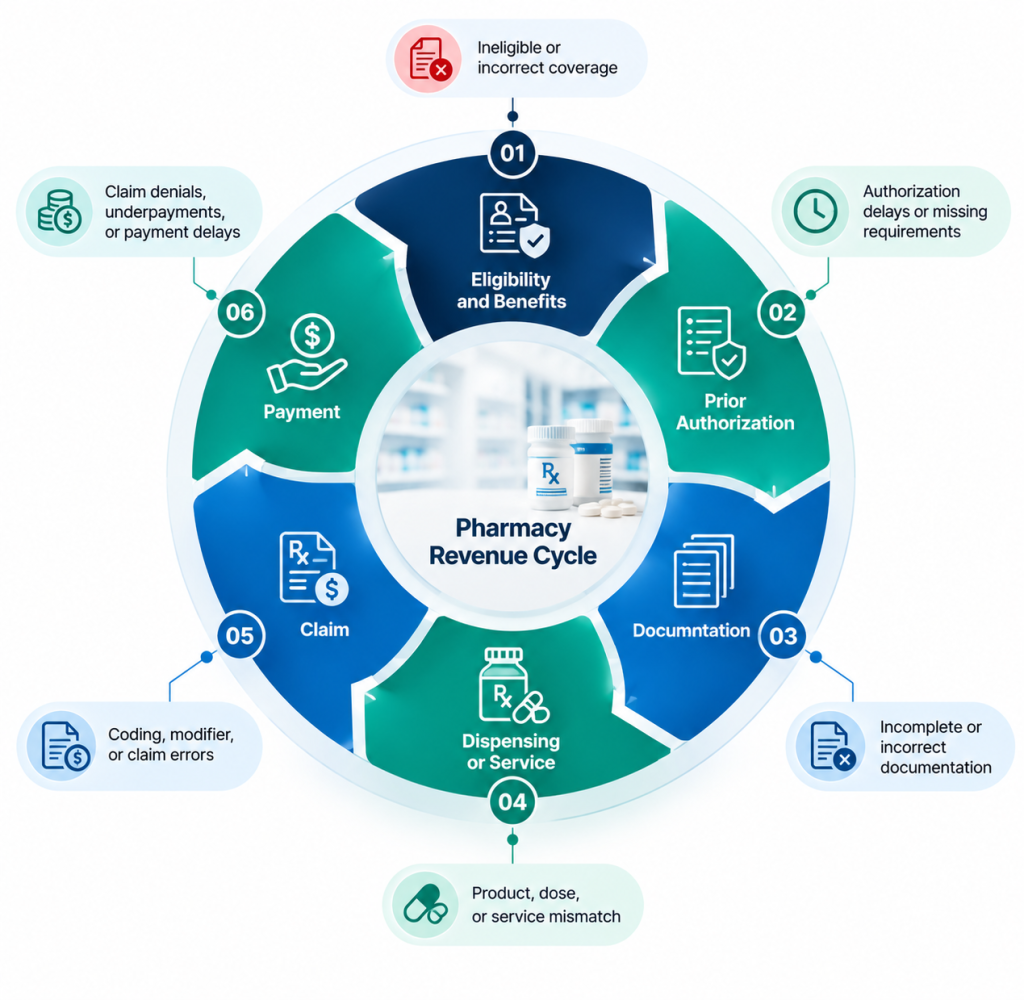
The question to ask a prospective partner is:
Where does your responsibility begin and where does it end?
If the billing company becomes involved only after the claim reaches its team, eligibility errors, authorization mismatches, incomplete documentation, or incorrect billing information may already have entered the process.
This is why prior authorization services should be evaluated as part of the wider reimbursement workflow when authorization is a significant requirement for the pharmacy.
Find the Gaps Before They Become Claim Problems
Eligibility, authorization, documentation, and billing should work as one connected process. AnnexMed helps pharmacies identify where pre-claim gaps may be contributing to delayed or denied reimbursement.
Identify Your Pre Claim GapsEvaluate Pharmacy Denial Management and Prevention
Almost every billing company can say it works with denials. The more useful question is:
What happens when the same denial keeps coming back?
A capable pharmacy billing partner should be able to trace recurring denials to their source.
Denial management should also account for financial priority. A high-value specialty claim with a strong recovery pathway may require a different escalation strategy from a lower-value recurring rejection. The billing partner should be able to prioritize intervention based on financial exposure, recoverability, payer behavior, and root cause rather than treating every denial as an equal work item.
NCPDP notes the importance of maintaining current standardized transaction values and definitions used in pharmacy transactions. Outdated or unsupported values can contribute to rejected transactions and manual correction work.
For recurring revenue-cycle issues, AnnexMed’s Denial Management and Prevention Services focus on identifying whether the underlying problem originates in areas such as eligibility, authorization, coding, documentation, or payer processing rather than treating each denial as an isolated event.
Evaluate Whether Reporting Creates Operational Visibility
Outsourcing billing should not mean outsourcing visibility. Before selecting a pharmacy billing company, ask to see the reporting that pharmacy leadership and operational teams will actually receive.
Depending on the pharmacy model, useful measures may include:
- First-pass or clean claim performance
- Claim rejection and denial trends
- Days in accounts receivable
- AR aging by payer
- Collections
- Prior authorization turnaround
- Underpayment trends
- Appeal and recovery status
- Payer-specific performance
Do not stop at asking whether the company provides a dashboard.
Ask:
What decisions will this reporting help the pharmacy make?
Reporting should help leadership identify which payers, therapies, claim types, or parts of the revenue cycle require intervention, how AR is moving, where actual reimbursement differs from expectations, and who owns the next action.
A dashboard that shows the amount of AR is useful. Operational visibility should go further by showing why that AR is building, where the largest recoverable balances are concentrated, which payers are creating disproportionate friction, and which issues require immediate intervention.
Where standard reporting does not provide that level of visibility, Denial and Underpayment Analytics can help connect payer behavior, root causes, reimbursement variance, and recovery opportunities.
Can You See Where Pharmacy Revenue Is Getting Stuck?
AnnexMed helps connect billing, denial, AR, payer, and reimbursement data so pharmacy teams can see where intervention is needed.
Review Your Revenue PerformanceVerify Compliance Security and Operational Controls
A pharmacy billing company will handle sensitive patient, payer, clinical, and financial information. Security and compliance should therefore be part of the initial evaluation, not a procurement formality.
Vendor Due Diligence Checklist
- HIPAA safeguards
- Workforce access controls
- Data access policies
- Security certifications and independent audits where applicable
- Business continuity processes
- Quality assurance controls
- Audit trails
- Staff training
- Defined escalation procedures
Operational accountability matters just as much. Determine who owns payer follow-up, authorization escalation, denial appeals, payment reconciliation, unresolved AR, and reporting.
Strong technology cannot compensate for unclear ownership.
Compare Pharmacy Billing Costs Against Service Scope
Pricing matters, but comparing percentage fees or monthly charges without comparing scope can lead to the wrong decision. Two pharmacy billing companies may quote similar prices while assuming responsibility for very different parts of the revenue cycle.
Evaluate cost alongside:
Scope
Which functions are included, and which remain with the pharmacy?
Expertise
Does the assigned team understand the pharmacy’s payer and reimbursement environment?
Accountability
Who owns unresolved claims and escalations?
Visibility
What performance information will leadership receive?
Integration
How will the partner work with existing pharmacy systems and internal teams?
Scalability
Can the operating model accommodate changes in volume, therapies, payers, facilities, or locations?
Continuous Improvement
Will performance data be used to reduce recurring issues, or only to report completed activity?
For long-term care pharmacies, this assessment should also account for Medicaid requirements and facility AR processes. LTC Pharmacy Services may therefore require a different evaluation framework than specialty or outpatient pharmacy billing.
The relevant comparison is not simply:
Which company charges less?
It is:
Which model provides the right level of control for the cost?
Questions to Ask a Pharmacy Billing Company Before Signing
Vendor discussions should reveal how the company will operate after implementation, not simply what appears in the proposal.
Ask:
- Which pharmacy models do you currently support?
- How do you manage pharmacy benefit and medical benefit billing?
- Where does your responsibility begin in the revenue cycle?
- How are prior authorizations tracked and escalated?
- How do you identify recurring denial root causes?
- How are underpayments identified and followed up?
- Which pharmacy-specific performance metrics will be reported?
- Who owns unresolved claims and payer escalations?
- How will your team work with our current systems and internal staff?
- What should we expect during the first 30, 60, and 90 days?
The quality of the answers matters more than the number of services listed in a sales presentation.
A prospective partner should be able to explain who performs the work, how exceptions are managed, what leadership can see, and how recurring problems are addressed.
How to Compare Pharmacy Billing Companies Before You Decide
Once proposals and vendor discussions are complete, bring the evaluation back to five dimensions.
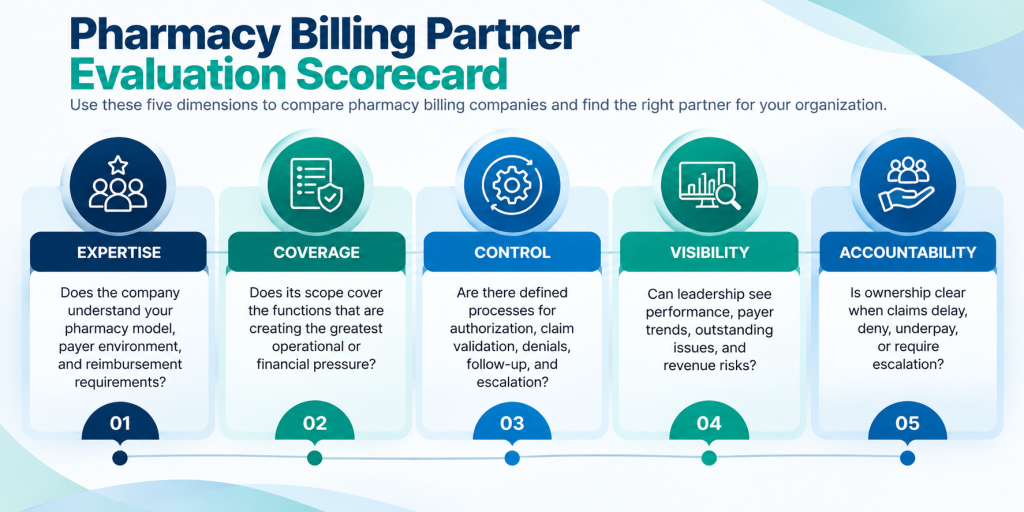
A company that performs well across all five areas is more likely to function as an extension of the pharmacy’s revenue operation rather than simply an outsourced claim-processing team.
Choosing the Right Pharmacy Billing Partner
The right pharmacy billing partner should fit the way your organization gets paid, not require your operation to fit a standard billing model.
AnnexMed supports specialty, infusion, long-term care, and other pharmacy organizations across the revenue cycle, connecting prior authorization, billing, denial management, AR follow-up, reimbursement analysis, and payer-specific workflows. The focus is not simply on processing claims, but on identifying where revenue is being delayed, denied, or underpaid and bringing clearer accountability to those areas.
If you are currently evaluating pharmacy billing companies, bring your existing billing challenges, payer mix, and revenue-cycle priorities to the discussion. AnnexMed can help assess where the current process is creating pressure and determine the level of billing support your pharmacy needs.
FAQs
Look for experience with your pharmacy model, appropriate medical and pharmacy benefit billing capabilities, prior authorization support, denial prevention and resolution, AR management, performance reporting, security controls, system compatibility, and clearly defined accountability.
Pharmacy reimbursement can involve pharmacy benefit transactions as well as medical benefit claims depending on the therapy, service, payer, and site of care. Pharmacy-specific product information, authorization requirements, transaction standards, billing units, and reimbursement workflows may also apply.
When authorization directly affects dispensing or reimbursement, the billing model should provide clear coordination between authorization and claims. Whether the company owns the complete authorization process depends on the pharmacy’s operating model and outsourced scope.
Relevant measures can include clean claim performance, rejection and denial rates, AR aging, collections, prior authorization turnaround, underpayments, recovery status, and payer-specific trends. Metrics should be selected according to the pharmacy’s business model.
It can be when the billing partner understands the pharmacy’s therapy mix, benefit pathways, payer requirements, prior authorization processes, and reimbursement model. Pharmacy-specific experience should therefore be verified before outsourcing.