

Last Updated on August 25, 2026
Every hospital makes hundreds of revenue cycle decisions each day.
- Which claims should be prioritized?
- When should an exception be escalated?
- Which payment variance requires investigation?
- What should be automated, and
- What requires expert judgment?
When these decisions depend on individual preference, local workarounds, or inconsistent rules, similar accounts can produce very different financial outcomes. One claim may be resolved quickly, while another remains in A/R, moves into denial, or becomes an underpayment that is never recovered.
For CFOs and RCM leaders, this is more than an operational concern. Decision variability affects cash predictability, denial performance, reimbursement accuracy, rework, and cost to collect.
Strong RCM governance creates consistent decision rules, clear ownership, escalation thresholds, and financial visibility across departments and facilities.
Make Better Governance an Operating Advantage
AnnexMed helps hospitals translate stronger governance into structured RCM execution across the workflows that directly influence revenue performance.
Connect With UsTable of contents
RCM Governance Reduces Revenue Cycle Variability
The financial value of RCM governance comes from reducing unnecessary variation in how similar revenue risks are handled across the enterprise. It defines who owns each decision, which rules apply, when issues must be escalated, and how results are measured. Without this structure, revenue cycle decisions may vary by department, facility, payer, work queue, or employee. That variability can create:
- Uneven denial follow-up
- Delayed escalation of high-value accounts
- Inconsistent authorization decisions
- Different approaches to payment variance
- Repeated documentation and coding errors
- Unclear ownership of exceptions
HFMA’s 2026 revenue cycle guidance describes revenue cycle performance as a central driver of financial sustainability and organizational resilience rather than only an operational function. This broader view makes governance increasingly important across finance, patient access, coding, HIM, managed care, compliance, IT, and operations.
Across complex hospital RCM environments, decision variability often appears inside work queues before it becomes visible in enterprise financial reporting. Similar payer issues may receive different levels of prioritization, escalation, or specialist intervention across teams, allowing financial exposure to build even while headline KPIs remain relatively stable.
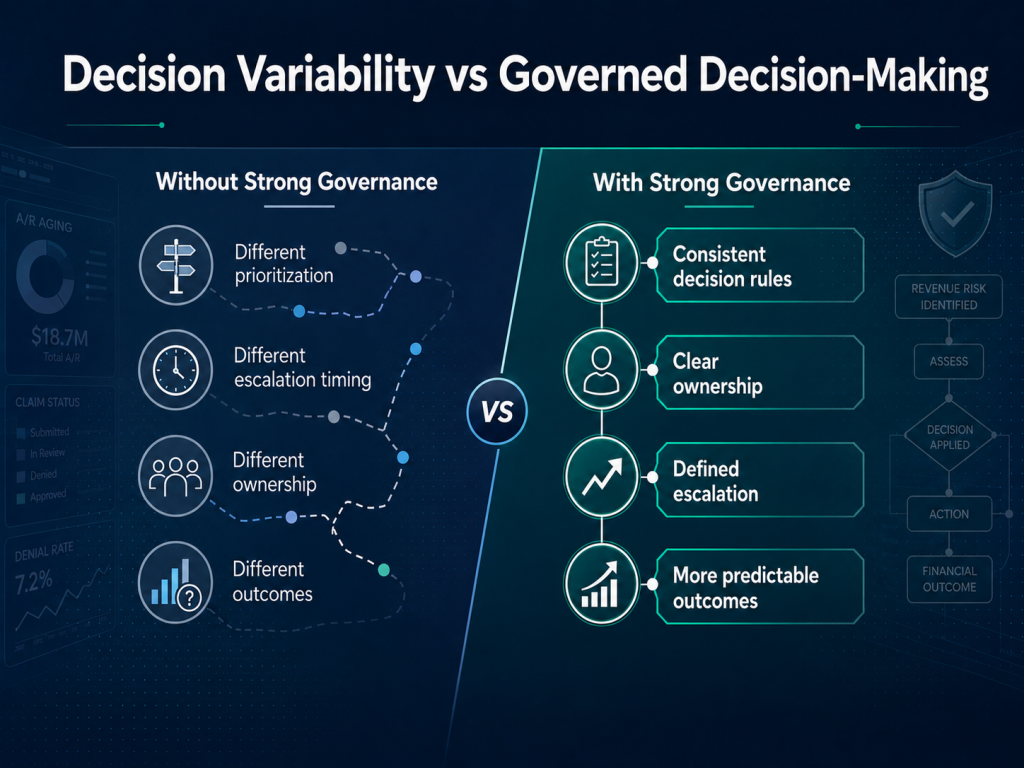
Illustrative Example
Consider two hospitals in the same health system managing similar high-dollar claims. Hospital A prioritizes accounts by balance, filing deadline, payer behavior, and recovery probability. Hospital B works claims mainly by age or queue volume.
Both facilities may report similar total AR. However, Hospital B may carry greater timely filing exposure and slower cash conversion. The difference may not be payer mix. It may be how consistently revenue decisions are made.
Governance Creates Consistent Revenue Decisions
Governance does not eliminate professional judgment. It ensures that judgment is applied within a consistent framework.
Standardize Prioritization Rules
AR and denial work queues should not rely on volume alone. Prioritization should consider:
- Dollar exposure
- Recovery probability
- Timely filing risk
- Payer behavior
- Denial category
- Service-line impact
- Required staff expertise
This helps teams focus effort where it can protect the most cash.
Define Escalation Thresholds
Governance should establish when an issue moves from routine processing to leadership review. Examples include:
- High-dollar claims without a documented next action
- Authorization exceptions approaching filing deadlines
- Repeated payer no-response cases
- Coding issues outside service-level targets
- Underpayments above a defined financial threshold
- Denial patterns concentrated in one payer or service line
Assign Ownership for Exceptions
A claim should not move between patient access, coding, billing, and denial teams without a clear owner. Each material exception needs a responsible team, a next action, and a deadline.
Reduce Variability Across Revenue Cycle Decisions
AnnexMed helps hospitals strengthen prioritization, escalation, coding, denial, AR payment, and revenue integrity workflows.
Explore Our RCM ServicesConsistent Governance Improves Financial Performance
Improves Cash Predictability
Cash forecasts become less reliable when important RCM decisions remain hidden inside disconnected work queues. Governance improves predictability by creating consistent rules for:
- High-value A/R follow-up
- Denial escalation
- Underpayment review
- Payment variance recovery
- Authorization exceptions
- Claim correction
- Write-off approval
Leaders can then connect operating signals to financial outcomes.
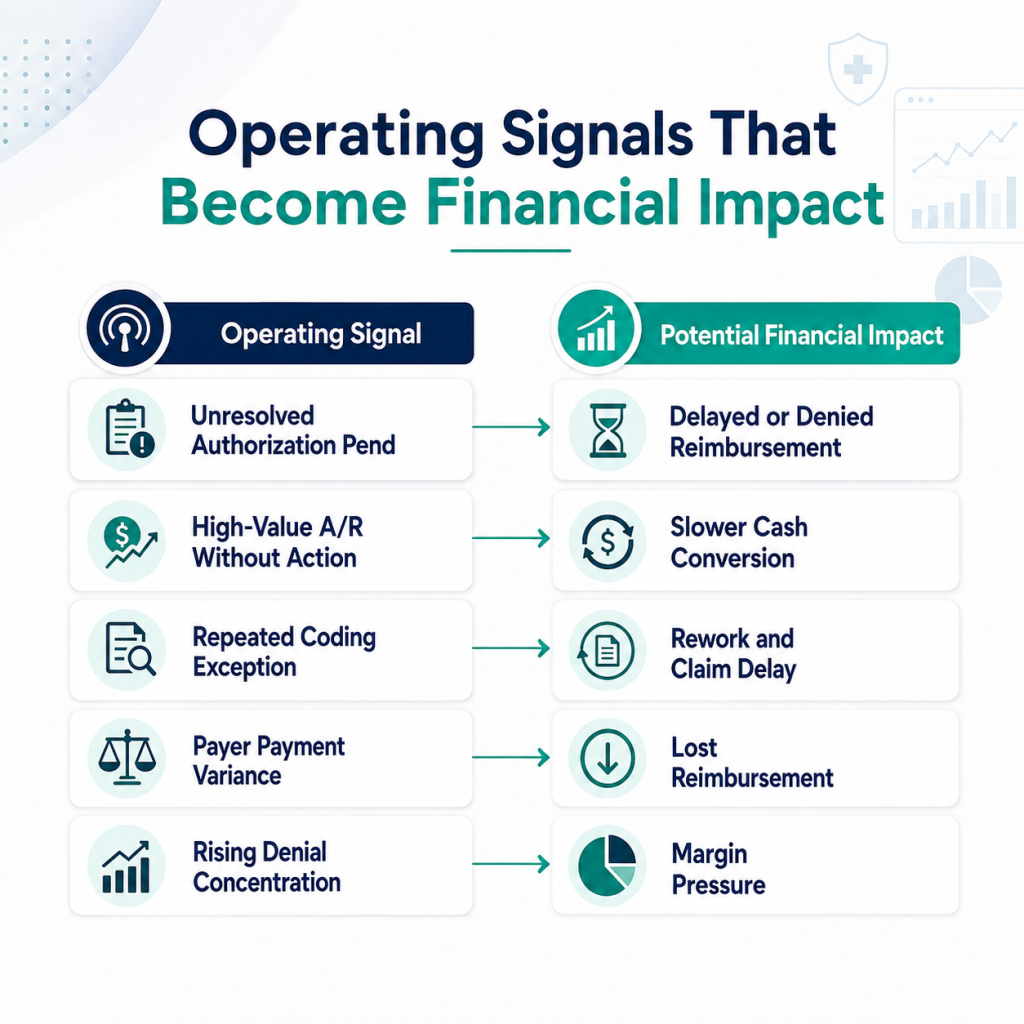
Strengthens Payer Performance Management
Payer issues should be measured through evidence rather than anecdotal complaints. Governance can bring together denial trends, authorization turnaround, payment variance, appeal outcomes, contract terms, and timely filing exposure.
This helps leaders separate a temporary payer delay from reimbursement problems that may require operational escalation, payer intervention, or contract review. Hospitals can strengthen payer performance management by bringing managed care and revenue cycle data into a shared financial view. This gives CFOs and RCM leaders clearer visibility into which payer relationships are creating disproportionate administrative effort, delayed cash, or reimbursement leakage.
Improves Revenue Integrity
Revenue integrity depends on consistent controls across the full account lifecycle:
Registration → Authorization → Documentation → Coding → Charge Capture → Claim → Payment
A break at any point can create rework, denial risk, underpayment, or delayed cash. Governance connects these stages so recurring downstream losses can be traced back to the upstream decision or control that created them.
AnnexMed’s revenue integrity service supports hospitals in strengthening controls across documentation, coding, charge capture, and reimbursement accuracy. This is where governance becomes an operating advantage. Hospitals that identify revenue risk earlier, escalate exceptions more consistently, and allocate resources based on financial exposure can respond faster than organizations relying on fragmented workflows and lagging indicators. The advantage is not simply better oversight. It is greater control over how quickly revenue moves from operational activity to financial outcome.
Governance Makes Automation More Reliable
Automation can reduce decision variability, but only when the underlying rules, data, and escalation paths are clear. Automation does not eliminate variability when the rules underneath it are inconsistent. It can scale that variability.
Before deploying AI or automation, RCM leaders should define:
- Which decisions can be automated
- Which exceptions require human review
- What data can inform the decision
- How accuracy and financial impact will be monitored
- Who owns the outcome
HFMA’s March 2026 reporting on enterprise AI implementation in RCM highlighted the importance of redesigning workflows, roles, decision rights, and cross-functional accountability before scaling AI. .
NIST’s AI Risk Management Framework reinforces this governance principle more broadly. Its GOVERN function emphasizes defined accountability, documented roles, continuous monitoring, executive responsibility, and clear human oversight for AI systems.
For example, an automated denial-routing tool may assign claims correctly in one facility but incorrectly in another if denial categories, payer rules, or ownership definitions differ. Standardization should come before scale.
Hospitals Can Build Stronger RCM Governance
A practical governance model does not need to create unnecessary bureaucracy. It should improve the speed, consistency, and quality of high-impact revenue decisions.
1. Identify Financial Exposure
Start with the risks that carry the greatest financial consequence:
Denial dollars, high-value A/R, authorization-related write-offs, contract payment variances, delayed charge capture, repeated coding errors, and service-line revenue leakage.
2. Define Decision Rights
Clarify who owns each material revenue decision.
Leadership should know who is responsible for prioritization, who controls escalation, who resolves exceptions, and who becomes accountable when an issue crosses a defined financial threshold.
3. Establish Escalation Thresholds
Age alone should not determine intervention. Thresholds can consider:
Dollar exposure | Filing risk | Payer behavior | Recoverability | Service-line impact
This allows specialist resources to enter the workflow based on financial exposure rather than simply how long an account has remained open.
4. Connect Cross-Functional Accountability
Effective RCM governance requires participation from finance, RCM, patient access, HIM, coding, clinical documentation, managed care, compliance, IT, and operations.
Not every function needs to own every decision. But ownership and handoffs should be clear when financial risk crosses departmental boundaries.
5. Measure Decision Quality
Traditional KPIs remain important, but governance also requires signals that show whether teams are making timely and financially meaningful decisions.
A focused governance scorecard can include:
- Initial denial rate
- Denial dollars by root cause
- AR over 90 days
- Underpayment variance
- Cost to collect
- High-value accounts without a defined next action
- Exceptions outside escalation thresholds
- Average exception resolution time
- Repeat issues by payer or service line
- Appeal overturn rate
The scorecard should also be segmented by payer, facility, service line, and account value.
Enterprise averages can look stable while concentrated financial risk develops underneath them.
Turning RCM Governance Into Financial Control
RCM governance creates value when it helps hospitals make critical revenue decisions earlier, more consistently, and with clearer accountability. That discipline can reduce avoidable variation across prioritization, escalation, denials, AR, payment variance, and other financially significant workflows.
AnnexMed helps hospitals strengthen this operating discipline across complex RCM environments through specialized expertise, structured workflows, analytics, and scalable support. The focus is on helping organizations create greater consistency across the decisions that influence cash flow, reimbursement, and revenue performance.
The real advantage of stronger RCM governance is simple: financial risk becomes easier to see, decisions become easier to control, and revenue performance becomes more predictable.
Move From Revenue Cycle Oversight to Financial Control
AnnexMed combines specialized RCM expertise, structured operating processes, and revenue intelligence to help hospitals create more predictable and controllable revenue performance.
Talk to Our RCM ExpertsFAQs
- What Is RCM Governance?
RCM governance is the framework that defines revenue cycle decision rights, accountability, escalation rules, reporting standards, and performance oversight across clinical, operational, financial, and technology teams.
- Why Does RCM Governance Matter to Hospital CFOs?
RCM governance helps CFOs see the operational causes behind denials, delayed cash, underpayments, and A/R growth. This creates an opportunity for earlier intervention before revenue risk becomes visible only as a reported financial outcome.
- How Does RCM Governance Reduce Decision Variability?
Governance creates shared rules for prioritization, escalation, exception handling, automation, payment review, and performance reporting. Similar revenue situations can then be handled more consistently across departments, facilities, and teams.
- How Does Governance Support AI Adoption?
Governance defines which decisions can be automated, which exceptions require human review, what data can inform an automated decision, who owns the outcome, and how financial and operational performance will be monitored.
- Which Revenue Cycle Areas Need the Strongest Governance?
Hospitals should prioritize governance around high-value A/R, prior authorization, denial management, coding and documentation exceptions, payer payment variances, underpayments, write-offs, and AI-enabled decision workflows. These areas combine frequent operational decisions with significant financial exposure.