

Last Updated on July 20, 2026
A busy dermatology practice doesn’t always translate into predictable reimbursement. Patient volumes remain steady, procedures are completed on time, and claims are submitted promptly, yet payments often take longer than expected to arrive. The gap between providing care and receiving payment is where many practices begin to experience revenue cycle pressure.
Partner with Specialists in Dermatology Billing
AnnexMed helps dermatology practices improve claim accuracy, reduce payment delays, and maximize reimbursement through specialized dermatology RCM.
Talk to Our Dermatology ExpertsUnlike claim denials, dermatology claims payment delays often develop quietly. Claims remain active in the billing process while coding inconsistencies, incomplete documentation, prior authorization requirements, or payer-specific review extend reimbursement timelines. As these delays accumulate, accounts receivable (A/R) grow, billing teams spend more time on follow-up, and cash flow becomes less predictable.
Dermatology presents unique reimbursement challenges because it combines high-volume procedures such as lesion removals, biopsies, excisions, injectables, biologic therapies, and phototherapy with detailed documentation and payer-specific billing requirements.
Understanding where payment delays begin and why they occur is the first step toward improving reimbursement performance and building a more efficient revenue cycle.
Table of contents
Where Dermatology Payment Delays Begin
Payment delays rarely begin after a claim reaches the payer. More often, they develop gradually as small issues accumulate throughout the revenue cycle. A missed authorization, incomplete procedure note, coding inconsistency, or payer-specific requirement can interrupt reimbursement long before a payment decision is made.
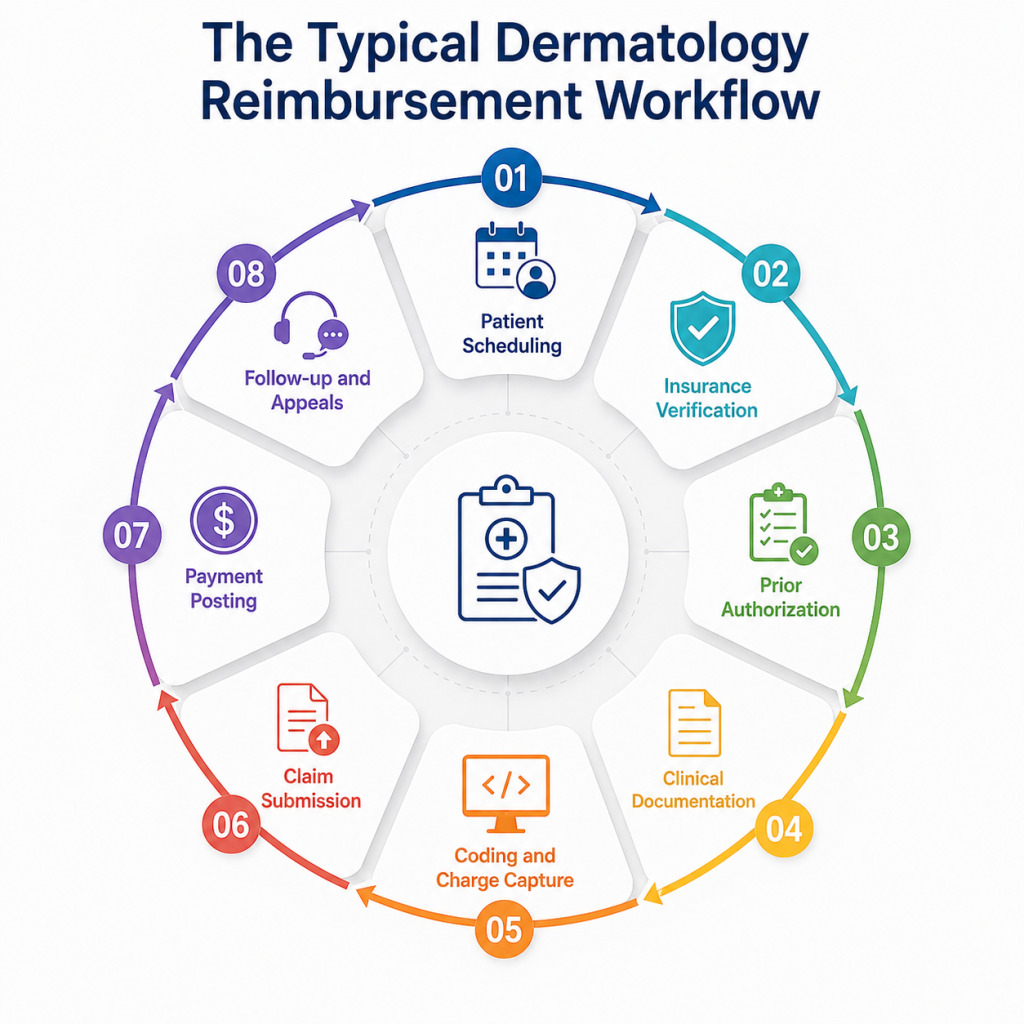
A delay at any stage can extend payment timelines, even when the clinical service has been performed correctly.
How Payment Delays Appear in Everyday Operations
Unlike denied claims, delayed claims usually remain active in the billing system, making them less obvious until accounts receivable begin to grow. Billing teams often spend more time tracking claim status, responding to payer requests, and following up on outstanding balances than submitting new claims.
Some of the most common indicators include:
| Operational Sign | What it Indicates |
|---|---|
| Claims remain unpaid beyond 30–45 days | Slower reimbursement and increasing A/R |
| Claims marked Pending or Under Review | Additional payer validation or documentation required |
| Frequent requests for clinical records | Documentation does not fully support claim processing |
| Growing manual follow-up workload | Billing teams spend more time resolving delayed claims |
| Different payment timelines for identical procedures | Payer-specific reimbursement variations |
Practice Snapshot
A dermatology practice performs approximately 10 lesion removals every week and consistently submits claims within 48 hours. Despite timely claim submission, several claims remain in A/R for more than 45 days because documentation requires clarification or payer review takes longer than expected.
Patient volume remains stable, but reimbursement becomes inconsistent, forcing the billing team to dedicate additional time to follow-up instead of proactive revenue cycle improvement.
This pattern is common in dermatology because many procedures require detailed documentation, precise code selection, and compliance with payer-specific reimbursement guidelines before payment is released.
Operational Insight
Dermatology payment delays often develop gradually rather than through a single billing error. Practices that monitor aging claims, pending claim status, and payer turnaround times are better positioned to identify reimbursement bottlenecks before they affect cash flow and operational performance.
Common Causes of Dermatology Billing Delays
Dermatology reimbursement is shaped by more than accurate claim submission. A single patient visit may involve multiple procedures, detailed clinical documentation, modifier usage, pathology services, and payer-specific billing requirements. When these elements are not fully aligned, claims often move into additional review instead of straight to payment. The most common causes are.Each of these areas contributes differently to delayed reimbursement, but together they create significant friction across the dermatology revenue cycle.
Procedural Coding Complexity
Dermatology involves a broad range of procedures that may appear clinically similar but require different CPT codes based on the technique performed, lesion characteristics, and supporting documentation.
Common coding challenges include:
- Distinguishing between biopsy, excision, and lesion destruction procedures.
- Selecting procedure codes based on lesion size and anatomical location.
- Reporting cryotherapy, laser therapy, or cautery using the correct CPT codes.
- Applying modifiers accurately when multiple procedures are performed during the same encounter.
- Reporting separately identifiable services without creating bundling issues.
Operational Impact
Accurate procedural coding helps reduce payer edits, minimizes manual corrections, and supports faster claim adjudication.
Documentation Requirements
Strong documentation supports both accurate code selection and medical necessity. Dermatology procedures frequently require clinical details that extend beyond the procedure itself, and incomplete records often lead to additional payer review.
Documentation should consistently capture:
- Lesion size and location.
- Lesion type and clinical characteristics.
- Clinical indication for treatment.
- Procedure performed.
- Pathology findings, when applicable.
- Clinical photographs if required by payer policy.
Even small omissions can interrupt the reimbursement process until additional documentation is provided.
Expected Result
Comprehensive documentation improves claim quality and reduces requests for supporting clinical records.
Payer Policy Variations
Dermatology reimbursement policies vary considerably across Medicare, Medicaid, and commercial insurers. Procedures involving biologics, lesion removal, phototherapy, and injectable therapies often require additional payer-specific validation before payment is released.
Common payer requirements include:
- Prior authorization for specialty medications and biologics.
- Frequency limitations for selected procedures.
- Medicare LCD and NCD compliance.
- Procedure-specific documentation standards.
- Medical necessity criteria for high-cost treatments.
Practices that standardize billing around a single workflow often encounter inconsistent reimbursement because each payer applies different review criteria.
Business Value
Aligning billing processes with payer-specific requirements helps reduce avoidable payment delays and improves reimbursement consistency.
Revenue Cycle Workflow Gaps
Not every delay originates from coding or documentation. Internal workflow inefficiencies can slow reimbursement even when claims are technically accurate.
Common workflow issues include:
- Delayed charge capture.
- Missing pre-bill claim validation.
- Manual claim corrections before submission.
- Slow follow-up on pending claims.
- Limited visibility into aging accounts receivable.
Small workflow gaps can accumulate across hundreds of monthly claims, extending payment turnaround and increasing administrative effort.
Long-Term Advantage
A standardized billing workflow helps claims move more efficiently from patient encounter to payment while reducing unnecessary follow-up and claim rework.
Dermatology differs from many physician specialties because it combines high procedural volume with detailed reimbursement requirements. A documentation gap or coding inconsistency that affects one claim can quickly affect dozens more, making operational consistency just as important as coding accuracy.
Small Billing Issues Create Big Payment Delays
AnnexMed helps dermatology practices identify the root causes of payment delays and strengthen billing workflows to improve reimbursement performance.
Talk to Our Dermatology ExpertsCommon Billing Scenarios That Delay Dermatology Claims
Not every payment delay is caused by a major billing error. In dermatology, reimbursement is often delayed by routine situations where documentation, coding, modifiers, or payer requirements do not fully align. These scenarios occur every day in busy practices and, if left unaddressed, can gradually increase accounts receivable and administrative workload.
The following examples illustrate how seemingly small issues can interrupt the payment process.
Scenario 1 – Lesion Removal Coding Does Not Match Documentation
Clinical Situation
A dermatologist removes a 1.2 cm lesion from the patient’s forearm. The clinical note documents the lesion size and location but does not clearly indicate whether the procedure was performed as a biopsy, simple excision, or complex excision.
What Happened
Based on the available documentation, the coder selects an excision CPT code. During claim review, the payer determines that the documentation does not fully support the reported procedure and requests clarification before adjudication.
Financial Impact
- Payment remains pending until documentation is updated.
- Billing staff spend additional time correcting and resubmitting the claim.
- Cash flow slows despite timely claim submission.
Scenario 2 – Biopsy and Lesion Destruction Reported Incorrectly
Clinical Situation
During a single patient visit, one suspicious lesion is biopsied while another lesion is destroyed using cryotherapy. Both services are clinically appropriate and separately performed.
What Happened
Only one procedure is reported, or the required modifier is omitted, preventing the claim from accurately representing both services.
Financial Impact
- The payer places the claim under manual review.
- Claim processing is interrupted while coding is corrected.
- Reimbursement is delayed even though patient care was delivered appropriately.
Scenario 3 – Biologic Therapy Without Verified Prior Authorization
Clinical Situation
A patient receives a biologic injection after meeting the clinical criteria for treatment. However, prior authorization has not been verified before the medication is administered.
What Happened
The payer places the claim on hold until authorization requirements are confirmed. In some cases, additional clinical records are also requested before payment can proceed.
Financial Impact
- Payment is delayed for several weeks.
- Billing teams must coordinate additional payer follow-up.
- Outstanding balances remain in A/R longer than expected.
Scenario 4 – Modifier Errors During Multiple Procedures
Clinical Situation
A dermatologist performs an Evaluation and Management (E/M) service along with a separately identifiable procedure during the same encounter.
What Happened
The required modifier is either omitted or incorrectly applied, making it difficult for the payer to distinguish between the E/M service and the procedure performed.
Financial Impact
- The claim is flagged for payer review.
- Manual corrections become necessary before reimbursement.
- Payment turnaround extends despite appropriate coding of the individual services.
A Common Pattern Across All Four Scenarios
Although these situations involve different procedures, they share one characteristic: the clinical care was delivered correctly, but the reimbursement process slowed because billing information did not fully support payer requirements.
Whether the issue involves documentation, procedure selection, modifiers, or authorization, the result is often the same:
- Additional payer review.
- Increased manual follow-up.
- Longer payment cycles.
- Greater administrative workload.
Practices that regularly analyze delayed claims by procedure type can identify these recurring patterns and strengthen billing workflows before they begin affecting larger portions of the revenue cycle.
Practical Strategies to Reduce Dermatology Claim Payment Delays
Reducing dermatology claims payment delays requires a proactive revenue cycle approach rather than reacting after claims enter accounts receivable. The goal is to identify potential reimbursement issues before submission, strengthen documentation, and standardize billing processes that support faster claim adjudication.
The following workflow improvements help practices reduce avoidable delays while improving overall reimbursement performance.
Standardize Procedure Documentation
Dermatology procedures often require detailed clinical information to support accurate coding and medical necessity. Standardized documentation templates help providers capture the information needed for consistent claim submission.
Every procedure template should include:
- Lesion size and anatomical location.
- Lesion type and clinical indication.
- Procedure performed and treatment method.
- Relevant pathology findings, when applicable.
- Clinical photographs if required by payer policy.
Standardizing documentation also reduces variation between providers, making coding and billing more consistent across the practice.
Expected Result
Better documentation reduces requests for additional records and supports faster claim processing.
Build Pre-Bill Reviews for High-Risk Procedures
Many reimbursement issues can be identified before a claim reaches the payer. A structured pre-bill review process helps billing teams verify coding accuracy and supporting documentation for procedures that frequently experience payment delays.
Prioritize reviews for:
- Lesion removals.
- Skin biopsies.
- Lesion destruction procedures.
- Injectables and biologic therapies.
- Phototherapy services.
During the review, confirm:
- CPT code selection.
- Modifier accuracy.
- Diagnosis-to-procedure linkage.
- Supporting documentation.
- Prior authorization status, when applicable.
Impact
Resolving billing issues before submission improves clean claim rates and reduces payer rework.
Apply Dermatology-Specific Claim Validation
General claim edits may not identify the reimbursement challenges unique to dermatology. Claim validation rules should reflect specialty-specific coding requirements and payer policies before claims are transmitted.
An effective validation process should review:
- National Correct Coding Initiative (NCCI) edits.
- CPT and ICD-10-CM code combinations.
- Modifier usage.
- Missing documentation.
- Payer-specific billing requirements.
- Conflicting code pairs and incorrect units.
Automated validation allows billing teams to correct issues early rather than after payment is delayed.
Business Value
Cleaner claims improve first-pass payment rates while reducing manual corrections and payer reviews.
Monitor Payer Performance by Procedure Type
Every payer processes dermatology claims differently. Monitoring reimbursement performance by procedure type helps practices identify recurring payment patterns and prioritize follow-up where it delivers the greatest financial impact.
Review performance indicators such as:
- Average time-to-pay by payer.
- Claims remaining unpaid beyond expected timelines.
- Procedures generating the highest payment delays.
- Recurring documentation requests.
- Payer-specific reimbursement trends.
These insights help practices refine billing workflows while improving communication with payers that consistently require additional review.
Operational Advantage
Data-driven payer monitoring enables billing teams to focus on the claims most likely to delay reimbursement.
Keep Billing Teams Current on Payer Requirements
Dermatology reimbursement requirements continue to evolve as Medicare, Medicaid, and commercial insurers update coverage policies, coding guidance, and documentation expectations. Regular education helps billing teams remain aligned with current requirements and reduces preventable billing inconsistencies.
Training should focus on:
- Annual CPT and ICD-10-CM updates.
- Medicare LCD and NCD revisions.
- Commercial payer policy changes.
- Documentation standards for high-volume procedures.
- Modifier updates.
- Common reimbursement trends affecting dermatology practices.
Providing billing teams with easy access to current payer guidance also promotes greater consistency across daily operations.
Long-Term Value
Continuous education strengthens coding accuracy, improves billing consistency, and supports faster reimbursement over time.
Dermatology practices that standardize documentation, validate high-risk claims before submission, monitor payer performance, and continuously update billing knowledge are better positioned to reduce administrative rework and shorten payment cycles.
Dermatology Billing Expertise Designed for Better Financial Outcomes
Dermatology billing requires expertise beyond standard medical billing. Frequent use of modifiers, pathology-linked procedures, medical necessity requirements, cosmetic versus medical service distinctions, and evolving payer policies demand a revenue cycle partner with specialty-specific knowledge.
AnnexMed supports dermatology practices by strengthening every stage of the billing lifecycle through:
- Specialized dermatology coding expertise for medical, surgical, and pathology-related services.
- Documentation validation that supports medical necessity and payer compliance.
- Payer-specific billing workflows that reduce claim edits and reimbursement delays.
- Prior authorization support to help prevent avoidable claim holds.
- Proactive denial management and underpayment analysis to improve collections.
- Revenue cycle reporting and performance analytics that provide greater visibility into reimbursement trends.
Rather than functioning solely as a billing vendor, AnnexMed works as an extension of your revenue cycle team helping dermatology practices improve operational efficiency, reduce payment delays, and maximize long-term financial performance.
Transform Delayed Claims into Predictable Cash Flow
AnnexMed helps dermatology practices improve billing accuracy, reduce payment delays, and create a more consistent reimbursement cycle through specialty-focused RCM.
Schedule a MeetingFAQs
Dermatology claim payment delays are commonly caused by coding confusion between procedures such as biopsies, excisions, and lesion destruction, incomplete documentation, missing prior authorizations, and payer-specific reimbursement requirements. Identifying and correcting these issues before claim submission helps reduce delays and improve reimbursement timelines.
High-volume procedural codes such as lesion removal codes (11400–11646), skin biopsy codes (11102–11107), destruction procedure codes (17000–17286), Mohs surgery codes (17311–17315), and injectable or biologic administration services are more likely to experience payment delays because they often require detailed documentation and payer-specific review.
Practices should regularly review claims aging beyond 30–45 days, monitor payment turnaround by payer and procedure type, and analyze recurring documentation requests or manual claim reviews. Tracking these patterns helps identify operational issues before they affect cash flow.
Dermatology practices should monitor days in accounts receivable (A/R), time-to-pay by payer, clean claim rate, first-pass resolution rate, denial rate by procedure, and net collection rate. These metrics provide valuable insight into claim quality, payer performance, and overall revenue cycle efficiency.
Yes. When combined with dermatology-specific claim editing rules, automated claim scrubbing can identify coding inconsistencies, modifier issues, missing documentation, and payer-specific billing errors before claims are submitted. Automation is most effective when supported by standardized workflows and regular coding reviews.