

Last Updated on October 21, 2026
Many 340B billing problems are not caused by a single wrong code. They are caused by incomplete ownership. A claim may go out. A payment may come in. On the surface, the process looks active.
Underneath, eligibility logic, modifier use, Medicaid interaction, replenishment alignment, and payment reconciliation may sit in different hands with no clear owner. That is when reimbursement gaps and 340B billing exceptions become harder to detect and even harder to correct.
For hospital outpatient pharmacies and covered-entity leaders, the practical question is not whether a billing company “supports 340B.” It is what that company is actually responsible for handling end to end.
Table of contents
- Why 340B Billing Ownership Breaks
- The 340B Billing Responsibility Stack
- Core Functions a 340B Pharmacy Billing Company Should Handle
- What the Pharmacy Should Keep or Closely Control
- Six Signs Your 340B Billing Scope Is Too Narrow
- A Stage-by-Stage Ownership Checklist
- How to Test Whether a Partner Can Handle 340B Scope
- Turning Scope Clarity Into Revenue Control
- FAQs
Why 340B Billing Ownership Breaks
340B sits at the intersection of pharmacy operations, compliance, payer rules, and reimbursement. When ownership is split without a defined handoff, defects move downstream. Common break points include:
- Patient or encounter eligibility is assumed rather than verified against current program rules
- Drug data used for billing does not align with accumulation or replenishment records
- Medicaid billing requirements are applied inconsistently
- Modifiers or claim indicators are added late, or not at all
- Payment is posted without comparing expected 340B economics to actual reimbursement
- Audit support depends on reconstructing records after the fact
Example
A hospital outpatient pharmacy bills a specialty self-administered drug under the medical benefit. The claim pays. Later, replenishment and Medicaid state requirements do not line up with what was billed. The issue is discovered only during internal review. By then, the correction path is slower, more manual, and more exposed.
The billing company did process claims. It did not fully handle the 340B reimbursement environment around those claims.
The 340B Billing Responsibility Stack
A useful way to evaluate scope is to separate 340B billing into layers:
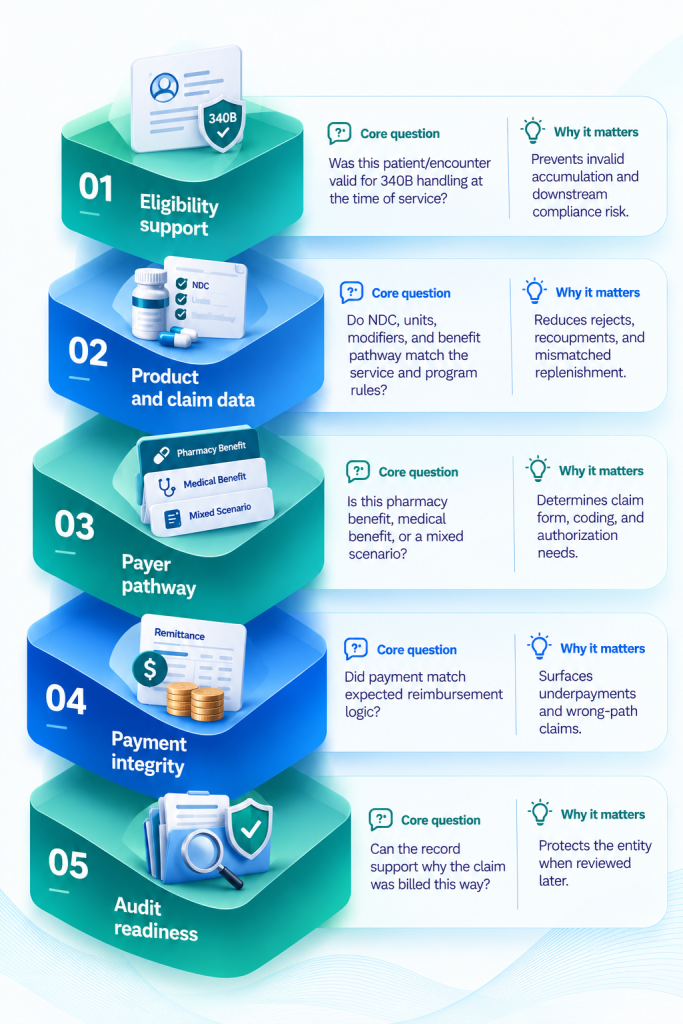
A billing company that only owns claim submission is handling one layer. 340B performance depends on the stack.
For hospital outpatient settings where medical-benefit drug billing is common, AnnexMed’s overview of infusion center billing and RCM outlines related operational requirements that often intersect with 340B workflows.
Does Your 340B Billing Scope Cover the Full Stack?
See where billing ownership ends today and where critical reimbursement responsibilities may still sit between teams.
Review Your 340B Billing ScopeCore Functions a 340B Pharmacy Billing Company Should Handle
If a partner says it handles 340B billing, these responsibilities should be explicit in the operating model.
1. Pre-claim alignment
Confirm the information needed for correct billing is available before submission: covered-entity context, relevant eligibility indicators, product identifiers, units, site-of-care details, and payer pathway.
For organizations evaluating the broader scope required around these activities, AnnexMed’s Hospital 340B Program Billing Services provides a closer look at billing, reimbursement, reconciliation, and operational support for covered entities.
2. Correct claim construction
Build claims with the code set, modifiers, quantity logic, and form appropriate to the benefit pathway and payer rules. This includes distinguishing pharmacy-benefit and medical-benefit routes when both are possible.
3. Medicaid and payer-specific rule application
Apply state and payer requirements that affect 340B claims, including billing identifiers, carve-in/carve-out implications, and documentation expectations where applicable.
4. Rejection and denial management with root-cause review
Work exceptions, but also identify whether failures are coming from eligibility, product data, modifiers, authorization, benefit routing, or payer processing.
5. Payment posting and expected-vs-actual review
Post payments and flag variance against expected reimbursement. A paid claim should not automatically be treated as a correctly reimbursed claim. Underpayments can remain hidden when payment posting is not followed by expected-versus-actual review.
6. Escalation and documentation support
Maintain clear ownership for unresolved claims, payer follow-up, and documentation needed for internal review or external audit support.
In 340B reviews, the highest-risk pattern is not a missing billing vendor. It is partial ownership: claims are submitted by one team, replenishment logic is tracked elsewhere, Medicaid handling is informal, and reconciliation happens only when something breaks. The pharmacy is active in every step and fully in control of none.
Map where 340B ownership is incomplete
AnnexMed helps hospital outpatient and covered-entity pharmacy teams identify which billing, reconciliation, and exception functions are defined and which are assumed.
Review Your 340B Billing ScopeWhat the Pharmacy Should Keep or Closely Control
Outsourcing operational work does not mean outsourcing accountability for program integrity. Pharmacy or covered-entity leadership should retain clear control over:
- 340B program policy decisions and compliance posture
- Eligibility framework and material changes to qualification logic
- Decisions on contract pharmacy relationships and data-sharing boundaries
- Approval of significant workflow changes that affect accumulation or billing
- Audit response strategy and final authority on compliance interpretations
- Performance expectations for any billing partner
A practical split looks like this:
The partner can operate inside the model. The entity still owns the model.
Six Signs Your 340B Billing Scope Is Too Narrow
These are the gaps that most often appear after a contract is already in place:
- Claims Are Submitted but Modifier and Indicator Validation Happens Later
Modifiers and claim indicators are added late, inconsistently, or without payer-specific validation. Claim submission may continue, but the control intended to prevent the exception is happening after the fact.
- Billing and Replenishment Data Are Managed Separately
Billing and replenishment may sit in different systems or teams without a defined process for comparing the information and assigning discrepancies. Each team assumes the other is checking alignment.
- Medicaid Rules Are Addressed Only After an Exception
State-specific Medicaid requirements are handled reactively, with differences becoming visible through denials, payment issues, or recoupment rather than through defined upfront controls.
- Paid Claims Are Not Checked Against Expected Reimbursement
A paid status is treated as the end of the workflow even when actual reimbursement has not been compared with the expected payment logic. Underpayments and wrong-path claims can remain hidden inside apparently successful claims.
- Audit Documentation Has to Be Reconstructed
The supporting trail is assembled only when internal review or an external request occurs instead of being maintained as part of the normal billing workflow.
- Ownership Ends When the Claim Is Submitted
Authorization coordination, benefit-pathway issues, underpayment review, unresolved denials, or other post-submission exceptions have no clearly assigned owner.
Want to examine these failure points more closely? Explore Common 340B Billing Challenges and Solutions for a deeper look at where billing and reimbursement issues typically surface.
A Stage-by-Stage Ownership Checklist
Use this as a working scope test with any current or prospective billing partner.
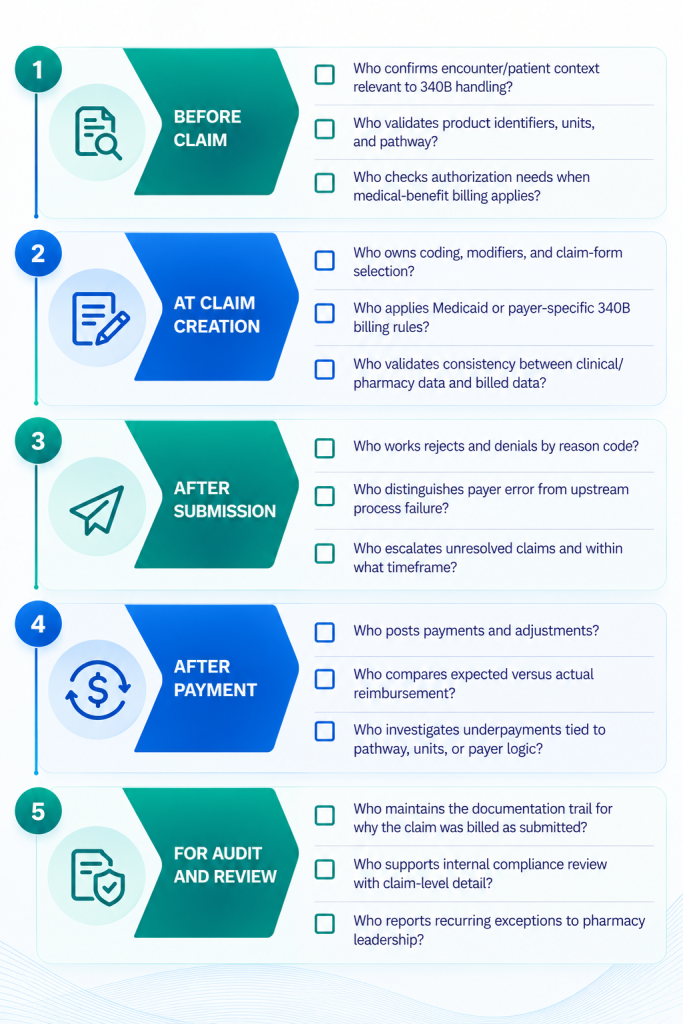
If several answers are “unclear” or “shared informally,” scope is incomplete.
Upstream defects often appear only after submission as denials or delayed cash. AnnexMed’s discussion of the invisible architecture of revenue explains how eligibility, authorization, and documentation gaps travel downstream.
How to Test Whether a Partner Can Handle 340B Scope
Ask for operating detail, not marketing language.
- Walk through a recent medical-benefit 340B drug claim from eligibility context to payment variance review.
- Explain how Medicaid-related 340B billing rules are applied for your states.
- Show how modifier and unit issues are prevented before submission.
- Demonstrate reporting for rejects, denials, underpayments, and aging on 340B-related claims.
- Define who owns replenishment-related discrepancies when billing data and pharmacy data diverge.
- Describe the first 30–60 days of implementation and what leadership will be able to see.
A partner that can only discuss claim volume is not yet demonstrating 340B billing ownership.
When underpayment leakage is part of the concern, AnnexMed’s Underpayment Analysis and Recovery Services compare actual reimbursement with expected terms so variance is visible inside normal operations.
Turning Scope Clarity Into Revenue Control
Effective 340B billing requires clear ownership from claim preparation through final reimbursement. When eligibility inputs, drug data, modifiers, payer requirements, denials, and payment variances are handled across disconnected teams, it becomes harder to determine where revenue is being delayed or where billing exceptions are originating.
AnnexMed supports hospital outpatient and covered-entity pharmacy teams by bringing these activities into a more accountable billing workflow. That includes validating claim-level requirements, managing payer-specific billing processes, working denials and unresolved AR, identifying reimbursement variances, and maintaining the reporting and escalation needed to keep exceptions visible.
Just as importantly, AnnexMed helps define the boundaries between what the billing team owns, what requires pharmacy or internal intervention, and what remains under covered-entity oversight. This gives leadership a clearer line of sight from claim construction to payment and exception resolution.
The value of a 340B billing partner should ultimately show up in fewer unresolved handoffs, stronger reimbursement visibility, and clear accountability when a claim does not perform as expected.
See Where Your 340B Billing Workflow Needs Greater Accountability
Review your current billing scope with AnnexMed to identify unclear ownership, unresolved reimbursement issues, and workflow gaps that may be affecting performance.
Review Your 340B Billing WorkflowFAQs
At minimum: claim construction for agreed pathways, payer-specific billing logic, rejection and denial management with root-cause visibility, payment posting, expected-vs-actual review, and documentation support for unresolved or audited claims.
No. The covered entity retains program compliance accountability. The billing company should execute within defined operational scope and surface exceptions that affect integrity or reimbursement.
Because denials often start upstream in eligibility context, product data, authorization, benefit routing, or payer-specific requirements. If those inputs are incomplete, claim processing alone cannot prevent repeat failures.
Billing teams may not own replenishment systems, but the operating model should define how billing data and replenishment records are compared and who owns discrepancies.
Reject and denial trends by reason, aging on unresolved claims, underpayment variance, payer-specific patterns, and exception categories that require pharmacy or compliance input.