
Last Updated on October 21, 2026
Pharmacy revenue leakage rarely begins as one large financial loss. More often, it starts with a billing error that appears manageable on its own.
An authorization expires before the next treatment. Drug units are entered incorrectly. A modifier is missing. A payer short-pays a claim that is later marked as resolved. One claim may represent a limited loss, but when the same issue repeats across therapies, payers, or billing cycles, the financial impact grows.
For pharmacy and revenue cycle leaders, claim acceptance is therefore only part of the picture. The more important question is whether the pharmacy received the reimbursement it expected and whether recurring errors are being prevented before another claim follows the same path.
Table of Contents
- Where Pharmacy Revenue Leakage Actually Begins
- Seven Pharmacy Billing Errors That Reduce Revenue
- How One Pharmacy Billing Error Creates Multiple Revenue Problems
- Why Paid Pharmacy Claims Can Still Leak Revenue
- How to Prevent Revenue Leakage in Pharmacy Billing
- A Five Step Framework for Controlling Recurring Pharmacy Billing Errors
- Prevent Pharmacy Billing Errors From Becoming Revenue Loss
- FAQs
Where Pharmacy Revenue Leakage Actually Begins
Revenue leakage can begin before a claim reaches the payer. A specialty pharmacy claim may move through:
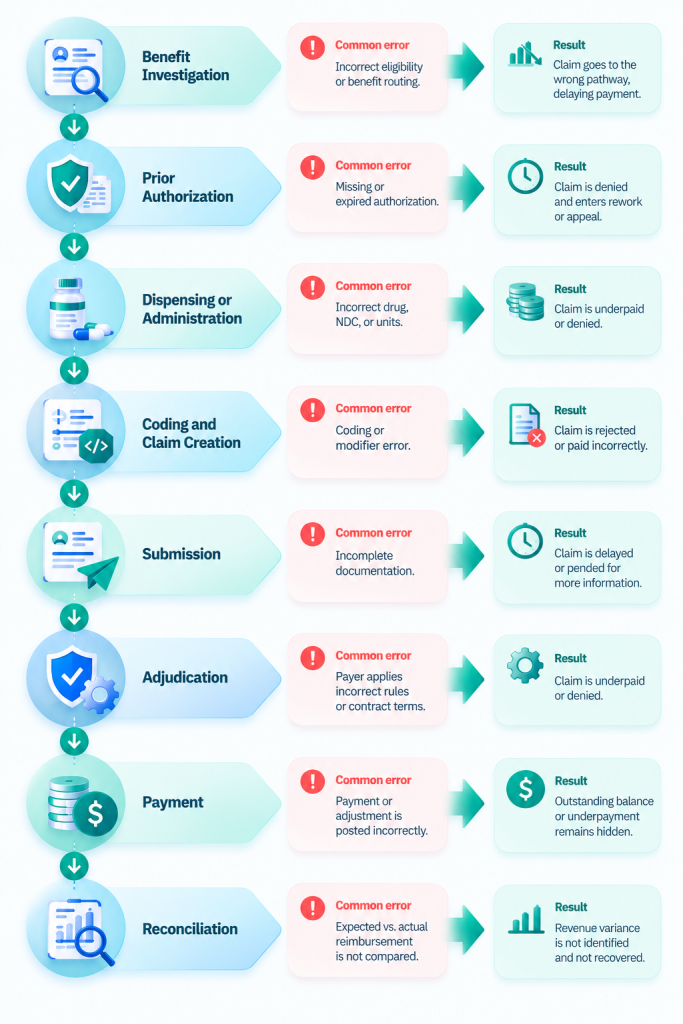
An error at one stage can affect everything that follows. Incorrect benefit routing can lead to the wrong authorization pathway. Incorrect drug information can affect claim construction. A posting error can hide a remaining balance after payment.
This matters particularly in specialty and infusion pharmacy, where high-cost therapies, medical and pharmacy benefits, authorization requirements, drug-specific billing rules, and payer requirements intersect.
See Where Pharmacy Billing Support Fits
From authorization and claim accuracy through reconciliation and revenue recovery, see how AnnexMed supports the workflows surrounding specialty and infusion pharmacy reimbursement.
Explore Our Pharmacy Billing ServicesSeven Pharmacy Billing Errors That Reduce Revenue
Pharmacy billing errors do not affect revenue in the same way. Some stop a claim before adjudication, while others allow the claim to move forward with incorrect reimbursement. Understanding where each error originates makes it easier to determine both the financial impact and the control needed to prevent recurrence.
- Incorrect Benefit Routing
A therapy may be covered under the pharmacy benefit, medical benefit, or a payer-specific arrangement depending on the drug, site of care, and plan. When the benefit pathway is identified incorrectly, the pharmacy may pursue authorization or submit the claim through the wrong route. The problem may not become visible until the payer rejects or denies the claim, leaving the billing team to correct work that began much earlier in the cycle.
Revenue impact: Rejection, denial, delayed payment, or incorrect reimbursement.
- Missing or Expired Prior Authorization
Obtaining authorization once does not mean every subsequent fill or treatment remains covered. Approval may be limited by effective dates, units, quantity, frequency, therapy, or treatment duration. If those conditions are not checked before dispensing or administration, the pharmacy may provide the therapy only to discover during adjudication that the authorization no longer supports the claim.
Revenue impact: Denial, rework, delayed cash, and aging AR.
For pharmacy teams managing recurring authorization issues, AnnexMed’s Prior Authorization and Appeals Services provides additional insight into authorization submission, reauthorization tracking, payer follow-up, and appeals.
- Incorrect NDC J Code or Units
Drug billing depends on accurately translating the product and quantity provided into the information required on the claim. Errors can occur when NDC information, HCPCS or J codes, package quantities, or billing units do not align with the drug administered or dispensed. With high-cost therapies, even a unit-level discrepancy can materially affect reimbursement and may require correction after adjudication.
Revenue impact: Rejection, denial, short payment, or claim correction.
For a closer look at how drug coding, NDC-to-HCPCS mapping, unit calculations, and modifier validation fit into specialty pharmacy billing, explore AnnexMed’s Specialty RCM Capabilities.
- Coding and Modifier Errors
Codes and modifiers tell the payer what service was provided and how the claim should be processed. A missing, incorrect, or payer-inappropriate modifier can change adjudication even when the underlying service and documentation are correct. When coding requirements vary by payer or billing pathway, relying on manual correction after rejection creates unnecessary rework and payment delay.
Revenue impact: Rejection, denial, incorrect reimbursement, or avoidable rework.
- Incomplete Documentation
A claim can contain the required billing fields and still lack sufficient supporting documentation. Payers may require records supporting medical necessity, authorization, therapy details, diagnosis, dosage, or other claim-specific information. When those records are incomplete or inconsistent with the billed service, the claim may be pending or denied and require additional documentation before reimbursement can proceed.
Revenue impact: Pended claims, denials, appeals, and delayed reimbursement.
- Payment Posting and Adjustment Errors
Revenue leakage can also occur after the payer has adjudicated the claim. Payments may be posted to the wrong balance, contractual adjustments may be applied incorrectly, or remaining patient or payer balances may be closed prematurely. When posting is treated as a transaction rather than a reconciliation step, outstanding revenue can disappear from routine follow-up even though the account appears complete.
Revenue impact: Distorted AR, hidden outstanding balances, and missed recovery opportunities.
- Missed Underpayments
An underpaid claim is particularly difficult to detect because the payer has already issued a payment. If the amount received is not compared with the expected reimbursement, a short payment may be posted and the claim marked as resolved. Repeated underpayments across the same payer, drug, or billing pathway can accumulate without appearing in standard denial reporting.
Revenue impact: Earned reimbursement remains unrecovered while the claim appears financially complete.
Underpayments can also become recurring when payer adjudication, contract terms, and billing workflows do not align. For a deeper look at these reimbursement gaps, explore our blog on Claim Underpayments in Managed Care Contracts 2026.
How One Pharmacy Billing Error Creates Multiple Revenue Problems
An expired authorization illustrates how quickly one error can spread through the revenue cycle.
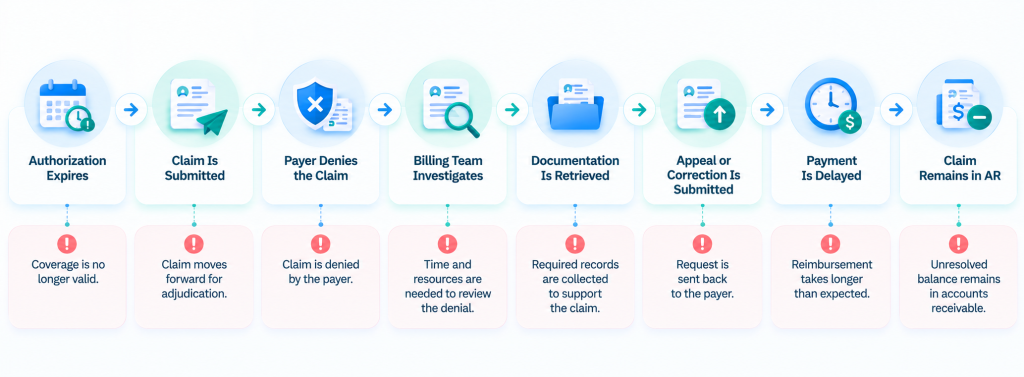
The pharmacy now carries more than a denial. The original authorization issue has created staff rework, delayed cash, payer follow-up, an aging receivable, and potentially less time to recover payment.
If the authorization process itself remains unchanged, another claim can enter the same cycle.
Why Paid Pharmacy Claims Can Still Leak Revenue
Denied claims are visible. Underpaid claims can be much harder to recognize. A payment creates the appearance that the revenue cycle has finished. But paid does not necessarily mean correctly reimbursed.
Revenue may still be lost when:
- Incorrect units reduce reimbursement
- Contracted reimbursement is applied incorrectly
- Partial payments are treated as final
- Payer adjustments are accepted without validation
- Incorrect modifiers affect payment
- Remaining balances are adjusted incorrectly
That is why payment reconciliation should be treated as a revenue control, not simply a posting activity.
Want to look beyond individual payment variances? Common Revenue Integrity Challenges and How to Solve Them blog examines how coding inaccuracies, documentation gaps, missed charges, payment variances, and underpayments can create revenue loss across the reimbursement cycle.
How to Prevent Revenue Leakage in Pharmacy Billing
Preventing pharmacy revenue leakage requires controls where errors enter the workflow, not only stronger follow-up after a denial or underpayment occurs.
Verify the Benefit Pathway Early
Confirm whether the therapy belongs under the medical or pharmacy benefit before authorization and billing begin. Validate payer, plan, therapy, and site-of-care requirements at the same point.
Keep Authorization Connected to Treatment
Track authorization status, effective dates, expiration dates, approved therapy, units, frequency, and reauthorization requirements. A valid authorization from an earlier treatment does not automatically mean the next claim is covered.
Validate Drug and Claim Data Before Submission
Check applicable NDC information, HCPCS or J codes, billed units, modifiers, and other required claim elements against source documentation.
The objective is simple: find the discrepancy before the payer does.
Maintain Payer Specific Billing Controls
Authorization, coding, documentation, filing, and appeal requirements can differ by payer. When requirements change, update the billing workflow and validation rules rather than relying on individual team members to remember the change.
Use Denials to Find Root Causes
Do not stop at correcting the denied claim. Categorize recurring denials by payer, drug or therapy, error source, and financial impact. Repeated authorization, coding, unit, or documentation failures should trigger a workflow correction.
Compare Expected and Actual Reimbursement
For claims with meaningful reimbursement exposure, compare:
Expected Payment → Actual Payment → Variance → Action
Unexplained variances should remain open until they are resolved, appropriately adjusted, or assigned for recovery.
Recurring underpayments can signal a broader reimbursement control issue rather than isolated payer variance. For a deeper look at the financial implications, explore our blog on when underpayment recovery requires executive attention.
When Paid Claims Still Leave Revenue Behind
See how AnnexMed identified payment variances and helped resolve 1,700 underpaid claims in six weeks.
View the Underpayment Recovery ResultsA Five Step Framework for Controlling Recurring Pharmacy Billing Errors
Recovering revenue addresses the financial consequence of a billing error. Preventing the same error from reaching another claim addresses the source.
A stronger pharmacy billing process should connect five actions:
Detect
Identify unusual denials, underpayments, unresolved balances, and reimbursement variances.
Trace
Follow the issue back to the authorization, documentation, drug or unit reporting, coding, submission, or payment stage where it originated.
Quantify
Determine how many claims are affected, the reimbursement at risk, and whether the issue is isolated or recurring.
Recover
Prioritize recoverable balances while payer filing, appeal, and reconsideration windows remain open.
Prevent
Correct the workflow, validation rule, payer-specific requirement, or ownership gap responsible for the error.
This distinction matters. A pharmacy may successfully recover an underpaid claim while the same billing defect continues affecting new claims. Sustainable revenue protection requires both recovery and prevention.
Prevent Pharmacy Billing Errors From Becoming Revenue Loss
Pharmacy billing performance should not be measured by how efficiently teams work denials after they occur. The stronger measure is how effectively the revenue cycle prevents the same authorization, coding, unit, payment, and reconciliation errors from creating the next denial or underpayment.
AnnexMed supports pharmacy organizations across the points where reimbursement can break down, from prior authorization and claim validation through payment reconciliation, underpayment identification, and AR recovery. This gives pharmacy organizations a more connected view of what caused the revenue loss, what can still be recovered, and what needs to change before the error reaches another claim.
The objective is not simply to work more pharmacy claims. It is to protect the reimbursement those claims were expected to generate.
Find the Revenue Gaps Behind Recurring Billing Errors
If authorization, coding, payment, or AR issues continue to affect reimbursement, AnnexMed can help identify where revenue is being lost and what needs to change upstream.
Review Your Pharmacy Revenue CycleFAQs
Common errors include incorrect benefit routing, missing or expired authorization, incorrect NDC or J code information, unit errors, coding and modifier issues, incomplete documentation, payment posting errors, and missed underpayments.
Errors can cause rejected claims, denials, delayed payment, incorrect reimbursement, underpayments, aging AR, write-offs, and additional rework. Leakage can also remain hidden when incorrectly paid claims are treated as resolved.
Yes. Payment may be below the expected amount because of units, payer adjustments, coding, modifiers, reimbursement terms, or other payment differences. Expected-versus-actual review helps identify these variances.
Recurring errors often indicate that individual claims are being corrected without addressing the upstream process responsible for the problem.
Pharmacies can strengthen benefit verification, authorization tracking, drug and claim validation, payer-specific billing controls, denial root-cause analysis, AR monitoring, payment reconciliation, and underpayment detection.