Last Updated on October 9, 2026
Wisdom tooth removal may be primarily dental, but some cases warrant evaluation under a patient’s medical benefits. Impacted third molars associated with infection, pathology, trauma, functional impairment, or other medical circumstances can create a more complex billing pathway.
The challenge is that dental-medical cross-coding for wisdom tooth removal is not a direct conversion from a CDT code to a CPT code. A medically evaluated claim must connect the diagnosis, medical necessity, surgical procedure, documentation, anesthesia, authorization, and payer requirements.
For dental practices and oral and maxillofacial surgery teams, getting that sequence right matters. A clinically appropriate procedure can still face delays or denials when the claim does not clearly show what was treated, why surgery was necessary, what was performed, and how the selected codes reflect the operative record.
Table of contents
- When Wisdom Tooth Removal May Qualify for Medical Billing
- Diagnosis and Medical Necessity for Impacted Wisdom Teeth
- D7230 and D7240 for Wisdom Tooth Removal
- Why CDT Does Not Convert Directly to CPT
- Anesthesia Coding and Documentation for Wisdom Tooth Surgery
- Documentation That Supports a Wisdom Tooth Medical Claim
- Where Wisdom Tooth Cross-Coding Claims Break Down
- Pre-Submission Checklist for Wisdom Tooth Medical Claims
- Turn Cross-Coding Complexity Into a Controlled Workflow
- FAQs
When Wisdom Tooth Removal May Qualify for Medical Billing
Not every wisdom tooth extraction belongs on a medical claim.
The appropriate claim pathway depends on the patient’s condition, medical and dental benefits, payer policy, provider eligibility, medical necessity, and procedure performed. Cases that may warrant medical-benefit evaluation can include impacted third molars associated with:
- Infection or significant inflammation
- Oral pathology
- Trauma or facial injury
- Functional impairment
- Certain systemic or medical conditions
- Surgical circumstances covered under the patient’s medical plan
Coverage should never be assumed simply because an extraction is surgical or the tooth is impacted. The practice should verify benefits, authorization requirements, provider status, and applicable medical policy before building the claim.
The goal is not to move every eligible-looking dental procedure to medical insurance. It is to identify the appropriate benefit pathway based on the documented clinical circumstances and payer requirements.
Diagnosis and Medical Necessity for Impacted Wisdom Teeth
Diagnosis coding establishes the condition being treated, but the diagnosis code alone does not establish coverage.
ICD-10-CM codes that may be relevant to wisdom tooth cases depend on the actual documented condition. Examples can include impacted teeth, disturbances in tooth eruption, and other diagnoses supported by the clinical record.
The stronger question is not simply:
What diagnosis code applies?
It is:
Does the clinical record explain why this diagnosis required the procedure being billed?
For an impacted third molar, documentation may need to establish factors such as:
- Location and type of impaction
- Pain or other symptoms
- Infection or inflammation
- Pathology
- Functional limitation
- Impact on adjacent structures
- Imaging findings
- Previous treatment
- Reason surgical intervention was selected
The diagnosis, clinical narrative, imaging, operative report, and procedure coding should support the same clinical story.
For a broader explanation of how procedure and diagnosis code sets interact on crossover claims, see AnnexMed’s guide to CDT vs CPT vs ICD-10-CM in medical-dental cross-coding.
D7230 and D7240 for Wisdom Tooth Removal
Two CDT codes frequently associated with impacted wisdom tooth removal are D7230 and D7240.
- D7230 describes removal of an impacted tooth that is partially bony.
- D7240 describes removal of an impacted tooth that is completely bony.
The appropriate CDT code depends on the procedure actually performed and the applicable current code descriptor. The operative documentation should support the level and nature of the impaction and surgical work reported.
The complexity begins when a case is evaluated for medical billing. A D7230 or D7240 dental code does not automatically convert into a specific CPT code.
Medical procedure reporting must reflect the actual service performed and the code set accepted by the payer. When no listed CPT code accurately represents the procedure, an unlisted code such as CPT 41899 may be considered based on the service and payer requirements.
Using an unlisted code requires stronger supporting documentation. The operative report should clearly describe:
- Anatomy and surgical site
- Nature of the impaction
- Incision and access where applicable
- Bone removal
- Tooth sectioning when performed
- Surgical technique
- Complexity of the procedure
- Reason the selected code accurately represents the service
The coding decision should come from the operative record, not from a static D7230-to-CPT or D7240-to-CPT crosswalk.
AnnexMed’s dental coding and claims processing services support CDT, CPT, ICD-10-CM, documentation, and payer-rule review for dental-medical claims.
Move Beyond a Simple CDT to CPT Crosswalk
AnnexMed evaluates the procedure, diagnosis, documentation, and payer requirements together to support more consistent medical crossover coding.
Explore Dental Coding SupportWhy CDT Does Not Convert Directly to CPT
CDT and CPT describe services within different coding systems. Even when both relate to the same encounter, they may describe the procedure from different perspectives.
A more structured cross-coding pathway looks like this:
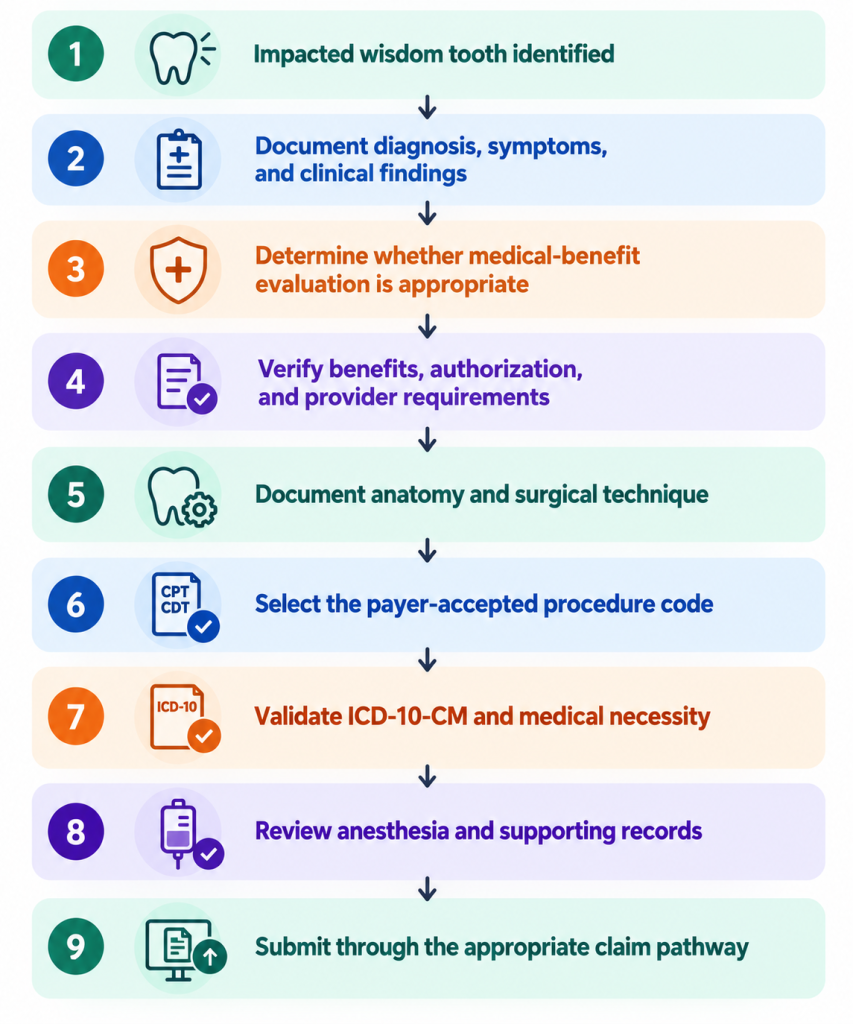
This is why cross-coding should begin before the claim reaches the coder. Waiting until after surgery to determine the medical pathway can leave the coding team without the authorization, documentation, or payer information needed to prepare the claim correctly.
Anesthesia Coding and Documentation for Wisdom Tooth Surgery
Anesthesia adds another layer to wisdom tooth cross-coding. The reporting requirements depend on factors such as:
- Type and depth of anesthesia or sedation
- Patient circumstances
- Provider administering the service
- Procedure performed
- Duration when time-based reporting applies
- Monitoring requirements
- Payer policy
- Whether the service is separately reportable
Practices should avoid applying a single anesthesia code to every wisdom tooth extraction. Dental and medical coding requirements differ, and payer-specific rules may affect whether and how anesthesia can be reported.
The record should clearly identify the anesthesia or sedation provided and include required time, monitoring, medications, provider information, and other supporting details where applicable.
For practices managing surgical and anesthesia billing together, AnnexMed’s oral and maxillofacial surgery billing guide provides additional context on the broader OMS revenue cycle.
Documentation That Supports a Wisdom Tooth Medical Claim
A medical payer reviewing a wisdom tooth claim needs enough information to understand both why the procedure was necessary and what was performed.
Depending on the case and payer, the supporting record may include:
Clinical condition
Document the patient’s chief complaint, symptoms, onset, duration, infection, inflammation, pathology, functional impact, or other relevant findings.
Imaging
Radiographs or other imaging should support the documented anatomy and clinical findings when relevant.
Medical necessity
The record should connect the condition to the reason extraction or surgery was required.
Surgical detail
The operative report should document the site, anatomy, impaction, surgical technique, bone removal, sectioning, and other relevant procedural details.
Anesthesia
When separately reported, applicable anesthesia or sedation documentation should support the service billed.
Authorization and payer requirements
Prior authorization, referrals, medical policy requirements, and other payer-specific documentation should be addressed when applicable.
Documentation consistency is just as important as completeness. Diagnosis coding, authorization, procedure coding, operative notes, and attachments should not tell different versions of the encounter.
Strengthen the Claim Before It Reaches the Payer
AnnexMed reviews coding, operative documentation, anesthesia details, authorization, and payer requirements to identify gaps before submission.
Review Your Cross-Coding WorkflowWhere Wisdom Tooth Cross-Coding Claims Break Down
Wisdom tooth crossover claims can encounter problems at several points in the workflow.
The Impaction and Procedure Coding Do Not Align
The selected code must reflect the procedure documented in the operative report. A code chosen from a generic crosswalk may not accurately represent the anatomy or surgical technique.
The Diagnosis Does Not Explain Medical Necessity
An impacted tooth diagnosis may identify the condition without fully explaining why the procedure required medical consideration. The record should connect clinical findings with treatment rationale.
The Operative Note Lacks Surgical Detail
This becomes especially important when an unlisted medical procedure code is used. Limited descriptions can make it difficult for the payer to understand what service was performed.
Anesthesia Documentation Is Incomplete
Missing time, monitoring, provider, or sedation details can create problems when anesthesia is separately reported.
Authorization and Final Treatment Do Not Match
The authorized procedure, diagnosis, and treatment actually performed should be reviewed before submission.
The Claim Is Built From a Static Crosswalk
A fixed CDT-to-CPT mapping cannot account for differences in technique, anatomy, documentation, or payer requirements.
For additional workflow risks, AnnexMed’s guide to common mistakes and coding pitfalls in dental cross-coding covers the broader issues that can affect dental-medical claims.
AnnexMed Observation
Wisdom tooth crossover claims can become harder to support when the medical billing decision is made only after the procedure using the CDT code as the starting point. Reviewing the potential medical pathway, authorization requirements, diagnosis, and expected documentation before surgery gives the coding team a more complete record to work with.
Pre-Submission Checklist for Wisdom Tooth Medical Claims
Before a wisdom tooth crossover claim is released, the practice should review the entire claim package rather than validating codes individually. Confirm:
- Is medical billing appropriate for the documented encounter?
- Were medical benefits verified?
- Was authorization obtained when required?
- Does the diagnosis reflect the documented condition?
- Is medical necessity clearly established?
- Does the procedure code match the surgical technique?
- Is an unlisted code adequately supported when used?
- Are modifiers supported by the record?
- Is anesthesia documentation complete when applicable?
- Are imaging and supporting records available?
- Does the payer accept the selected code set?
- Are the claim, authorization, clinical note, and operative report consistent?
Practices developing a broader crossover process can also use AnnexMed’s tips for implementing dental to medical coding to build these controls into everyday operations.
A pre-submission review cannot guarantee coverage or payment. It can, however, identify coding, documentation, authorization, and claim-preparation gaps before the payer encounters them.
Turn Cross-Coding Complexity Into a Controlled Workflow
Wisdom tooth medical billing requires dental coding, medical coding, clinical documentation, authorization, and payer requirements to work together. D7230 and D7240 may describe the dental procedure, but the medical claim must also establish the appropriate diagnosis, medical necessity, surgical details, and supporting documentation.
AnnexMed helps dental practices, DSOs, and OMS teams bring these elements into one controlled workflow through CDT and CPT review, ICD-10-CM alignment, medical-necessity validation, operative and anesthesia documentation review, payer-rule validation, pre-submission audits, and denial analysis.
The goal is not to route every wisdom tooth extraction through medical insurance. It is to identify appropriate crossover cases earlier and keep the diagnosis, procedure, documentation, and payer requirements aligned from the clinical record through claim submission.
Bring More Control to Complex Wisdom Tooth Claims
AnnexMed supports dental practices, DSOs, and OMS teams with dual coding review, documentation validation, payer-rule checks, and denial analysis across the crossover workflow.
Talk to a Dental Coding SpecialistFAQs
Some wisdom tooth removal cases may qualify for medical-benefit evaluation depending on the patient’s condition, benefits, medical necessity, payer policy, provider requirements, and procedure performed. An impacted tooth alone does not guarantee medical coverage.
D7230 and D7240 are CDT codes used for different categories of impacted tooth removal. The appropriate code should reflect the documented level of impaction and procedure performed under the current CDT definitions.
There is no universal one-to-one CPT equivalent for D7240. The appropriate medical procedure code depends on the actual surgical service, documentation, and payer requirements. When no listed CPT code accurately represents the service, an unlisted code may be considered where appropriate.
CPT 41899 is an unlisted procedure code for dentoalveolar structures. Its use depends on the procedure performed and payer requirements. When used, detailed operative documentation is important because the code itself does not provide a specific procedure description.
Documentation may include the diagnosis, symptoms, infection or pathology, functional impairment, examination findings, imaging, treatment rationale, surgical details, and other information required by the payer. The record should clearly connect the patient’s condition with the reason the procedure was necessary.