

Last Updated on July 30, 2026
A high-performing pathology practice depends on more than accurate laboratory testing. It also depends on a revenue cycle that captures every billable service, supports medical necessity, and converts completed tests into timely reimbursement. When coding, documentation, or billing workflows break down, revenue begins to leak long before a claim is denied.
Partner with Specialists in Pathology Revenue Cycle Management
AnnexMed delivers specialized pathology RCM that improves coding quality, reduces revenue leakage, and maximizes reimbursement. Talk to Our Pathology Experts
Talk to Our Pathology ExpertsPathology revenue leakage often develops without a single obvious red flag. Test volumes remain steady, specimens continue moving through the laboratory, and day-to-day operations appear unchanged. Yet coding inaccuracies, documentation gaps, billing process inefficiencies, and payer-specific reimbursement requirements can quietly reduce collections and delay cash flow. That is what a leaking pathology revenue cycle looks like: revenue that was earned but never fully captured.
The stakes are higher than a routine billing inefficiency. Every point of pathology revenue leakage compresses already-thin margins on high-volume, low-reimbursement tests, stretches days in accounts receivable (A/R), and, when payer requirements are not met, creates additional compliance and reimbursement challenges.
Pathology billing is uniquely complex. Dense CPT code sets, frequent modifier requirements, and payer-specific coverage policies across Medicare, Medicaid, and commercial insurers all contribute to a more challenging reimbursement environment. When these requirements are combined with fragmented billing workflows, even small process gaps can lead to significant financial losses over time.
Below, we break down where pathology revenue leakage occurs, the factors that contribute to it, and the practical strategies pathology practices can implement to identify hidden gaps, improve reimbursement accuracy, and build a more predictable revenue cycle.
Table of contents
- Where Revenue Leakage Occurs in the Pathology Revenue Cycle?
- Common Causes of Pathology Revenue Leakage
- Diagnosing Revenue Leakage in the Pathology Revenue Cycle
- Practical Fixes to Stop Pathology Revenue Leakage
- Pathology Revenue Cycle KPIs That Matter
- Specialized Pathology RCM Built to Protect Revenue
- FAQs
Where Revenue Leakage Occurs in the Pathology Revenue Cycle?
Revenue leakage rarely begins with a denied claim. In pathology, financial losses often develop much earlier as specimens move through accessioning, coding, billing, and payment workflows. Because pathology reimbursement depends on accurate charge capture, complete documentation, and payer-specific billing requirements, even minor breakdowns can create downstream reimbursement challenges.
Common Signs of a Leaking Pathology Revenue Cycle
- Increasing denial rates for surgical pathology, molecular diagnostics, or special stains.
- Growing days in A/R despite stable specimen volumes.
- Frequent underpayments for high-complexity pathology services.
- Missed or delayed charge capture resulting in lost reimbursement opportunities.
- Inconsistent net collection rates across Medicare, Medicaid, and commercial payers.
- Repeated claim corrections or manual rework before payment.
Several characteristics make pathology particularly vulnerable to revenue leakage. Practices often process large test volumes with relatively low reimbursement per case, rely on complex CPT coding for surgical pathology and molecular diagnostics, and navigate varying payer coverage policies for specialized laboratory testing. Without standardized revenue cycle controls, these factors can gradually erode financial performance without creating an obvious operational issue.
Revenue leakage in pathology rarely stems from a single problem. It typically develops through multiple small coding, documentation, billing, and reimbursement gaps that accumulate across the revenue cycle. Identifying where those gaps occur is the first step toward improving reimbursement performance.
Common Causes of Pathology Revenue Leakage
Once revenue leakage is identified, the next step is understanding what causes it. In pathology, reimbursement problems rarely result from a single mistake. More often, they develop through a combination of coding inaccuracies, documentation deficiencies, billing workflow inefficiencies, and payer-specific reimbursement requirements. Addressing these underlying issues helps pathology practices reduce preventable denials, improve claim accuracy, and strengthen overall revenue cycle performance.
Coding Errors
Accurate CPT coding is the foundation of pathology reimbursement. Because pathology services often involve surgical specimens, special stains, immunohistochemistry, and molecular testing, selecting the appropriate procedure code can be challenging. Even small coding inaccuracies may lead to underpayments, delayed reimbursement, or claim denials.
Common coding issues include:
- Incorrect selection of surgical pathology CPT codes (88300–88309 series)
- Reporting inappropriate codes for special stains or immunohistochemistry
- Coding molecular or genetic testing without meeting payer requirements
- Incorrect application of modifiers such as 26, TC, 59, or 90
- Missing add-on codes when additional pathology services are performed
Impact: Coding inaccuracies increase claim edits, manual rework, reimbursement delays, and compliance risk.
Documentation Gaps
Even when the correct CPT code is reported, reimbursement depends on documentation that supports medical necessity and accurately reflects the services performed. Incomplete pathology reports or missing clinical information often result in medical necessity denials, particularly for high-complexity testing.
Common documentation gaps include:
- Missing or incomplete pathology findings
- Insufficient clinical indications supporting advanced diagnostic testing
- Inadequate documentation for molecular or genetic testing
- Lack of diagnosis-to-procedure linkage
- Missing physician authentication or incomplete reports
Impact: Poor documentation weakens claim support, increases audit exposure, and contributes to avoidable payment delays.
Billing Process Gaps
Many pathology revenue leaks occur after coding is completed. Manual billing processes, inconsistent quality checks, and inefficient workflows can introduce errors before a claim reaches the payer.
Common billing process issues include:
- Manual charge entry mistakes
- Delayed charge capture
- Missing pre-bill quality reviews
- Incomplete claim edits before submission
- Slow denial follow-up and appeals
These operational gaps often remain unnoticed until A/R begins to increase or reimbursement trends decline.
Impact: Inefficient billing workflows reduce clean claim rates and increase administrative effort throughout the revenue cycle.
Payer Policy Variations
Pathology reimbursement requirements vary significantly across Medicare, Medicaid, and commercial insurers. Coverage policies for molecular diagnostics, special stains, and advanced laboratory testing frequently differ by payer, making consistent billing more complex.
Common payer-related challenges include:
- Failure to follow Local Coverage Determinations (LCDs) or National Coverage Determinations (NCDs)
- Differences in medical necessity requirements across payers
- Varying prior authorization requirements for specialized testing
- Inconsistent reimbursement policies for molecular and genetic diagnostics
Practices that do not routinely monitor payer policy updates may experience increasing denials despite maintaining accurate coding practices.
Impact: Payer policy mismatches contribute to recurring denials, underpayments, and unnecessary claim rework.
Identifying these root causes provides a clear starting point for strengthening the pathology revenue cycle before financial losses continue to accumulate.
Stop Revenue Leakage Before It Impacts Cash Flow
AnnexMed helps pathology practices uncover hidden billing inefficiencies and improve reimbursement through specialized revenue cycle management.
Talk to UsDiagnosing Revenue Leakage in the Pathology Revenue Cycle
Fixing revenue leakage begins with identifying exactly where reimbursement is being lost. Rather than focusing only on denied claims, pathology practices should evaluate coding accuracy, workflow performance, payer trends, and financial metrics across the entire revenue cycle. A structured review helps uncover hidden inefficiencies before they become recurring financial losses.
Step 1 – Analyze Revenue Cycle Performance
Begin by analyzing revenue cycle performance to identify patterns that indicate potential leakage. Reviewing data by payer, CPT code, and service line provides a clearer picture of where reimbursement is being affected.
Focus on metrics such as:
- Denial rates by CPT code and payer
- Days in A/R across pathology service lines
- Underpayment trends by payer
- Net collection rates
- Clean claim rate
Pay particular attention to high-volume services such as surgical pathology, molecular diagnostics, and immunohistochemistry, as small reimbursement issues in these areas can have a significant financial impact.
Step 2 – Audit High Volume Pathology CPT Codes
A code-level audit helps determine whether pathology services are being reported accurately and reimbursed appropriately. Rather than reviewing every claim, prioritize the CPT codes that generate the highest claim volume or revenue.
During the audit, verify:
- Appropriate CPT code selection
- Correct modifier usage
- Complete diagnosis-to-procedure linkage
- Missed add-on or ancillary procedure codes
- Expected reimbursement versus actual payment
Regular audits help identify coding trends before they result in widespread denials or underpayments.
Step 3 – Evaluate Revenue Cycle Workflows
Revenue leakage is often the result of operational bottlenecks rather than isolated coding mistakes. Reviewing the claim lifecycle helps determine where delays or manual errors are introduced. Assess each stage of the workflow:
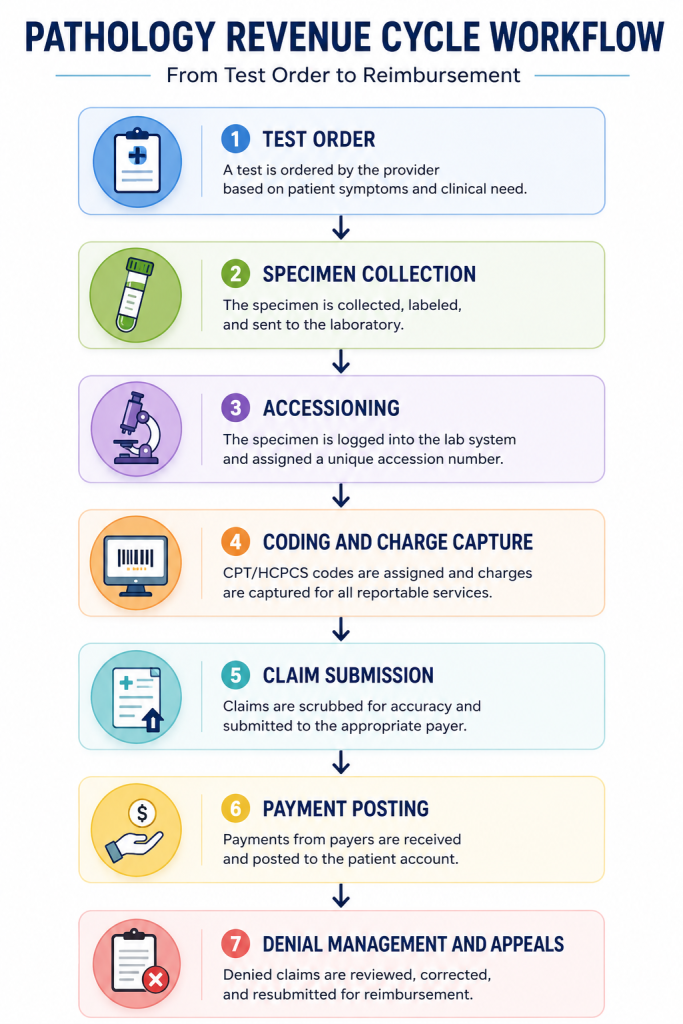
During the review, look for:
- Delayed charge entry
- Manual claim corrections
- EDI transmission errors
- Slow denial follow-up
- Repeated claim rework before submission
Identifying workflow inefficiencies allows practices to focus improvement efforts where they will have the greatest impact.
Step 4 – Review Payer Policies and Coverage Requirements
Payer policies change frequently, particularly for pathology, molecular diagnostics, and specialized laboratory testing. Comparing internal billing practices against current payer requirements helps prevent recurring reimbursement issues.
Review areas such as:
- Local Coverage Determinations (LCDs)
- National Coverage Determinations (NCDs)
- Prior authorization requirements
- Medical necessity criteria
- Payer-specific billing and documentation guidelines
Routine policy reviews help ensure that coding and billing processes remain aligned with evolving reimbursement requirements.
Diagnosing pathology revenue leakage requires more than reviewing denied claims. A structured evaluation of revenue cycle data, high-volume CPT codes, billing workflows, and payer policies helps identify where reimbursement is being lost and provides the information needed to implement targeted improvements before financial losses continue to grow.
Practical Fixes to Stop Pathology Revenue Leakage
Once the source of revenue leakage has been identified, the next step is implementing targeted improvements. Rather than relying on a single solution, high-performing pathology practices strengthen their revenue cycle through standardized coding, workflow controls, automation, staff education, and continuous performance monitoring. These improvements help reduce preventable denials, improve reimbursement accuracy, and create a more predictable revenue cycle.
Standardize Coding for High-Risk Pathology Services
Consistent coding practices help reduce variability and improve claim accuracy, particularly for high-volume pathology procedures. Establishing standardized coding guidelines ensures that similar services are reported consistently across providers and coders.
Focus on standardizing:
- Surgical pathology CPT codes (88300–88309 series)
- Special stains and immunohistochemistry coding
- Molecular and genetic testing procedures
- Modifier usage for pathology services
- Add-on code reporting where applicable
Benefit: Standardized coding improves coding consistency, reduces manual corrections, and supports more accurate reimbursement.
Implement Pre-Bill Coding and Documentation Reviews
Many reimbursement issues can be prevented before a claim reaches the payer. Pre-bill reviews help identify coding inaccuracies, documentation gaps, and billing errors while corrections are still easy to make.
Prioritize reviews for:
- High-value pathology claims
- Molecular and genetic testing
- Surgical pathology procedures
- Claims requiring multiple CPT codes or modifiers
- Services with historically high denial rates
Expected Outcome: Pre-bill reviews improve clean claim rates and reduce downstream claim rework.
Automate Claim Scrubbing and Edit Validation
Manual claim reviews alone are often insufficient for high-volume pathology operations. Automated claim scrubbing helps identify coding inconsistencies, missing information, and payer edit failures before claims are submitted.
Effective claim scrubbing should validate:
- CPT and ICD-10-CM code combinations
- Modifier requirements
- National Correct Coding Initiative (NCCI) edits
- Medical necessity requirements
- Missing claim information
Operational Advantage: Automated claim validation reduces preventable denials and improves first-pass claim acceptance.
Keep Coding Teams Updated on Payer Requirements
Pathology reimbursement requirements continue to evolve as Medicare, Medicaid, and commercial payers update coverage policies and documentation expectations. Ongoing education helps coding and billing teams remain aligned with current requirements.
Training should include:
- Annual CPT and ICD-10-CM updates
- LCD and NCD changes
- Payer-specific laboratory billing requirements
- Documentation expectations for complex pathology services
- Common denial trends and corrective actions
Impact: Regular education reduces coding inconsistencies and strengthens long-term compliance.
Pathology Revenue Cycle KPIs That Matter
Monitoring financial performance is just as important as improving coding accuracy. These KPIs help pathology practices measure reimbursement performance, identify emerging risks, and evaluate whether revenue cycle improvements are producing measurable results.
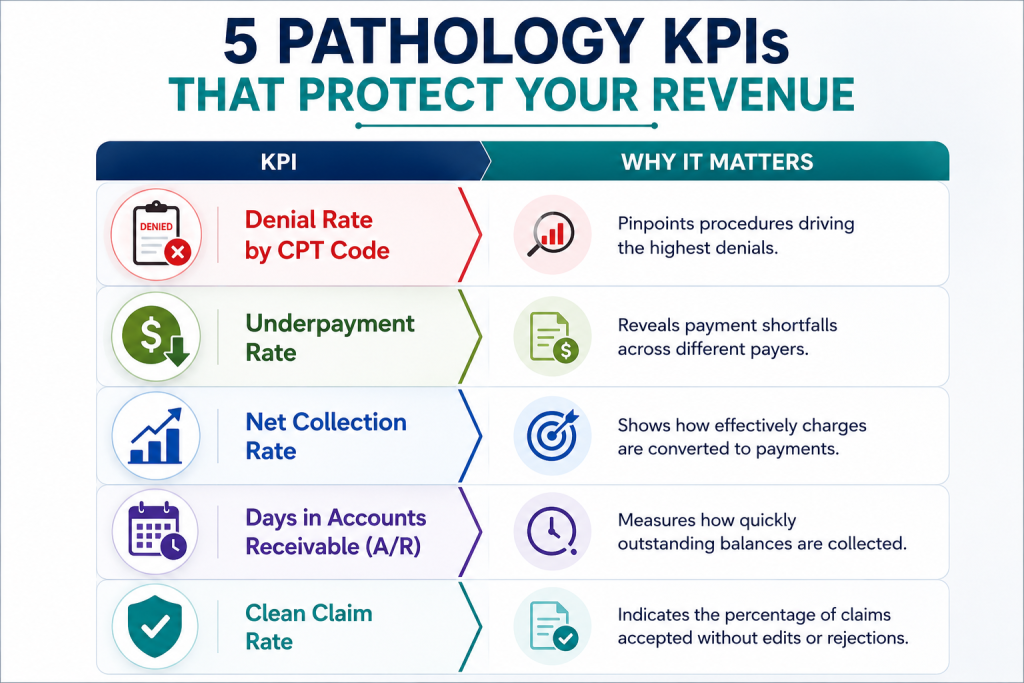
Monitoring these KPIs helps practices identify trends early and make data-driven improvements before reimbursement performance declines.
Specialized Pathology RCM Built to Protect Revenue
Pathology reimbursement depends on far more than accurate claim submission. Complex CPT coding, molecular diagnostics, professional and technical component billing, and evolving payer requirements require a revenue cycle partner with deep pathology expertise. Without the right processes in place, coding inaccuracies, documentation gaps, and payer-specific billing challenges can quietly reduce reimbursement and increase administrative burden.
AnnexMed delivers pathology-focused revenue cycle management designed to strengthen coding accuracy, improve documentation quality, reduce preventable denials, and maximize reimbursement across the pathology billing lifecycle.
How AnnexMed Supports Pathology Practices
- Specialty pathology coding expertise to improve coding accuracy and reimbursement consistency.
- Documentation validation that strengthens medical necessity and supports compliant claim submission.
- Payer-specific billing workflows that reduce claim edits and accelerate payment turnaround.
- Underpayment analysis and recovery to identify missed reimbursement opportunities across payers.
- Proactive denial management and appeals to improve collections and reduce preventable revenue loss.
- Actionable revenue cycle reporting that provides greater visibility into financial performance and operational trends.
Rather than operating solely as an outsourced billing provider, AnnexMed works as an extension of your pathology revenue cycle team, strengthening charge capture, coding, billing, payment reconciliation, and accounts receivable workflows. The result is a more efficient pathology revenue cycle that supports consistent reimbursement, stronger financial performance, and long-term operational stability.
Build a Stronger Pathology Revenue Cycle
From charge capture and coding quality to denial prevention and underpayment analysis, AnnexMed helps pathology practices strengthen every stage of the revenue cycle.
Schedule a MeetingFAQs
Coding errors, missing documentation, manual charge entry mistakes, and overlooked payer policies are the most frequent sources of revenue leakage. These issues often go unnoticed until they result in claim denials, underpayments, or increasing accounts receivable.
Surgical pathology codes (the 88300 series), special stain codes (88341–88342), and molecular profiling codes carry the highest error and denial risk. Because these services often involve complex documentation and payer-specific requirements, they require careful coding and claim review.
Compare actual payments to expected fee schedules by code and payer, and track underpayment rate as an ongoing metric rather than a one-time check. Regular payment variance analysis helps identify recurring reimbursement gaps and supports timely recovery efforts.
Denial rate by code, underpayment rate, net collection rate, days in A/R, and clean claim rate are the core metrics to track consistently. Monitoring these KPIs over time helps identify trends early and supports data-driven revenue cycle improvements.
Yes. When paired with lab-specific rules and regular audits, automated claim scrubbing reduces manual errors and catches issues before they become denials. However, automation is most effective when supported by accurate coding, complete documentation, and ongoing quality oversight.