Last Updated on November 2, 2026
A completed endoscopy report does not automatically mean a gastroenterology claim is ready for submission. The report must contain enough clinical and procedural detail to support CPT code selection, diagnosis assignment, medical necessity, modifiers, and any separately reportable services.
For gastroenterology practices and endoscopy centers, documentation gaps can arise when the scheduled procedure differs from what was performed, a lesion is removed without a clearly documented technique, or the procedure is discontinued before reaching its intended extent.
These discrepancies can lead to coding queries, delayed claims, incorrect reimbursement, and avoidable denials.
This GI procedure documentation checklist follows the information from the endoscopy report through coding validation and final claim submission, helping billing teams identify what to verify, where documentation commonly breaks down, and when clarification is required.
What Makes a GI Procedure Report Ready for Billing?
An endoscopy report should establish three things: why the procedure was performed, what actually occurred, and which services the documentation supports.
The billing team must be able to connect the clinical indication with the completed procedure, findings, interventions, and final diagnosis.
Five Documentation Elements That Support GI Claims
These elements must be internally consistent.
For example, a report may document that a colonoscopy was planned for screening, but the procedure findings may show that a polyp was removed. The final claim must reflect the documented indication, actual intervention, and applicable payer requirements.
The distinction becomes particularly important when selecting procedure codes, diagnosis codes, and screening-related modifiers.
Are Documentation Gaps Delaying Your GI Claims?
Identify inconsistencies between endoscopy reports, procedure coding, and charge records before they affect claim submission.
GI Procedure Documentation Checklist: What to Verify Before Coding
A structured review should begin with the completed clinical record rather than the charge ticket alone.
The following checklist groups documentation requirements according to when the information is created and how it supports claim accuracy.
| Documentation area | What the report or record should establish | Billing validation |
|---|---|---|
| Patient and encounter | Correct patient, procedure date, performing provider, and service setting | Match the clinical record with the billing encounter |
| Procedure indication | Screening, surveillance, diagnostic symptoms, or therapeutic purpose | Validate diagnosis selection and payer coverage requirements |
| Procedure performed | Actual endoscopic procedure and anatomical region examined | Match the GI CPT code to the documented service |
| Procedure extent | Maximum extent reached, relevant landmarks, and completion status | Determine whether the documentation supports a complete or incomplete procedure |
| Findings | Lesion location, size when relevant, characteristics, and clinical observations | Support diagnosis and procedure code selection |
| Interventions | Biopsy, polypectomy, dilation, hemostasis, or other treatment | Confirm technique, site, and applicable CPT code |
| Specimens | Tissue obtained, anatomical source, and pathology submission | Reconcile documented specimens with pathology records |
| Procedure outcome | Completion, interruption, complications, and recommendations | Review coding and modifier implications |
| Final authentication | Completed and authenticated procedure report | Resolve missing or conflicting information before claim release |
Why the Procedure Indication Matters
The reason for an endoscopy influences how the claim is evaluated.
A screening colonoscopy, surveillance colonoscopy, and diagnostic colonoscopy may involve similar procedural steps, but they do not necessarily have the same diagnosis, reporting, coverage, or patient cost-sharing implications.
The documentation should preserve the original indication even when findings during the procedure require additional intervention.
For example, removing a polyp during a screening colonoscopy does not erase the reason the examination was initially scheduled. The coding team must determine how the screening indication, findings, and therapeutic procedure should be reported under the applicable payer policy.
Procedure-Specific Documentation: Colonoscopy, EGD, and Therapeutic Endoscopy
Not every GI procedure requires the same documentation checks.
A colonoscopy report emphasizes examination extent, findings, and removal techniques. An upper endoscopy report must establish the anatomical structures examined and any interventions performed. Therapeutic procedures may require additional details about the treatment technique and the circumstances supporting the service.
| Procedure | Critical documentation checks |
|---|---|
| Colonoscopy | Indication, extent reached, bowel preparation quality, findings, completion status |
| EGD | Anatomical extent examined, findings, biopsy sites, interventions performed |
| Biopsy | Tissue sampling method, anatomical location, and specimen documentation |
| Polypectomy | Polyp location, removal technique, number of lesions, and relevant findings |
| Dilation | Site treated, dilation method, and documented procedure details |
| Hemostasis | Bleeding site, treatment method, and whether treatment is separately reportable |
Colonoscopy Documentation
For colonoscopy, the report should establish the extent of examination, including relevant anatomical landmarks and whether the intended examination was completed.
When a lesion is removed, the documentation must identify the technique used. Biopsy, snare removal, and other methods can support different CPT code selections.
A report stating only “polyp removed” may not provide enough information to select the correct therapeutic code.
Coders should also distinguish lesion count from reportable procedure units. Multiple interventions do not automatically justify multiple separately payable services. Applicable coding conventions, NCCI edits, and payer requirements must be considered.
Accurate gastroenterology CPT code selection depends on matching documented interventions with the procedure performed, anatomical site, and applicable coding requirements.
Upper Endoscopy Documentation
For esophagogastroduodenoscopy (EGD), documentation should identify the anatomical extent examined and the procedures performed.
When biopsies or therapeutic interventions occur, the report should support their anatomical locations and techniques.
A report describing an intervention without specifying the method or site may require clarification before coding.
Therapeutic Endoscopy Documentation
Therapeutic procedures require particular attention because the final intervention may differ from the original plan.
For example, a procedure scheduled for diagnostic evaluation may result in dilation, lesion removal, or bleeding control.
The coding team should confirm that the report describes the actual service and supports any additional procedure code. When multiple interventions occur during the same encounter, separate reporting must be assessed under applicable CPT and payer rules.
From Endoscopy Report to Claim: A Five-Step Validation Workflow
GI documentation should move through a defined review process before a claim is submitted.
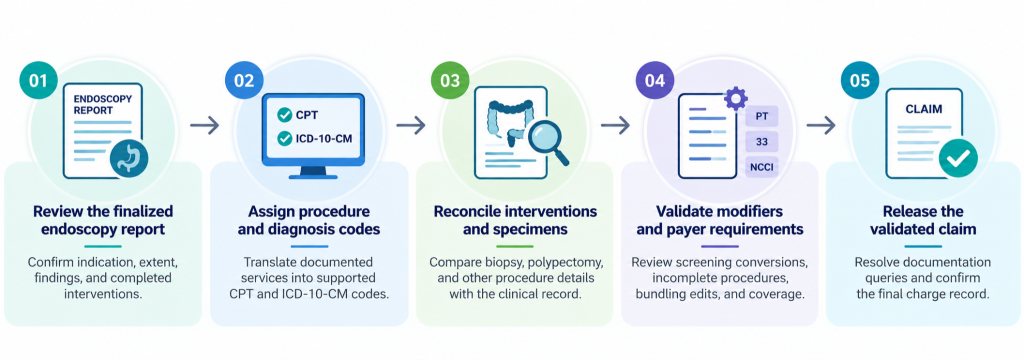
Step 1: Review the Finalized Endoscopy Report
Coding should be based on the completed procedure documentation.
The report should distinguish the intended examination from the actual services performed and explain any relevant change in procedure scope.
Step 2: Validate CPT and Diagnosis Selection
The selected CPT code must reflect the documented intervention, not merely the scheduled procedure.
Diagnosis codes should be supported by the clinical indication and findings, following applicable coding guidelines.
Step 3: Reconcile Interventions and Specimens
When biopsies or polypectomies are performed, compare the documented sites and techniques with the procedure record and available specimen information.
The objective is to identify inconsistencies, not to assume that each specimen represents a separately billable procedure.
Step 4: Apply Modifier and Payer Validation
Modifier selection requires review of the circumstances documented in the report.
For example, Medicare modifier PT may apply when a colorectal cancer screening test is converted to a diagnostic or therapeutic procedure. Modifier 33 is used for qualifying preventive services under applicable reporting rules. These modifiers are not interchangeable, and payer requirements can differ.
Incomplete or discontinued procedures also require careful evaluation of the service setting, extent completed, and applicable coding guidance.
Step 5: Confirm Claim Readiness
Before claim release, verify that the procedure report, assigned codes, diagnoses, modifiers, and charges are consistent.
If the documentation is insufficient, a compliant provider query should resolve the uncertainty rather than relying on coder assumptions.
Where GI Documentation Gaps Change Claim Outcomes
Some documentation gaps are administrative. Others directly affect the procedure code, reimbursement methodology, or claim eligibility.
The distinction matters because not every error can be resolved through routine claim editing.
| Documentation gap | Potential billing consequence | Recommended action |
|---|---|---|
| Screening indication not clearly recorded | Incorrect diagnosis or modifier selection | Verify the original procedure indication |
| Polyp removal technique missing | Unsupported or incorrect CPT selection | Request clarification of the documented intervention |
| Colonoscopy extent unclear | Incorrect complete or incomplete procedure reporting | Confirm anatomical landmarks and completion status |
| Multiple interventions poorly differentiated | Duplicate or unsupported procedure charges | Review each intervention against CPT and NCCI requirements |
| Specimen locations inconsistent | Coding or pathology reconciliation discrepancies | Compare the procedure and specimen records |
| Final report differs from charge ticket | Omitted or inaccurate procedure charges | Reconcile the final report against charge entry |
| Incomplete procedure reason missing | Modifier or reimbursement errors | Clarify why the procedure was not completed |
Why These Errors Can Persist Beyond Initial Coding
Documentation discrepancies are not always detected at charge entry.
A claim may pass basic formatting edits even when the underlying report does not fully support the selected code. The issue may surface later through payer review, requests for records, or denial investigation.
Recurring gastroenterology billing errors therefore need to be examined at their source, including procedure documentation, coding interpretation, and charge transfer.
Find the Root Causes Behind Recurring GI Claim Denials
Understand how documentation, coding, and billing workflow issues contribute to repeat denials and where corrective action should begin.
Before the GI Claim Is Submitted: Final Verification Checklist
Pre-Submission GI Claim Review
A completed checklist should not be treated as evidence that every claim is payable. Its purpose is to establish that the claim is supported by the available documentation and has passed the practice’s coding and billing controls.
For organizations with recurring coding discrepancies, periodic medical coding audits can help distinguish isolated documentation errors from broader workflow problems.
How Gastroenterology Practices Can Measure Documentation Quality
Documentation quality should be evaluated through operational measures that connect clinical records with coding and claim outcomes.
| Measure | What it reveals |
|---|---|
| Documentation clarification rate | Frequency of reports requiring provider queries |
| Procedure-to-charge match rate | Differences between completed procedures and billed services |
| Coding correction rate | CPT, diagnosis, or modifier changes before submission |
| Report finalization turnaround | Time between procedure completion and an authenticated report |
| Documentation-related denial rate | Claims denied due to missing or insufficient documentation |
| Claim hold time | Delays caused by unresolved documentation discrepancies |
These measures should be reviewed by procedure type, provider, location, and payer where practical.
A high clarification rate does not always indicate poor documentation. It may initially reflect a more thorough coding review. The more useful question is whether the same documentation gaps continue to recur.
For gastroenterology practices, connecting documentation review with gastroenterology billing operations helps identify where procedure reporting, coding, and charge capture need better coordination.
Strengthening GI Claim Accuracy Starts With Complete Procedure Documentation
Accurate gastroenterology billing depends on more than selecting the correct CPT code. The clinical indication, completed procedure, findings, interventions, and charge record must support the same encounter.
When these records are inconsistent, billing teams may face coding queries, delayed submissions, avoidable denials, or reimbursement discrepancies.
AnnexMed supports gastroenterology practices through specialty coding, documentation validation, charge reconciliation, and revenue cycle management. Connecting these functions helps identify claim discrepancies earlier and address recurring documentation gaps across the billing workflow.
Improve GI Documentation and Claim Accuracy
Evaluate how your endoscopy reports, procedure coding, and charge validation processes work together before claims are submitted.
FAQs
The report should establish the procedure indication, examination extent, relevant findings, interventions performed, completion status, and final authenticated documentation. When biopsies or polypectomies occur, the technique and anatomical location should support CPT code selection.
It can change the procedure code and modifier requirements. The original screening indication should remain documented, while the actual therapeutic intervention must be reported according to the applicable payer rules.
Different removal techniques can support different CPT codes. A report that only states a polyp was removed may not contain enough detail for accurate code selection.
Potentially, but separate reporting depends on the documented services, applicable CPT conventions, NCCI edits, and payer requirements. Multiple findings or specimens do not automatically establish separate billable procedures.
The coder should identify the missing information and seek a compliant clarification from the appropriate provider. Unsupported procedure details should not be inferred solely from the scheduled service or charge ticket.