
Last Updated on July 20, 2026
There are days when 43235 is the quiet hero, clean, diagnostic, brush/wash if needed, done. Other days it’s a trap door into denials. This blog shows the judgment calls that separate clean claims from headaches, with the exact documentation lines that keep auditors happy.
Table of contents
New Updates About CPT 43235?
In 2026, CPT 43235 (EGD – diagnostic upper GI endoscopy) usage is now more tightly regulated due to new codes and payer edits.
No Direct Descriptor Change
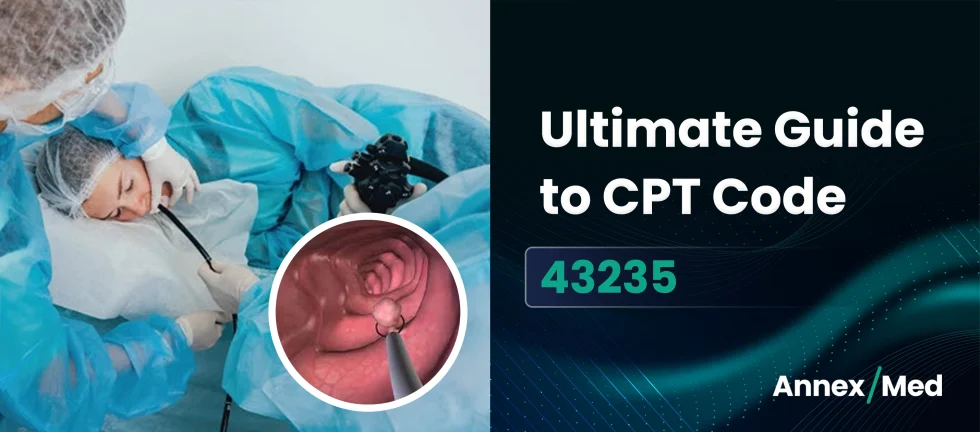
- CPT 43235 still describes esophagogastroduodenoscopy (EGD), diagnostic, with or without collection of specimen(s) by brushing or washing.
- No new work RVU or descriptor changes were published for 2026.
Bundling With New Code 43889
- CPT 43889 (endoscopic sleeve gastroplasty) was introduced in 2026.
- Do not report 43235 with 43889 as payers will deny as bundled.
- This reflects AMA’s effort to prevent double billing when diagnostic EGD is performed as part of bariatric endoscopy.
Global Period Clarifications
- CPT 43235 remains a 0‑day global period service.
- By contrast, 43889 carries a 90‑day global period, meaning follow‑up E/M is bundled.
- Practices must distinguish between diagnostic EGDs and therapeutic bariatric procedures to avoid compliance issues.
Your Partner in GI Revenue Performance
Whether it’s CPT 43235, biopsy coding, modifier compliance, or denial management, AnnexMed helps practices protect revenue across the entire billing cycle.
Schedule a MeetingWhat CPT 43235 really is
CPT 43235 reports a flexible, trans-oral diagnostic EGD, examining the esophagus, stomach, and typically the second part of the duodenum. You can collect specimens by brushing or washing and still report 43235, as long as no tissue is removed and no therapeutic work is performed. Document indication, extent reached, segmental findings, specimens collected, and post-procedure status for medical necessity and LCD compliance.
For GI-specific workflows, explore our gastroenterology billing services.
Do not use 43235 if any of the following occur in the same session:
| What Happened | Correct Code | Why 43235 Doesn’t Work |
| Biopsy taken (one or many) | 43239 | Diagnostic endoscopy bundled into surgical endoscopy |
| Bleeding control (thermal, clipping, injection) | 43255 | Therapeutic code is comprehensive service for session |
| Dilation of stricture | 43249 | Therapeutic code replaces diagnostic code |
| Foreign body removal | 43247 | Therapeutic code is comprehensive service |
| EUS performed | 43237–43242 | EUS codes replace base diagnostic EGD code |
Core rule to remember: Surgical endoscopy includes diagnostic endoscopy. If a more extensive upper-GI endoscopic service is performed, report only the single most comprehensive code, never stack 43235 with another EGD family code. NCCI edits prevent bundling violations.
Real-world scenarios with CPT Code 43235
These are the patterns coders see most. Each case outlines the correct code, the NCCI logic that prevents unbundling, the LCD cues that prove necessity, and the exact documentation to include. If the work changes, we point to the right endoscopy code so you do not stack or overcode.
Casefile #1 – Anemia Workup with Brushings, No Tissue Removed
Scenario: Iron-deficiency anemia with melena. Endoscopist advances to D2, documents segmental findings, and takes brushings only. No biopsy or therapy.
Code: 43235 (diagnostic EGD).
Why it pays: Brush/wash is included in 43235. Anchor medical necessity to your MAC’s LCD for Upper-GI Endoscopy and state the extent reached. Latest LCD requirements explicitly include anemia with melena as covered indication
Audit-friendly note lines: “EGD (diagnostic). Indication: melena with iron-deficiency anemia (meets LCD criteria). Extent: to D2. Specimens: brushings only; no biopsy/therapy. Post-procedure: stable.”
Sedation check:
- Medicare: if the same physician/QHP provides moderate sedation, report G0500 (first 15 min) + 99153 (each additional 15). Document intra-service time and an independent trained observer. CY 2026 conversion factor $33.57 applies
- Commercial: Typically 99152/99153 when moderate sedation is by the same physician/QHP. Verify payer-specific policies before billing.
- If an anesthesia professional provides deep sedation/GA: Bill anesthesia codes per payer policy. Do not bill G0500/99153 with anesthesia professional present
Casefile #2 – Planned Diagnostic, Then You Took a Bite
Scenario: Dysphagia evaluation. Mucosal abnormality → biopsy taken.
Code: 43239 only.
Why: The moment tissue is removed, the diagnostic service is bundled into the surgical endoscopy. Reporting 43235 + 43239 will trigger edits. NCCI edits and automatic denials. 2026 NCCI edits are stricter on this bundling rule.
Same-day E/M? Bill only if the visit is significant & separately identifiable beyond the usual pre/post work of a minor procedure, then append modifier 25. Avoid auto-adding it. Document distinct HPI, assessment, and plan for the E/M service.
Casefile #3 – Tight structure; Incomplete Exam
Scenario: Severe narrowing stops the scope before reaching the duodenum; no therapy performed.
Code: 43235-52 (reduced service) or 43235-53 (discontinued), depending on whether the endoscopy began and why it stopped. Be explicit in documentation.
Modifier 52 (reduced service): Use when procedure began but incomplete (e.g., unable to reach D2 due to stricture).
Modifier 53 (discontinued procedure): Use when procedure discontinued after induction due to patient safety concerns (e.g., hypoxia, cardiac instability).
Example wording:
- “EGD reduced due to critical stricture; unable to reach D2. No therapy.” → 43235-52
- “Procedure discontinued post-induction because of hypoxia.”→ 43235-53
Tip: Document reason for incomplete/discontinued explicitly. Payers deny without clear clinical justification.
CPT 43235 Sedation Coding 2026 (G0500, 99152, 99-153)
G0500 (Medicare Moderate Sedation, First 15 Minutes)
G0500 reports moderate sedation services provided by the same physician/QHP performing the procedure, first 15 minutes. Report with 99153 for each additional 15 minutes. Document intra-service time, sedation level, independent trained observer present, and patient monitoring. Commercial payers typically use 99152/99153 instead of G0500.
99153 (Moderate Sedation, Additional Time)
99153 reports moderate sedation services, each additional 15 minutes of intra-service time (list separately in addition to primary code). Use with G0500 for Medicare or 99152 for commercial payers. Document cumulative intra-service time, sedation level, and independent trained observer for Medicare claims. 2026 documentation requirements tightened.
99152 (Commercial Moderate Sedation, First 15 Minutes)
99152 reports moderate sedation services, first 15 minutes of intra-service time, provided by same physician/QHP performing procedure. Use for commercial payers (not Medicare).
Report with 99153 for each additional 15 minutes. Document intra-service time, sedation level, and patient monitoring.
Requirement: Medicare requires independent trained observer documentation. Commercial payers vary, verify payer-specific policies before billing sedation codes.
Modifiers for CPT 43235
Use modifiers sparingly and only when the record clearly supports them. For 43235, these are the few that legitimately apply, and the ones that do not.
Commonly used Modifiers
Modifier 25 – Significant, separately identifiable E/M, same day
Use only when a same-day visit goes beyond the usual pre and post work of a minor procedure and is clearly documented as a distinct service.
Documentation cue: Separate HPI/Exam/MDM tied to a different problem or a materially expanded decision process, clearly reflected in your EHR Software.
Modifier 52 – Reduced services
Use when the diagnostic EGD was performed but not to the full extent described (for example, unable to reach D2 due to critical stricture) and no more extensive endoscopic service was done.
Note line: “EGD reduced due to severe stricture; unable to reach D2. No therapy performed.”
Modifier 53 – Discontinued procedure
Use when the procedure was terminated after anesthesia or scope start due to extenuating circumstances or patient safety, and the full diagnostic service was not completed.
Note line: “Procedure discontinued after induction due to hypoxia; scope withdrawn; patient stabilized.”
Misused Modifiers with CPT 43235
Modifier 59 or X modifiers – Do not append 59 to unbundle 43235 from other upper-GI endoscopy codes in the same session. Surgical endoscopy includes diagnostic; report the single most comprehensive code.
Modifier 26 or TC – Not appropriate, 43235 is a surgical endoscopy code, not a service with professional/technical splits like imaging.
Modifier 51 – Unnecessary for most payers and not a workaround for endoscopy family bundling. It does not convert 43235 into a separately payable add-on.
Modifiers 76/77 – “Repeat procedure” modifiers are rarely appropriate for 43235. Repeating the same endoscopic service in the same anatomic region during the same session is generally one unit only.
NCCI and LCD Guidelines for CPT 42325
1) NCCI fine print that matters
- One code per session: choose the most comprehensive upper-GI endoscopy performed. NCCI edits prevent stacking diagnostic + therapeutic codes in same session. 2026 NCCI edits expanded bundling rules.
- Integral services not separately reported such as venous access, routine infusions/injections, pulse oximetry, and anesthesia provided by the surgeon/QHP are not separately reportable with an endoscopy. Clean these off the claim to prevent automatic denials.
- Same-day E/M: Permissible with modifier 25 only when truly significant & separately identifiable.
NCCI edits updated for EGD + E/M bundling. Modifier 25 documentation requirements tightened. Payers reject claims without explicit justification.
2) LCD reality (medical necessity)
Use your MAC’s LCD for Upper-GI Endoscopy (e.g., L35350) to frame indications (GI bleeding, alarm symptoms, dysphagia/odynophagia, abnormal imaging, etc.). Mirror LCD language for indication, always document extent reached, segmental findings, what was and wasn’t done (e.g., “brush/wash only; no biopsy/therapy”), sedation details, and post-procedure status.
New indications added include unexplained weight loss, refractory GERD, and abnormal imaging findings. Older indications (e.g., “rule out malignancy”) are no longer sufficient without supporting clinical evidence. One minute checks that prevent CPT 43235 denials
Before submitting any CPT 43235 claim, verify:
- Any tissue removed? Yes → 43239 (don’t stack with 43235).
- Sedation coded by payer? Medicare: G0500 (+99153). Commercial: 99152/99153. Note time + independent observer for Medicare.
- Integral services appearing separately? Clean them off the claim per NCCI (venous access, pulse ox, routine infusions).
- Units right? Most Part B endoscopies are 1 unit per date under MUE; verify the current Practitioner MUE table/MAC lookup.
- Extent reached documented? Always document “to D2” or specify where exam stopped.
- Modifier 52/53 needed? Use 52 for reduced service (incomplete). Use 53 for discontinued (patient safety).
- Modifier 25 justified? Document distinct HPI, assessment, plan for same-day E/M.
These six checks prevent 80% of CPT 43235 denials before claim submission.
CPT 43235 Reimbursement 2026
Skip static dollar amounts. Pull current, locality-specific rates from the CMS Physician Fee Schedule Look-Up Tool (professional component). Context: CY 2025 conversion factor = $32.35 (-2.83% vs 2024). Multiply CF × total RVUs for the code and site of service to estimate before locality adjustments.
While the 2026 conversion factor increase provides some relief from reimbursement pressure, payer scrutiny around documentation, medical necessity, and code selection continues to increase. Accurate coding and complete procedure documentation remain critical to preventing denials and protecting reimbursement.
Code selection at a glance
| You saw / did | Report | Why it’s not 43235 |
| Visualized UGI tract; brush/wash only | 43235 | Brush/wash is included in 43235. Document extent reached |
| Any biopsy (one or many) | 43239 | Diagnostic endoscopy is included in the surgical endoscopy. |
| Therapy (bleeding control, dilation, foreign body) | 43255 / 43249 / 43247… | The therapeutic code is the comprehensive service for the session. |
| EUS performed | 43237–43242 | EUS codes replace the base diagnostic EGD code. |
| Incomplete exam (no therapy) | 43235-52 | Modifier 52 for reduced service. Document why incomplete. |
| Discontinued (patient safety) | 43235-53 | Modifier 53 for discontinued procedure. Document reason. |
Rule: Choose the single most comprehensive endoscopy code performed during the session. Do not report CPT 43235 alongside biopsy, therapeutic, or EUS services. NCCI edits bundle diagnostic endoscopy into more extensive procedures and will typically prevent separate reimbursement.
Get Expert certified coders on your side
Reduce avoidable edits and rework by partnering with coders who standardize documentation and code choice across clinics, providers, and payers.
Let’s ConnectFAQs
CPT 43235 is diagnostic EGD with brushing/washing only. CPT 43239 is EGD with biopsy (single or multiple). If any tissue is removed, use 43239, not 43235. Diagnostic endoscopy is bundled into surgical endoscopy.
Yes, use modifier 52 (reduced service) when EGD is incomplete (e.g., tight stricture prevents reaching D2) but no therapy is performed. Use modifier 53 (discontinued procedure) if procedure started but discontinued due to patient safety concerns.
Medicare: report G0500 (first 15 min moderate sedation) + 99153 (each additional 15 min) if the same physician/QHP provides sedation. Commercial payers: typically 99152/99153. Document intra-service time and independent trained observer for Medicare.
Bill E/M with modifier 25 only if the visit is significant and separately identifiable beyond the usual pre/post work of the procedure. Avoid auto-adding modifier 25, document distinct HPI, assessment, and plan for the E/M service.
Medicare conversion factor for 2026 is $33.57 for qualifying APM participants and $33.40 for non-qualifying participants. Multiply CF × total RVUs for the code and site of service to estimate reimbursement before locality adjustments.