
Last Updated on October 12, 2026
Choosing an EHR for a multi-specialty practice is more complex than selecting a digital charting platform. The system must support different clinical workflows, documentation requirements, scheduling models, billing processes, and reporting needs while maintaining one connected patient record across providers, specialties, and locations.
A platform that works well for one department may create unnecessary steps for another. The right EHR should give each specialty enough flexibility to work efficiently while giving administrators consistent visibility into clinical operations and revenue cycle performance.
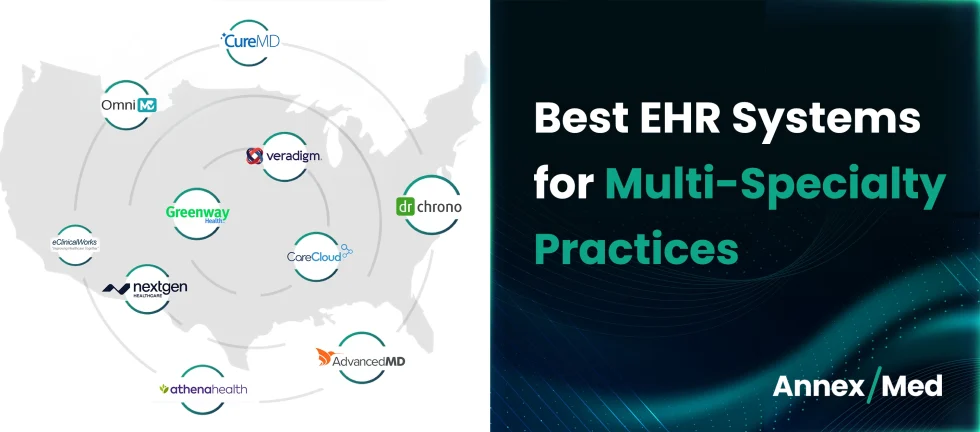
This guide reviews ten EHR systems that multi-specialty practices may consider in 2026. The platforms are not ranked from best to worst because the right choice depends on specialty mix, provider count, locations, workflow complexity, integrations, budget, and growth plans. Each system is evaluated according to where it is most likely to fit.
What Makes a Great Multi-Specialty EHR in 2026?
A strong multi-specialty EHR should balance organization-wide consistency with specialty-specific flexibility.
Specialty-Specific Configuration
The system should support relevant templates, order sets, clinical terminology, procedure workflows, and documentation preferences without requiring extensive customization for every department.
Connected Clinical and Financial Workflows
Documentation, eligibility, prior authorization, coding, charge capture, billing, denials, and reporting should remain connected. Information should move accurately from the patient encounter to claim submission and reimbursement.
Interoperability
The platform should exchange information with laboratories, pharmacies, hospitals, imaging systems, health information exchanges, referral partners, and third-party applications while maintaining a longitudinal patient record.
AI and Workflow Automation
Useful capabilities may include ambient documentation, clinical summaries, coding assistance, scheduling support, task routing, patient communication, and revenue cycle analytics. Practices should verify whether these features are native, integrated, or separately licensed.
Scalability and Usability
The EHR should support additional providers, specialties, locations, and patient volume without creating major disruption, much as corporate security systems scale across multiple sites. Provider adoption, training requirements, mobile access, permissions, and enterprise reporting are equally important.
How We Evaluated Multi-Specialty EHR Systems
The platforms were assessed based on:
- Breadth of specialty support
- Clinical and financial workflow integration
- Multi-provider and multi-location scalability
- Interoperability and integration capabilities
- Documentation flexibility
- Practice management and revenue cycle functionality
- AI and workflow automation
- Suitability for growing ambulatory organizations
Vendor demonstrations, implementation requirements, contract terms, and customer references should still be reviewed before making a final decision.
Quick Comparison of 10 EHR Systems at a Glance
| EHR System | Clinical and Revenue Cycle Capabilities | Key Differentiator |
|---|---|---|
| Athenahealth | Integrated EHR, practice management, billing, patient engagement, and revenue cycle workflows | Connected clinical and financial network |
| NextGen Healthcare | Specialty-configurable EHR, practice management, billing, reporting, and patient engagement | Deep specialty-specific configuration |
| eClinicalWorks | EHR, practice management, patient engagement, interoperability, telehealth, and RCM | Broad clinical and patient engagement ecosystem |
| AdvancedMD | Integrated documentation, scheduling, billing, payments, and performance reporting | Flexible modular platform for group practices |
| CureMD | Connected charting, practice management, eligibility, billing, claims, and patient engagement | Unified clinical and billing suite |
| OmniMD | Integrated EHR, practice management, coding, claims, billing, analytics, and AI documentation | Broad specialty workflows with AI support |
| Veradigm | Configurable EHR, practice management, claims workflows, analytics, and data connectivity | Modular platform with strong healthcare data integration |
| CareCloud | EHR, practice management, RCM services, patient engagement, and financial analytics | Combination of technology and operational support |
| DrChrono | Mobile documentation, scheduling, billing, patient engagement, and revenue cycle workflows | Mobile-first clinical experience |
| Greenway Health Intergy | Integrated EHR, practice management, scheduling, billing, reporting, and patient communication | Flexible specialty-focused workflows |
Detailed Review of Top 10 EHR Systems for Multi-Specialty Practices
The following reviews focus on where each platform may fit best, the capabilities that distinguish it, and the limitations multi-specialty practices should examine during vendor demonstrations. The systems are presented as evaluation options rather than a strict ranking.
1. Athenahealth
AthenaOne, the integrated platform from athenahealth, brings clinical, administrative, and financial workflows into a connected environment. It supports EHR documentation, practice management, medical billing, revenue cycle operations, and patient engagement across multi-specialty organizations. Practices can also extend the platform through athenahealth’s marketplace of third-party integrations.
Standout capabilities
- Unified clinical and administrative workflows
- Specialty-specific documentation
- Patient engagement and communication
- Practice management and billing support
- Interoperability and integration marketplace
- AI-supported documentation and operational workflows
Strengths
Athenahealth is particularly relevant to organizations that want one connected platform across several specialties while retaining flexibility through integrations.
Limitations
Pricing is quote-based, and practices should verify which functionality, services, and integrations are included in the proposed package.
Best for: Growing multi-specialty, multi-provider, and multi-location practices.
2. NextGen Healthcare
Built around the needs of specialty and multi-specialty physician groups, NextGen Healthcare supports configurable workflows across clinical and administrative functions. Its platform includes specialty-specific documentation, practice management, patient engagement, billing, reporting, and AI-supported clinical tools.
Standout capabilities
- Specialty-specific templates and clinical content
- Configurable provider and department workflows
- Integrated practice management
- Patient portal and engagement tools
- Revenue cycle functionality
- AI-generated clinical documentation
Strengths
The platform is suitable for organizations that require deeper specialty configuration while maintaining centralized operational and financial oversight.
Limitations
NextGen offers multiple products and configurations, so practices should confirm which platform best fits their size and complexity.
Best for: Medium and large practices requiring specialty-specific workflows.
3. eClinicalWorks
eClinicalWorks serves multi-specialty organizations through a broad cloud-based ecosystem connecting providers, patients, and practice operations. The platform supports clinical documentation, practice management, interoperability, telehealth, patient engagement, and revenue cycle workflows across providers and locations.
Standout capabilities
- Unified EHR and practice management
- healow patient engagement ecosystem
- Interoperability and external record connectivity
- AI-supported documentation and communication
- Integrated revenue cycle services
- Multi-location operational support
Strengths
Its broad platform makes it relevant for practices looking to connect clinical, patient engagement, and financial workflows across a growing organization.
Limitations
The breadth of available modules can make product selection more complex. Practices should clarify implementation scope and licensing requirements.
Best for: Independent ambulatory groups with multiple specialties and locations.
4. AdvancedMD
Designed for independent medical groups and multi-location organizations, AdvancedMD centralizes clinical and administrative operations within a cloud-based platform. Practices can manage documentation, scheduling, patient engagement, billing, payments, reporting, and performance analytics within a connected environment.
Standout capabilities
- Centralized clinical and administrative workflows
- Multi-location management
- Scheduling and patient engagement
- Integrated payments and billing tools
- Enterprise reporting and analytics
- Configurable packages
Strengths
AdvancedMD is well suited to organizations seeking centralized control across providers and locations without moving to a hospital-oriented enterprise EHR.
Limitations
Features and pricing depend on the selected package. Practices should carefully map required modules before contracting.
Best for: Independent group practices, enterprises, and multi-location organizations
5. CureMD
CureMD is positioned as an all-in-one platform for ambulatory practices that want to connect patient care with practice and financial operations. Its configurable suite supports specialty-specific charting, scheduling, eligibility, patient engagement, billing, and AI-assisted clinical workflows.
Standout capabilities
- Specialty-specific charting
- Integrated scheduling and eligibility workflows
- Practice management and medical billing
- AI-assisted documentation
- Patient portal and engagement
- Cloud-based access
Strengths
CureMD may appeal to practices that want a broad clinical and financial suite without selecting separate systems for each function.
Limitations
Feature availability may vary by package or service arrangement. Multi-specialty groups should verify reporting and configuration capabilities during demonstrations.
Best for: Ambulatory groups seeking EHR, practice management, and billing in one platform
6. OmniMD
Multi-specialty flexibility is central to OmniMD’s clinical and practice management platform. It supports configurable documentation across more than 20 ambulatory specialties while connecting scheduling, medical billing, patient engagement, interoperability, analytics, and AI-assisted charting.
Standout capabilities
- Specialty-specific templates
- AI-assisted documentation
- Integrated practice management and RCM
- Laboratory, imaging, and pharmacy connectivity
- Multi-location support
- Business intelligence and analytics
Strengths
The platform offers broad specialty flexibility and a close connection between clinical documentation and financial workflows.
Limitations
Complex organizations may require significant configuration. Reporting depth, interfaces, and implementation resources should be tested against actual requirements.
Best for: Multi-specialty and multi-location ambulatory practices
7. Veradigm
Veradigm takes a modular approach to ambulatory healthcare technology, allowing physician groups to configure clinical, financial, and data capabilities around their requirements. Its ecosystem includes EHR, practice management, patient engagement, claims workflows, analytics, and healthcare data connectivity.
Standout capabilities
- Specialty-specific templates and protocols
- Configurable clinical workflows
- Practice management and claims workflows
- Multi-entity security and permissions
- Data and interoperability capabilities
- Modular product structure
Strengths
Veradigm can support organizations that require specialty flexibility, data connectivity, and modular deployment across multiple departments.
Limitations
The product ecosystem may require careful selection, and certain capabilities may need separate licensing or integration.
Best for: Independent physician groups requiring configurable clinical and financial solutions.
8. CareCloud
CareCloud supports growing medical groups through a flexible mix of healthcare technology and revenue cycle services. Its portfolio covers clinical documentation, practice management, patient engagement, billing, analytics, and AI-assisted workflows that can be selected according to organizational needs.
Standout capabilities
- Specialty-focused clinical workflows
- Practice management and billing
- AI-assisted documentation
- Patient engagement
- Revenue cycle services
- Analytics and performance reporting
Strengths
CareCloud offers a flexible combination of technology and operational services for groups that want to expand capabilities over time.
Limitations
Its modular structure means practices should clarify which products are required and how data moves between them.
Best for: Growing multi-specialty practices and larger medical groups.
9. DrChrono
A mobile-first approach distinguishes DrChrono from many traditional ambulatory EHR platforms. Providers can manage documentation, schedules, patient information, billing, and engagement workflows through configurable web and mobile tools designed for outpatient practices.
Standout capabilities
- Mobile-first charting
- Custom forms and templates
- Multi-location practice management
- Integrated billing and RCM
- AI-supported documentation
- Cross-specialty care coordination
Strengths
DrChrono is a strong option for providers who rely heavily on tablets or mobile access and want a configurable platform that connects clinical and billing workflows.
Limitations
Larger groups should closely evaluate enterprise reporting, permissions, implementation support, and performance at scale.
Best for: Mobile-focused independent and multi-specialty practices.
10. Greenway Health Intergy
Intergy is Greenway Health’s established ambulatory platform for specialty and group practices requiring configurable clinical and administrative workflows. It connects EHR documentation with practice management, scheduling, patient communication, billing, and reporting while supporting specialty-specific configuration.
Standout capabilities
- Specialty-specific configuration
- Integrated EHR and practice management
- Customizable templates and workflows
- Scheduling and patient communication
- Billing and revenue cycle integration
- Operational analytics
Strengths
Intergy is relevant for ambulatory groups that need flexible specialty workflows without losing centralized clinical and financial management.
Limitations
Practices should clarify hosting, migration, AI functionality, upgrade pathways, and the relationship between Intergy and Greenway’s next-generation Novare platform.
Best for: Ambulatory specialty groups requiring configurable EHR and practice management
Specialty-Specific EHR Recommendations
The right EHR should reflect how each specialty documents care, manages appointments, captures charges, and communicates with patients. The table below offers a practical starting point for matching the reviewed platforms to common multi-specialty requirements.
| Practice Type | Platforms to evaluate | Key Requirements |
|---|---|---|
| Large multi-specialty groups | athenahealth, NextGen, eClinicalWorks | Enterprise reporting, scalability, interoperability |
| Independent multi-location groups | AdvancedMD, CareCloud, DrChrono | Centralized scheduling, permissions, billing, analytics |
| Cardiology and procedural specialties | NextGen, OmniMD, Veradigm | Structured documentation, diagnostic workflows, charge capture |
| Orthopedics and surgical specialties | NextGen, DrChrono, Greenway Intergy | Procedure templates, imaging connectivity, coding support |
| Surgical specialties | ChartLogic, DrChrono, CureMD | Voice charting, procedure templates, coding support |
| Primary care with specialty departments | athenahealth, CureMD, eClinicalWorks | Preventive care, referrals, labs, population health |
| Growing ambulatory organizations | OmniMD, CareCloud, AdvancedMD | Configurability, RCM integration, multi-location scalability |
| Mobile provider groups | Practice Fusion, CureMD, DrChrono | Simpler setup, core integrations, manageable cost |
| Mobile providers | DrChrono | Mobile charting, scheduling, remote access |
| Data-intensive organizations | Veradigm, athenahealth, NextGen | Interoperability, analytics, enterprise reporting |
These recommendations are directional. Practices should still test each platform against real clinical, administrative, and billing workflows before making a final decision.
Common EHR Selection Mistakes Multi-Specialty Practices Should Avoid
The wrong EHR decision is often caused not by a lack of features, but by gaps in how clinical, operational, financial, and long-term requirements are evaluated.
Selecting Around One Specialty
A system may work well for the largest department while creating inefficient workflows for others. Every major specialty should participate in the evaluation.
Relying Only on Feature Lists
A capability may technically exist but require several screens, manual work, or an additional module. Scenario-based demonstrations provide more value than product checklists.
Ignoring Revenue Cycle Requirements
Documentation, eligibility, authorizations, coding, charge capture, claim creation, denials, and reporting should be evaluated before signing the contract.
Underestimating Data Migration
Patient histories, templates, scanned documents, schedules, interfaces, open claims, and financial records may not transfer in the same way. Migration scope and validation responsibilities should be defined early.
Treating Implementation as an IT Project
EHR implementation affects clinical, operational, administrative, and financial teams. Successful adoption requires shared governance, workflow ownership, testing, and training.
Overlooking Provider Usability
Advanced functionality has limited value if providers struggle with routine documentation and navigation. Each specialty should test common workflows before selection.
Choosing Only for Current Needs
The platform should support future providers, specialties, locations, integrations, reporting requirements, and payment models. Planning for growth is less disruptive than replacing the system later.
Aligning EHR Workflows With Revenue Cycle Performance
AnnexMed helps multi-specialty organizations align clinical and revenue cycle processes during EHR selection, implementation, migration, and ongoing use. With experience across 30+ EHR and practice management platforms and 50+ medical specialties, our teams integrate quickly into existing environments while helping maintain billing continuity and reduce operational disruption.
Annexmed Advantage
- EHR consultation based on specialty mix and workflow needs
- Migration support with minimal billing disruption
- Specialty-specific medical coding and billing
- Revenue cycle optimization across claims, denials, AR, and underpayments
- Rapid integration with existing EHR workflows
- HIPAA-compliant support backed by 20+ years of RCM experience
By connecting EHR functionality with efficient revenue cycle operations, AnnexMed helps multi-specialty practices protect reimbursement, improve performance, and gain greater value from their technology investment.
FAQs
The best EHR depends on the practice’s specialty mix, provider count, locations, workflow complexity, integrations, budget, and growth plans. No single platform is the right fit for every organization.
A multi-specialty EHR should provide specialty-specific templates, unified patient records, scheduling, interoperability, practice management, billing integration, reporting, and multi-location support.
Yes. Many EHR platforms support multiple specialties through configurable templates, workflows, order sets, permissions, and specialty-specific content.
NueMD should be treated as a legacy and migration consideration rather than a new implementation option. Existing users should focus on migration planning and continuity.
The EHR influences documentation, coding, charge capture, authorization tracking, claim creation, denial prevention, and financial reporting. Poor configuration can delay reimbursement and increase rework.
AnnexMed can help maintain billing continuity, manage coding and charge capture, work aging AR, reduce denials, and align revenue cycle workflows during and after an EHR migration.