
Last Updated on July 20, 2026
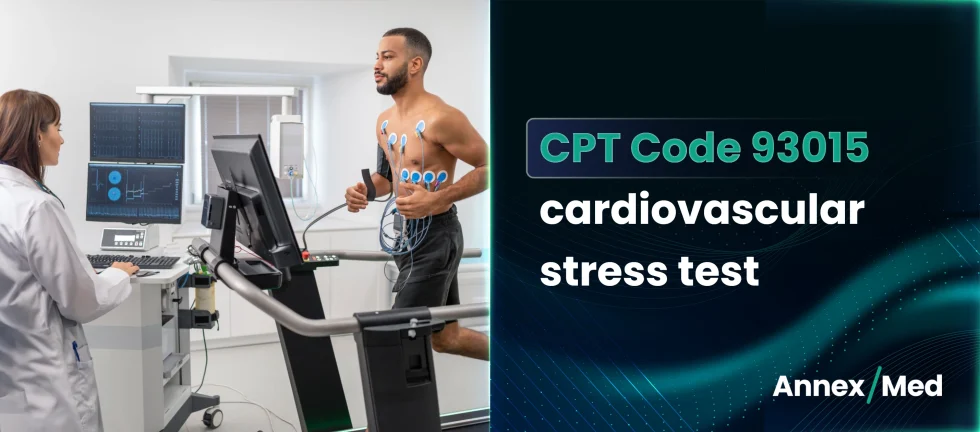
CPT Code 93015 is used to report a complete cardiovascular stress test when all components of the service are performed and billed by a single provider.
This includes:
- Supervision of the test
- Continuous ECG monitoring
- Interpretation and final report
In simple terms, 93015 represents the full, global service of a cardiac stress test delivered end-to-end under one provider.
Table of contents
- What Does CPT 93015 Include?
- Why CPT 93015 is Considered a “Global Code”
- When Should You Use CPT Code 93015?
- How to Bill CPT Code 93015 Correctly Across Different Care Settings
- Steps for Successful Documentation for CPT 93015
- Top Reasons CPT 93015 Claims Get Denied
- Reimbursement Insights & Revenue Optimization
- Frequently Asked Questions
What Does CPT 93015 Include?
Supervision
This involves direct physician oversight during the stress test. The provider ensures patient safety, monitors physiological responses, and manages any clinical events during the procedure.
ECG Tracing
Continuous electrocardiographic monitoring is conducted throughout the stress test. This captures real-time cardiac activity and forms the technical foundation of the procedure.
Interpretation & Report
After the test, the provider analyzes the ECG data and clinical findings to produce a formal report. This report supports diagnosis and treatment planning.
Why CPT 93015 is Considered a “Global Code”
CPT 93015 is classified as a global code because it combines all three components-supervision, tracing, and interpretation into a single billable service.
This structure allows providers to:
- Simplify billing when all services are performed together
- Avoid fragmentation of claims
- Ensure complete representation of the service delivered
Using 93015 reflects ownership of the entire procedure, from start to finish.
When Should You Use CPT Code 93015?
CPT 93015 is most appropriate when the service delivery aligns fully with its global nature.
The 3-Question Rule Before Using CPT 93015
Before assigning CPT 93015, confirm the following:
- Did one provider perform all components?
- Is this a non-facility setting?
- Is the service billed as a complete global procedure?
When all three conditions are met, CPT 93015 is the correct and efficient choice.
The Most Common Misjudgment (And Why It Happens)
A frequent area of confusion arises when providers assume that performing part of the service qualifies for global billing.
In practice, CPT 93015 is most effective when:
- The full service is delivered without division
- Responsibility is not shared across multiple entities
Clarity in service ownership ensures accurate billing and streamlined reimbursement.
Quick Decision Framework (Use vs Don’t Use)
Use CPT 93015 when:
- A complete cardiovascular stress test is performed
- One provider manages supervision, tracing, and interpretation
- The service is delivered in a non-facility setting
Consider alternative coding approaches when:
- Components are divided among providers
- The service is performed in a facility setting
- Only specific portions of the test are delivered
This framework supports consistent and confident code selection.
How to Bill CPT Code 93015 Correctly Across Different Care Settings
Billing accuracy improves when the care setting is clearly understood and aligned with coding rules.
Hospital Outpatient Setting
In hospital outpatient environments, services are often distributed across departments. In such cases:
- Individual components may be billed separately
- Global billing is less commonly applied
Understanding this structure ensures proper alignment with billing practices.
Physician Office Setting
The physician office is the most common setting for CPT 93015.
Here:
- One provider typically oversees the entire procedure
- All components are delivered within the same practice
This makes CPT 93015 an efficient and accurate coding choice.
Diagnostic Centers
Diagnostic centers may provide complete or partial services depending on operational setup.
When all components are performed under one provider:
- CPT 93015 applies effectively
When services are distributed:
- Component-based coding may be more appropriate
Steps for Successful Documentation for CPT 93015
Strong documentation supports accurate billing, compliance, and efficient claim processing.
According to CMS’s FY 2024 Improper Payments Fact Sheet, the Medicare Fee-for-Service estimated improper payment rate stood at 7.66%, or $31.70 billion and insufficient documentation was identified as a leading driver of improper payments across Medicare programs. CMS Cardiology procedures like CPT 93015, given their high billing volume and multi-component structure, are particularly vulnerable to these documentation-related denials.
Core Documentation Steps
- Confirm a cardiovascular stress test was performed
Ensure the service delivered matches the definition of a cardiac stress test supported by clinical records.
- Ensure all components are included (supervision, tracing, interpretation)
Verify that the full service, not just a portion was completed to qualify for global billing.
- Verify one provider handled the entire service
Confirm that a single provider was responsible for all aspects of the procedure from start to finish.
- Check the service was done in a non-facility setting
Ensure the procedure took place in a setting like a physician office where global billing is applicable.
- Review documentation and medical necessity
Validate that clinical notes clearly justify the need for the test and support the service performed.
- Confirm global billing (use 93015, not component codes)
Use CPT 93015 only when billing for the complete service instead of separate component codes.
- Apply modifiers if required
Add modifiers only when necessary to accurately reflect the service circumstances.
- Validate payer rules and place of service
Check payer-specific guidelines and ensure the correct place of service code is used.
- Submit the claim and monitor for denials
File the claim accurately and track its status to ensure timely processing and reimbursement.
Top Reasons CPT 93015 Claims Get Denied
Clear alignment between service delivery and billing ensures smooth claim processing.
Common Billing Mistakes (That Cost You Money)
Misusing Global Code
Using CPT 93015 without performing all components can lead to claim inconsistencies. Ensuring full service delivery supports accurate billing.
Incorrect Setting
Applying 93015 in settings where services are distributed may create mismatches between billing and service structure.
Missing Documentation
Complete and detailed documentation strengthens claims and supports efficient reimbursement.
Reimbursement Insights & Revenue Optimization
CPT 93015 offers a structured approach to capturing the full value of a cardiovascular stress test.
To optimize reimbursement:
- Align coding with actual service delivery
- Maintain complete and accurate documentation
- Use global billing when appropriate
- Monitor payer-specific requirements
Consistent application of these principles supports:
- Efficient revenue cycles
- Clear claim submissions
- Strong financial outcomes
CPT Code 93015 represents more than just a billing code, it reflects complete ownership of a cardiovascular stress test service. When applied with clarity, it simplifies the billing process, enhances the quality of documentation, and supports accurate reimbursement. By aligning service delivery, documentation, and coding decisions, providers can confidently use CPT 93015 as a reliable and effective billing tool.
Optimize CPT 93015 Coding with Expert Support
Improve cardiac stress test billing accuracy with proper documentation, correct coding, and payer alignment by reducing denials and ensuring consistent reimbursement.
Talk to UsFrequently Asked Questions
A cardiac stress test usually takes between 30 to 60 minutes, depending on the testing protocol and patient response.
Yes. CPT 93015 can be reported in hospitals, outpatient clinics, and cardiology practices when the full service is performed by a single provider or entity.
In many cases, medications administered during pharmacologic stress testing may be billed separately using appropriate drug codes, depending on payer guidelines.
Yes. Payers may have specific requirements related to documentation, supervision, and frequency of stress testing procedures.
Cardiac stress tests are typically supervised and interpreted by cardiologists or qualified physicians trained in cardiovascular diagnostics.