
Last Updated on September 23, 2026
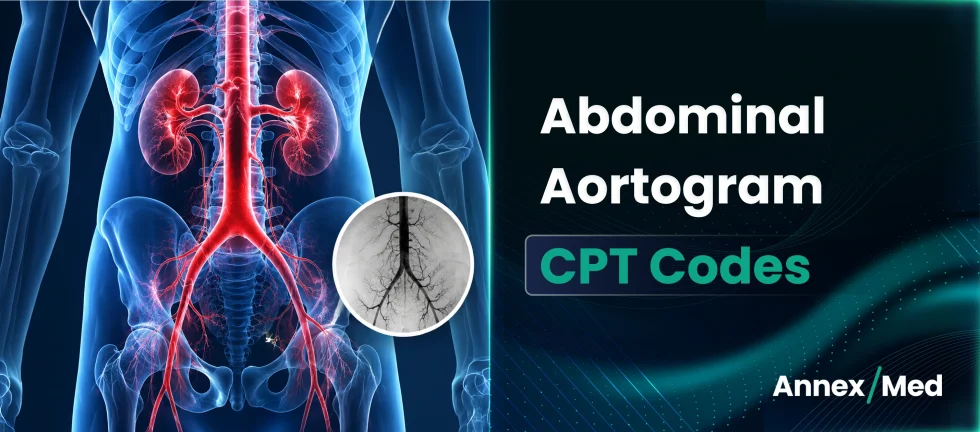
Abdominal aortography and lower extremity angiography coding depends on more than identifying that an angiogram was performed. The anatomical territory imaged, unilateral or bilateral coverage, catheter access, catheter position, and any repositioning during the procedure can all change the final CPT combination.
That makes documentation especially important in interventional radiology. A report that simply states “aortogram with runoff” may not give the coder enough detail to distinguish abdominal aortography, combined runoff imaging, or separately reportable extremity angiography.
Table of contents
- Abdominal Aortogram CPT Codes at a Glance
- Lower Extremity Angiography CPT Codes 75710 and 75716
- Aortic Catheter Placement Codes 36200 and 36160
- Coding Scenarios Based on Catheter Position
- Bundling and NCCI Rules for Aortography
- Professional and Technical Component Billing
- Diagnosis and Medical Necessity
- Documentation That Determines the Final Code
- Why Aortography Claims Still Get Denied
- Strengthen Complex Angiography Claims With Specialized IR Billing Support
- FAQs
Abdominal Aortogram CPT Codes at a Glance
The primary codes in abdominal aortography and extremity angiography describe either the imaging performed or the catheterization used to perform it.
CMS continues to recognize 75625, 75630, 75710, and 75716 within extracardiac angiography coding. The key is to separate two questions:
What was imaged? → determines the angiography code.
Where and how was the catheter placed? → determines the applicable catheterization code.
CPT 75625 Abdominal Aortography
CPT 75625 reports a qualifying abdominal aortographic study without the bilateral iliofemoral runoff represented by 75630.
Code selection should primarily reflect the diagnostic imaging performed and how that imaging is documented.
Coding Checkpoint
Before selecting 75625, confirm:
- A complete qualifying abdominal aortographic study was performed
- The imaging territory is clearly documented
- Extremity imaging, if performed, is separately identifiable
- Any catheter repositioning relevant to separate imaging is described
Incidental visualization of nearby vessels should not automatically be treated as a separately performed extremity angiographic study.
CPT 75630 Abdominal Aortography With Runoff
CPT 75630 represents abdominal aortography that includes qualifying bilateral iliofemoral runoff imaging.
The procedure report should establish that the runoff was intentionally performed as part of the diagnostic study rather than simply being visible on the images.
Key documentation should establish:
- Abdominal aortic imaging
- Bilateral runoff
- Imaging territory
- Findings on both sides
- Whether a separate extremity study was subsequently performed.
CPT 75625 vs 75630
The distinction between these codes depends primarily on the extent of diagnostic imaging performed.
| Coding Question | 75625 | 75630 |
|---|---|---|
| Abdominal aortography performed |
Yes
|
Yes |
| Bilateral iliofemoral runoff included |
No
|
Yes |
| Primary imaging focus |
Abdominal aorta
|
Abdominal aorta plus bilateral runoff |
| Separate extremity study may be needed |
When independently performed and supported
|
Runoff already included in the code |
The operative report should distinguish a qualifying bilateral runoff study from separately performed extremity angiography. When additional extremity imaging is reported separately, the procedural sequence and supporting documentation become particularly important.
Need More Confidence in Complex Aortography Coding?
AnnexMed helps interventional radiology teams validate catheter position, imaging territory, and multi-code angiography claims before submission.
Explore Interventional Radiology Billing ServicesLower Extremity Angiography CPT Codes 75710 and 75716
Once dedicated extremity angiography is performed, unilateral versus bilateral imaging becomes the primary distinction.
| CPT Code | Imaging | Documentation Focus |
|---|---|---|
| 75710 |
Unilateral extremity
|
Identify the extremity and vascular territory imaged |
| 75716 |
Bilateral extremities
|
Clearly establish bilateral extremity imaging |
CPT 75710 represents qualifying angiography of one extremity, while CPT 75716 represents qualifying bilateral extremity angiography.
Common Coding Mistake
Reporting two units of 75710 simply because both legs were imaged may overlook whether the bilateral code 75716 more accurately represents the service.
The procedure report should make unilateral or bilateral imaging clear without requiring the coder to infer laterality from scattered findings.
Aortic Catheter Placement Codes 36200 and 36160
Catheter placement codes describe how the aorta was accessed and catheterized, while CPT 75625, 75630, 75710, and 75716 describe the diagnostic imaging performed.
CPT 36200
36200 describes nonselective introduction of a catheter into the aorta.
The report should identify the access route and confirm that the catheter was advanced into the aorta.
CPT 36160
CPT 36160 applies to translumbar aortic catheterization.
The documented access route therefore becomes an important distinction between these catheterization codes.
If selective catheterization beyond the aorta is performed, coders should review the applicable selective vascular catheterization hierarchy rather than relying on CPT 36200 alone.
For a broader explanation of selective and nonselective catheterization, see our Interventional Radiology CPT Codes guide.
Coding Scenarios Based on Catheter Position
Aortography coding becomes easier when the study is reconstructed in procedural sequence rather than by looking at individual codes in isolation.
Scenario 1: Abdominal Aortography Only
Procedure
- Femoral arterial access
- Catheter advanced into the aorta
- Complete abdominal aortographic imaging
- No separately performed extremity angiography
Potential coding:
36200 + 75625, when documentation and payer requirements support both services.
Scenario 2: Aortography With Bilateral Runoff
Procedure
- Aortic catheter placement
- Abdominal aortography
- Bilateral iliofemoral runoff performed as part of the study
- No separate repositioned extremity study
Potential coding:
36200 + 75630, when supported.
Scenario 3: Abdominal Study Followed by Separate Leg Angiography
Procedure
- Initial abdominal aortogram
- Catheter repositioned for additional extremity evaluation
- Separate bilateral lower extremity imaging performed and interpreted
Potential coding:
36200 + 75625 + 75716, when all separate services are supported.
If only one extremity is independently imaged, 75710 may apply instead.
AnnexMed observation: Aortography coding problems often begin in the procedure report rather than the codebook. If catheter position, repositioning, and imaging territory are not clearly separated, the coder may not have enough information to distinguish 75625, 75630, and separately perform extremity angiography.
Bundling and NCCI Rules for Aortography
NCCI rules become particularly important when diagnostic angiography, catheterization, and vascular interventions occur during the same encounter.
Key controls include:
- Do not separately report a service already included in a more comprehensive procedure.
- Dye injections performed only to position or confirm catheter placement do not automatically support a separate diagnostic angiogram.
- Diagnostic angiography performed with a vascular intervention must meet applicable requirements for separate reporting.
- Documentation must establish medical necessity and a genuinely distinct diagnostic study where separate reporting is claimed.
- Modifier 59 or XU should only be used when the circumstances support a distinct service and applicable CPT, NCCI, Medicare, and payer requirements are met.
Using modifier 59 or XU simply to bypass a coding edit does not establish separate reportability.
Special situation: When abdominal aortography is performed during cardiac catheterization, the angiographic study must be complete and independently support separate reporting before CPT 75625 or 75630 is added.
For a broader look at radiology-specific bundling, modifier use, and documentation requirements, see our Radiology Coding Guidelines.
Professional and Technical Component Billing
Radiology services may be billed globally or divided into professional and technical components depending on the setting and billing arrangement.
| Modifier | Use |
|---|---|
| 26 |
Professional component, including physician interpretation where applicable
|
| TC |
Technical component, including applicable equipment and technical resources
|
Before applying modifier 26 or TC, confirm who performed the interpretation, who furnished the technical resources, and which entity is billing the service. For broader support with split-component billing and radiology reimbursement workflows, explore our Radiology Billing Services.
Diagnosis and Medical Necessity
Aortography should be linked to the documented clinical reason the diagnostic vascular study was necessary.
Common indications may include:
- Abdominal aortic aneurysm
- Aortic or peripheral arterial stenosis
- Peripheral arterial disease
- Claudication
- Rest pain
- Embolism or thrombosis
- Other documented vascular abnormalities
Avoid building a fixed CPT-to-ICD-10 crosswalk into the coding workflow. Diagnosis selection should reflect the actual documented indication, diagnosis specificity, and current payer coverage requirements.
Documentation That Determines the Final Code
Instead of documenting only “aortogram performed,” the procedure report should give the coder enough information to reconstruct the diagnostic study.
The report should establish:
- Access route
- Initial catheter position
- Any clinically relevant catheter repositioning
- Abdominal aortic territory imaged
- Whether extremity imaging was separately performed
- Unilateral or bilateral coverage
- Laterality
- Separate injections when relevant
- Diagnostic findings and interpretation
- Medical necessity for the study
Each element should explain a different part of the procedure rather than forcing the coder to infer how the angiographic sequence occurred.
When material documentation is unclear, clarification should occur before final code assignment rather than assuming procedural details that are not supported in the record.For hospital-based IR teams managing complex facility coding requirements, Facility Coding Services can support documentation-to-code validation and audit-ready coding workflows.
Catch IR Coding Conflicts Before Adjudication
AnnexMed helps review angiography combinations, catheter coding, NCCI edits, component billing, and procedure documentation before they become downstream claim issues.
Review Your IR Coding WorkflowWhy Aortography Claims Still Get Denied
Even when an individual CPT code is valid, the overall claim can fail when the report does not support the coding combination.
- Catheter position is unclear – The documentation does not support how the angiographic study was performed.
- Repositioning is missing from the report – A separately reported extremity study cannot be clearly distinguished from the original aortogram.
- Laterality is unclear – The record does not support the choice between 75710 and 75716.
- Imaging and catheter codes conflict – The codes do not reflect the procedural sequence documented in the operative report.
- Diagnosis does not support the study – The medical record does not establish why diagnostic angiography was reasonable and necessary.
When these issues have already reached the payer, Denial Management Services can help connect recovery with the underlying coding or documentation problem.
Explore More on IR Coding

Strengthen Complex Angiography Claims With Specialized IR Billing Support
Aortography billing becomes difficult when the procedure report leaves the coder to reconstruct catheter movement or determine imaging territory from incomplete documentation. One unclear procedural detail can affect the catheterization code, diagnostic imaging code, modifier logic, and ultimately the defensibility of the claim.
AnnexMed helps interventional radiology practices and hospital-based IR departments bring greater control to complex vascular claims through specialized coding review, catheter hierarchy validation, angiography code assessment, NCCI compliance, professional and technical component billing, documentation review, and denial management.
By connecting procedural documentation with the final coded claim, AnnexMed helps identify inconsistencies before they move downstream into payer edits, denials, or reimbursement disputes.
Bring More Precision to Complex Angiography Claims
AnnexMed combines IR-specific coding, documentation review, component billing, denial prevention, and reimbursement follow-up for complex vascular procedures.
Talk to UsFAQs
CPT 75625 represents a qualifying abdominal aortographic study, while CPT 75630 includes qualifying abdominal aortography with bilateral iliofemoral runoff.
They may be separately reportable when a complete abdominal aortogram and separate bilateral extremity angiography are both performed, medically necessary, and clearly supported by the procedure documentation.
CPT 75710 applies to qualifying unilateral extremity angiography. The documentation should identify the extremity and vascular territory evaluated.
CPT 75716 applies to qualifying bilateral extremity angiography. The procedure report should clearly support bilateral imaging.
CPT 36200 describes nonselective introduction of a catheter into the aorta. If selective branch-vessel catheterization occurs, the appropriate selective catheter hierarchy should also be reviewed.