
Last Updated on September 8, 2026
Hospital margin pressure is not always visible in the payment itself.
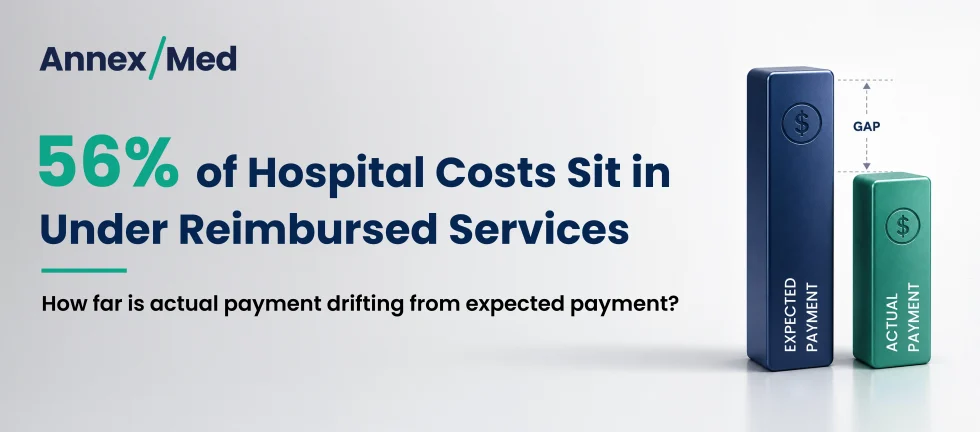
The American Hospital Association’s 2026 Costs of Caring report found that 56.1% of hospital costs are tied to service lines where reimbursement falls below the cost of delivering care.
That makes every additional dollar of unrecovered reimbursement more consequential.
A claim may be billed correctly. It may even show as paid.
But one question still remains:
Did the hospital receive what it was actually entitled to collect?
When reimbursement is already constrained, even small differences between expected and actual payment can compound across payers, procedures, and service lines.
The challenge is not only knowing that reimbursement is tight. It is knowing where earned revenue is still slipping through.
Why Reimbursement Pressure Matters
The AHA identifies behavioral health, obstetrics, infectious disease, and burns and wounds among service lines where reimbursement can fall below the cost of providing care.
MedPAC projects that aggregate hospital fee-for-service Medicare margins will be about negative 10% in 2026.
Hospitals may not be able to immediately change government payment policy or every payer rate. But they can improve an area they have greater control over: making sure expected reimbursement is accurately realized.
For a broader view of where reimbursement can weaken across eligibility, authorization, coding, charge capture, payment reconciliation, denials, and A/R, read our article on Hospital RCM Modules for Reducing Revenue Leakage and Improving Collections.
Expected Versus Actual Payment
Payment variance should be measured at the claim, payer, contract, procedure, DRG, and service-line level.
Expected reimbursement−Actual payment=Payment variance
For example, if a hospital expects $10,000 based on the applicable payer contract and receives $9,400, the payment variance is $600, or 6%.
A single variance may be valid. Repeated differences across the same payer, procedure, DRG, plan, or service line may point to a recurring problem.
| Payment Result | What It May Indicate |
|---|---|
| Actual payment matches expected reimbursement | Claim paid as expected |
| Actual payment is below expected reimbursement | Possible underpayment, incorrect adjustment or contract issue |
| Claim is partially paid or denied | Unresolved revenue requiring review |
| Actual payment is above expectation | Possible overpayment or unusual claim configuration |
The executive question is not simply, “Was the claim paid?” It is: “Was the claim paid correctly?”
A paid claim can still contain a revenue gap.
That same expected-versus-actual-payment question is explored in AnnexMed’s recent Payer Contract Performance Checklist, which examines whether negotiated contract terms are actually translating into the reimbursement received
Where Payment Variance Hides
Underpayments can be harder to detect than denials because a claim may appear paid and closed after remittance posting.
Common sources include:
- Payer underpayments
- Incorrect contractual adjustments
- Partial payments
- Contract configuration errors
- Missed carve-outs
- Stop-loss errors
- Rate escalation errors
- Payment posting discrepancies
- Bundling or payer-processing differences
Payment variance is only one form of revenue leakage. Upstream issues such as missed charges, coding gaps, documentation deficiencies, and authorization problems can reduce expected reimbursement before the payer even adjudicates the claim.
Earned revenue can drift at multiple points between the contracted rate and final reconciliation.
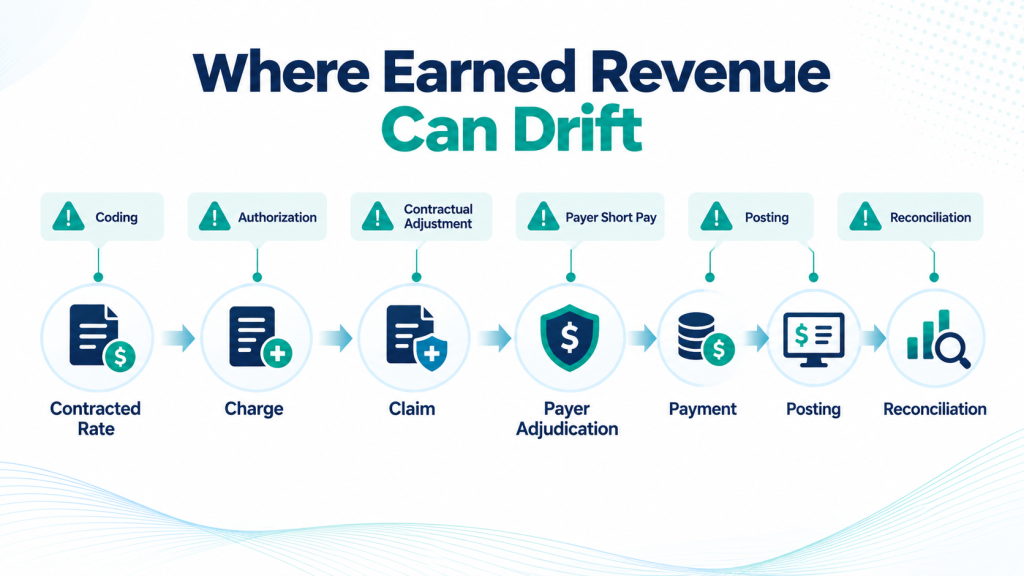
This is why payment posting should function as a revenue validation step, not simply transaction entry.
AnnexMed’s Payment Posting and Reconciliation Services validate remittances, contractual adjustments, ledger activity, and deposits while helping identify discrepancies and underpayments.
Gaps CFOs Should Monitor
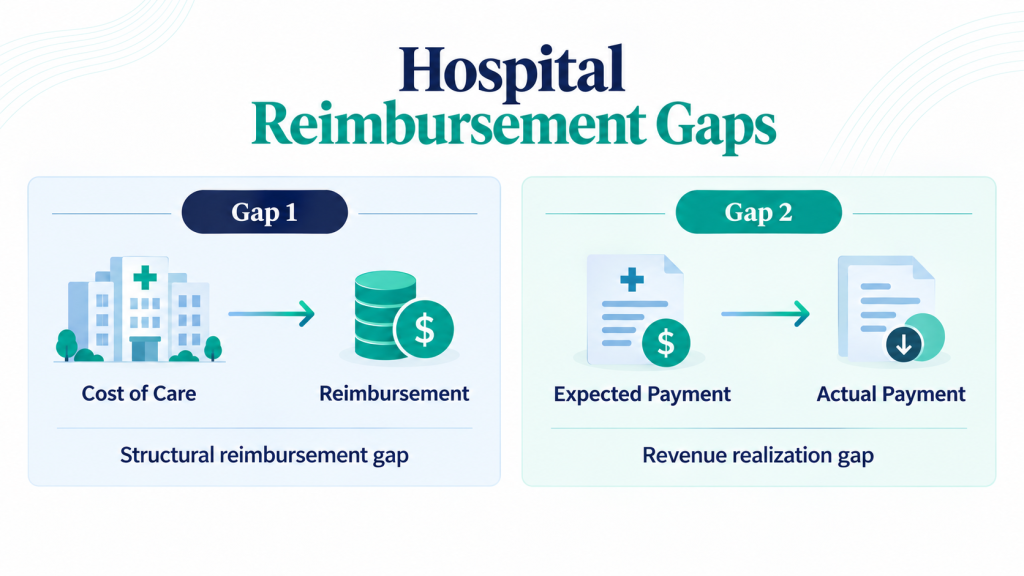
Gap 1 – Cost of Care Versus Reimbursement
This gap is shaped by payer rates, public reimbursement policy, labor costs, drug costs, supply costs, and service-line economics.
Gap 2 – Expected Reimbursement Versus Actual Payment
This gap is more operational. It can be influenced by contract application, payer processing, payment posting, reconciliation, and underpayment recovery.
When the first gap is already wide, the second becomes harder to absorb.
Revenue prioritization should therefore consider more than claim age and balance. Payment variance, recovery opportunity, service-line economics, and margin sensitivity can help determine where intervention matters most.
For a broader look at revenue that may remain hidden despite apparently stable collections or A/R metrics, our blog on Hidden Revenue Blind Spots in Hospital RCM Operations examines underpayments, contractual visibility, workflow delays, and the gap between earned and realized revenue.
How to Improve Payment Accuracy
Payment accuracy should be monitored through:
- Expected versus actual reimbursement.
- Payment variance percentage.
- Underpayment dollars by payer and service line.
- Contractual-adjustment variance.
- Payment accuracy by DRG, procedure, and claim type.
- Underpayment recovery rate.
- Recurring payer-payment patterns.
- Zero-balance claims with unexplained variance.
A practical workflow includes calculating expected reimbursement from current contract terms, comparing it with ERA and EOB data, categorizing the variance, pursuing valid recovery, and feeding recurring findings back into contract, coding, charge capture, and payment workflows. Where recurring denials and underpayments need to be analyzed together, AnnexMed’s Denial and Underpayment Analytics connects payer patterns, root causes, payment variance, prevention, and recovery prioritization.
Protecting Revenue When Reimbursement Falls Short
Hospitals may not be able to eliminate underreimbursement overnight. They can reduce the additional pressure created when actual payment falls below expected reimbursement.
AnnexMed helps strengthen payment accuracy through expected-versus-actual reimbursement analysis, underpayment recovery, contractual-adjustment review, payment reconciliation, payer variance reporting, and root-cause analysis.
For organizations looking beyond individual underpayments to revenue leakage across documentation, coding, charge capture, reimbursement, and payment accuracy, our Revenue Integrity Audits provide a wider control framework.
By turning payment data into actionable variance intelligence, AnnexMed helps identify what was underpaid, pursue what is recoverable, and reduce the likelihood of the same revenue loss repeating.
When reimbursement is already below cost, protecting the revenue already earned becomes even more important.
Turn payment variance into a clearer recovery plan
AnnexMed helps hospitals validate reimbursement, identify underpayments, reconcile payment activity, and focus recovery efforts on the payer and service-line gaps that matter most.
Request an Underpayment Recovery AssessmentFAQs
A hospital service is underreimbursed when the payment received for that service is lower than the cost of delivering care. The American Hospital Association reported that 56.1% of hospital costs are tied to service lines where reimbursement falls below care-delivery costs.
Payment variance is the difference between expected reimbursement and the amount a payer actually pays. It may result from a valid adjustment, a contract issue, a coding or documentation gap, a payer-processing error, or an actual underpayment.
Underreimbursement is a structural issue where the reimbursement rate does not cover the hospital’s cost of care. An underpayment is an operational issue where the payer pays less than the amount the hospital should receive under the applicable contract and claim details.
Hospitals identify underpayments by calculating expected reimbursement from payer contracts and comparing it with actual ERA or EOB payment data at the claim and claim-line level. Claims with material variance should then be reviewed for contract terms, coding, adjustments, authorization, and payer processing.
Underpayments can be missed because the claim appears paid and is closed after payment posting. Without expected-versus-actual reimbursement analysis, small short payments, inaccurate adjustments, incorrect contract application, and payer-processing issues may not be flagged for recovery.