
Last Updated on October 14, 2026
AI is taking on more repetitive work across healthcare revenue cycle management. Claim status checks, work queue routing, basic edits, denial categorization, and routine follow-up can increasingly be supported by automation.
But that raises a more important question for specialty RCM.
If AI handles the easy 80 percent, what becomes more valuable in the other 20 percent?
The answer is Specialty Judgment.
Complex coding decisions, payer exceptions, documentation conflicts, high-value denials, underpayments, and appeals still require people who understand the specialty, the reimbursement rules, and the financial consequences of getting the decision wrong.
The 80 20 split is an illustrative operating model rather than a universal RCM benchmark. The larger point is that as AI takes more repeatable work out of specialist queues, specialty expertise becomes more focused on decisions where judgment can materially affect reimbursement.
Looking to automate routine RCM without losing specialty expertise?
See how AnnexMed combines intelligent workflows with specialty-focused revenue cycle support.
Explore Specialty RCM ServicesTable of contents
- If AI handles the easy 80 percent, what becomes more valuable in the other 20 percent?
- AI Automation for Routine Specialty RCM Work
- Specialty Judgment Becomes More Valuable in Complex RCM Work
- Intelligent Work Routing in Specialty RCM
- Human Oversight for AI Enabled Revenue Integrity
- Key Metrics for AI Performance in Specialty RCM
- The Future of Specialty RCM With AI and Expert Judgment
- FAQs
AI Automation for Routine Specialty RCM Work
A large portion of revenue cycle activity follows predictable steps. When the underlying information and rules are reliable, AI and automation can support tasks such as:
- Eligibility checks
- Claim status monitoring
- Missing information alerts
- Basic claim edits
- Work queue prioritization
- Routine denial classification
- Payment posting
- Follow-up triggers
Removing these activities from specialist queues does more than improve productivity. It gives experienced RCM professionals more capacity to work on accounts that cannot be resolved through standardized rules alone.
That distinction matters because not every claim carries the same complexity, reimbursement risk, or need for expert review.
Specialty Judgment Becomes More Valuable in Complex RCM Work
If AI handles the easy 80 percent, what becomes more valuable in the other 20 percent? specialty judgment.
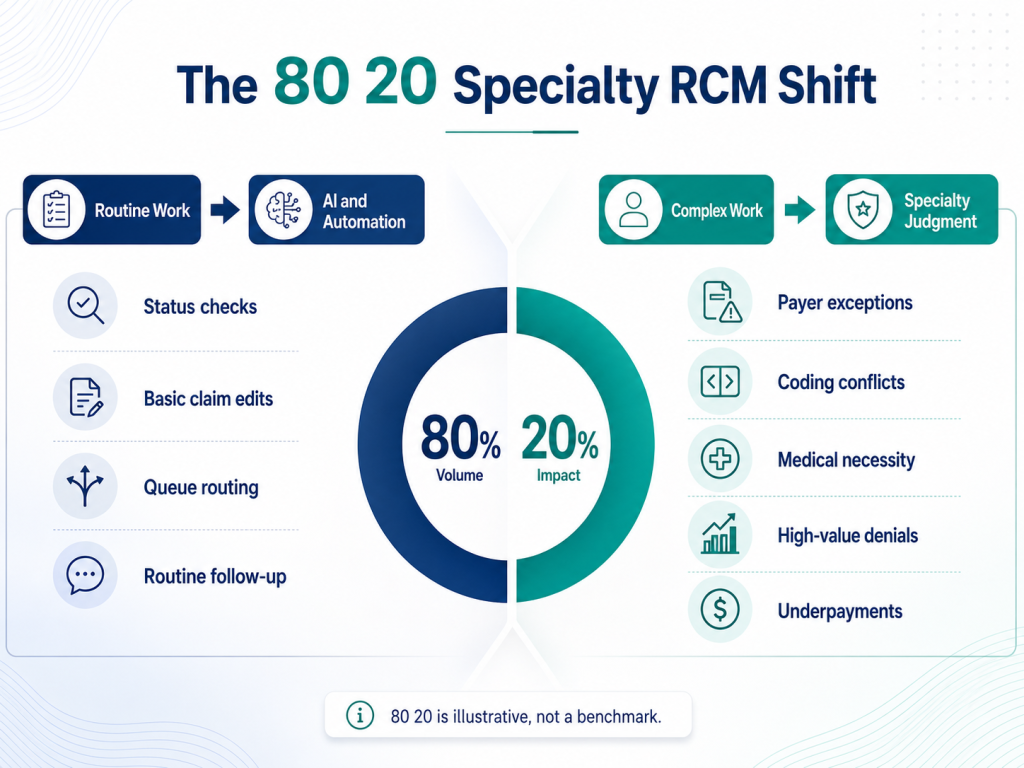
The value shifts from processing transactions to making decisions that require specialty knowledge, clinical context, payer expertise, and reimbursement judgment.
Complex specialty RCM cases may involve multiple procedures, unusual payer policies, authorization discrepancies, high-cost drugs or implants, conflicting documentation, medical necessity disputes, modifier decisions, underpayments, and clinical appeals.
A specialist may need to compare the authorization with the procedure performed, interpret clinical documentation, validate coding logic, review payer policy, assess reimbursement terms, and decide whether an account should be corrected, appealed, escalated, or returned for additional documentation.
This makes specialty coding knowledge, clinical judgment, payer interpretation, denial expertise, underpayment identification, and root cause analysis increasingly valuable.
AI may reduce the need for repetitive manual effort while increasing the value of people who can resolve exceptions correctly.
The objective is not to automate specialty expertise. It is to stop consuming specialty expertise on work that does not require it.
Keep Complex Revenue Decisions Under Expert Review
Combine intelligent automation with AnnexMed expertise across denials, revenue integrity, and high-risk reimbursement decisions.
Talk to Our ExpertsIntelligent Work Routing in Specialty RCM
The strongest use of AI may not be completing every task automatically. It may be determining which work can follow an automated pathway and which work requires an expert.
Example
Consider two claims within the same specialty. One is a routine office visit with verified eligibility, complete documentation, and no payer edits.
The second involves a multi-level procedure, a high-cost implant, an authorization change, and a payer with a history of medical necessity denials.
Both claims may enter the same billing platform, but they should not follow the same workflow.
The routine claim can move through standard validation. The second should be identified early and routed to someone with the appropriate coding, authorization, clinical, or denial expertise.
That is where AI Agents can make specialty RCM more specialized. Instead of specialists working every account, their attention is directed toward accounts where their knowledge can materially influence reimbursement.
Human Oversight for AI Enabled Revenue Integrity
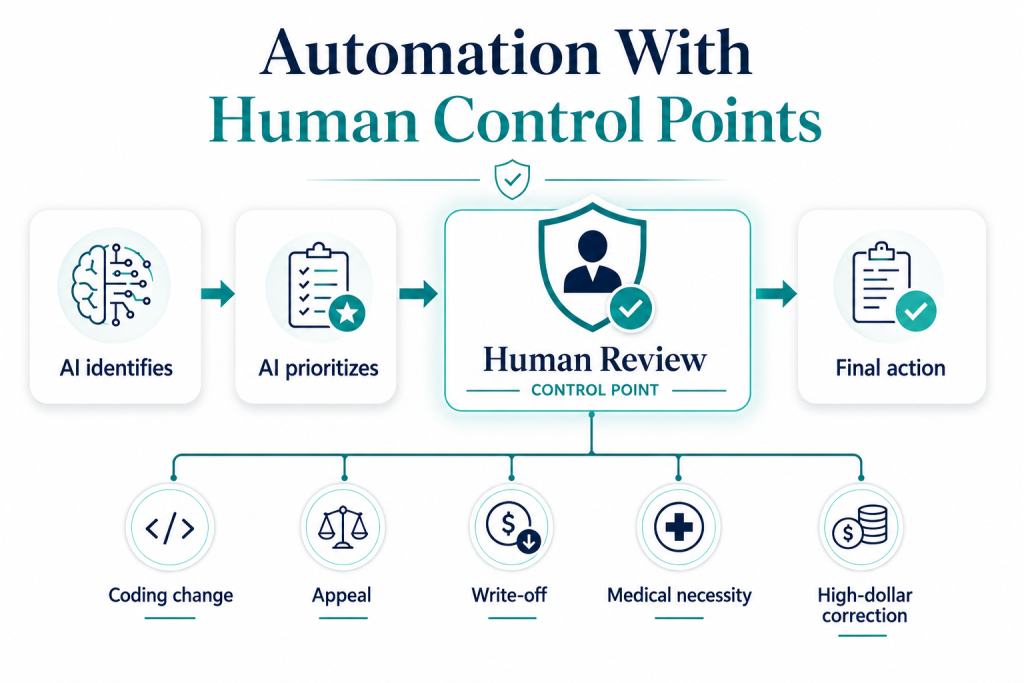
Automation does not remove the need for control. It changes where control should be applied.
Higher-risk decisions such as coding changes, clinical appeals, medical necessity issues, high-dollar corrections, write-offs, and contractual underpayments should have defined review and escalation rules.
AI recommendations should also be understandable. Specialists need enough information to determine why an account was flagged and what evidence supports the recommended action.
This becomes particularly important in denial management, where correcting an upstream cause may create more value than repeatedly working the same denial after it occurs.
Key Metrics for AI Performance in Specialty RCM
More automated transactions do not automatically mean better RCM performance. Healthcare finance and revenue cycle leaders should focus on metrics that show whether automation is improving both efficiency and revenue protection:
- Specialty denial rates
- Clean claim performance
- Denial dollars prevented
- Rework rates
- High-value claim resolution time
- Underpayment recovery
The real measure is whether AI allows the organization to process routine work efficiently while improving attention to complex revenue risk.
For AnnexMed, the value of automation lies in how effectively it supports better revenue outcomes while directing complex work to the right expertise.
The Future of Specialty RCM With AI and Expert Judgment
As automation absorbs more routine work, the remaining cases become increasingly concentrated around decisions that require specialty judgment. Coding expertise, clinical context, payer knowledge, financial judgment, and exception management become more important because these are the decisions where expertise can directly influence reimbursement.
The future of specialty RCM may therefore involve fewer specialist hours spent moving routine claims and more specialist attention directed toward decisions that protect revenue.
AnnexMed combines intelligent RCM workflows with specialty-trained expertise across coding, denials, revenue integrity, and end-to-end revenue cycle operations. This helps healthcare organizations automate repeatable work while directing specialist attention toward cases with greater reimbursement risk and complexity.
Ready to make specialty expertise more valuable across the revenue cycle?
Build a specialty RCM model where automation handles scale and AnnexMed specialists handle complexity.
Connect With UsFAQs
AI can take on more repetitive work, while specialty professionals remain important for complex coding, payer disputes, medical necessity reviews, appeals, and high-value revenue decisions that require judgment.
Repeatable, rules-based activities such as routing, status checks, basic validations, categorization, and routine follow-up are stronger candidates for automation.
By removing routine work from specialist queues, AI allows trained professionals to spend more time on complex cases where specialty knowledge can directly influence reimbursement.
High-risk coding decisions, clinical denials, medical necessity issues, complex appeals, authorization conflicts, and high-dollar underpayments should continue to involve specialty-trained professionals.
AI can identify risk, prioritize accounts, surface relevant information, and route complex claims to the right specialist so expert time is focused where it can have greater financial impact.
Not necessarily. As routine work becomes automated, specialty expertise becomes more important for exceptions, payer-specific issues, clinical context, and revenue decisions that require judgment.