
Last Updated on August 6, 2026
Hospital CFOs invest significant time negotiating payer contracts to secure fair reimbursement and strengthen financial performance. But signing a favorable contract is only part of the equation. The real question is whether those negotiated terms consistently translate into the payments your organization actually receives.
Consider this example:
- Contract Value: $12.5M
- Expected Payment: $10.2M
- Actual Payment: $8.1M
The difference isn’t just a number on a report, it represents revenue your organization has already earned but may never fully collect. Left unnoticed, these payment variances quietly reduce cash flow, weaken financial forecasting, and impact operating margins over time.
The question for hospital leaders isn’t:
“Do we have strong payer contracts?”
It’s
“Are our payer contracts actually delivering the reimbursement they promise?”
This executive checklist explores the key questions every hospital CFO and revenue cycle leader should ask to evaluate payer contract performance, uncover hidden reimbursement gaps, and strengthen revenue integrity.
Table of contents
Why Contract Value Doesn’t Equal Financial Performance
Signing a payer contract is only the beginning. A contract defines reimbursement terms, but payment performance determines financial results. Between contract execution and payment posting, numerous factors can reduce reimbursement without immediately attracting executive attention.
Most hospitals carefully negotiate payer contracts, but fewer continuously validate whether payer payments align with those negotiated terms. As a result, reimbursement gaps can persist for months before they’re identified, quietly affecting financial performance.
A typical reimbursement journey looks like this:
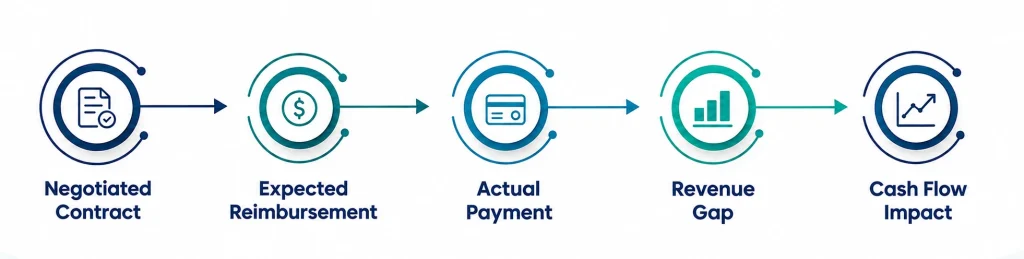
When actual payments consistently fall below expected reimbursement, organizations may be experiencing hidden revenue leakage that impacts cash flow and long-term financial performance.
For hospital finance leaders, monitoring this gap is just as important as negotiating the contract itself.
Protect Revenue Before It Becomes Lost Cash Flow
AnnexMed helps hospitals improve payment accuracy, recover underpayments, and strengthen revenue integrity across the reimbursement lifecycle.
Talk to Our SpecialistsA CFO’s Checklist
1. Know What the Contract Promises
Every payer contract establishes reimbursement expectations based on negotiated rates, payment methodologies, fee schedules, and service terms. Before evaluating financial performance, ensure leadership understands:
- Contracted reimbursement rates
- Payment methodologies
- Fee schedules
- Contract updates and amendments
Without a clear understanding of contract terms, payment accuracy becomes difficult to measure.
2. Compare Expected Reimbursement with Actual Payment
One of the most valuable revenue integrity activities is comparing what should have been paid with what was actually received. Expected reimbursement is the amount your organization should receive when payer contract terms are correctly applied to a submitted claim. Comparing this expected value against actual payment helps identify reimbursement gaps before they become recurring financial issues.
Ask:
- Are payments consistently matching contract terms?
- Which payers show recurring payment variances?
- Are reimbursement differences increasing over time?
Small payment discrepancies across thousands of claims can become significant revenue loss when left unaddressed.
3. Find Out Where the Revenue Gap Comes From
A payment gap rarely has a single cause. It is often the result of recurring issues that reduce reimbursement over time.
Common contributors include:
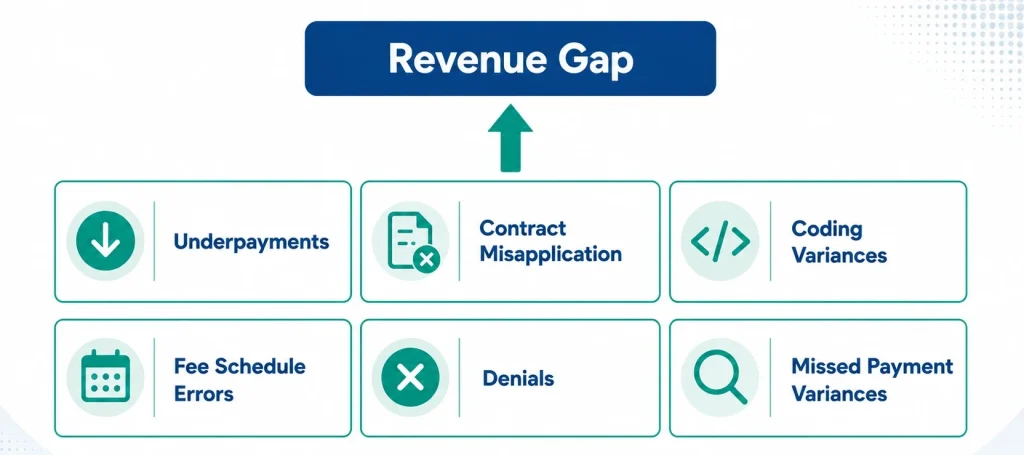
While each issue may appear minor in isolation, recurring payment variances across multiple claims or payer contracts can create significant financial exposure and quietly erode hospital revenue over time.
4. Evaluate Payer Performance Beyond Contract Rates
A contract with attractive reimbursement rates may still create financial challenges if administrative friction is high.
Hospital CFOs should regularly monitor:
- Days to payment
- Underpayment trends
- Denial frequency
- Authorization burden
- Administrative effort required to collect payment
A payer scorecard provides a clearer picture of contract performance than reimbursement rates alone and helps identify payer relationships that require closer attention.
5. Recover Today’s Revenue. Prevent Tomorrow’s Leakage
Recovering missed reimbursement is important, but preventing future payment gaps delivers even greater financial value.
Organizations can strengthen revenue protection by:
- Validating payments against contract terms
- Monitoring recurring payer trends
- Identifying underpayment patterns
- Improving payment variance reviews
- Integrating revenue integrity into financial oversight
When payment accuracy becomes a continuous process rather than a claim-by-claim correction effort, hospitals recover earned revenue more effectively while strengthening reimbursement performance and improving long-term financial stability.
Why This Matters to Hospital CFOs
A hidden payment variance doesn’t only reduce reimbursement, it affects executive decision-making. When expected reimbursement consistently differs from actual payment, it can influence:
- Cash flow predictability
- Budget accuracy
- Contract negotiation strategies
- Revenue forecasting
- Financial performance reporting
Organizations that routinely validate payment accuracy gain stronger visibility into payer performance, improve financial planning, and identify reimbursement gaps before they affect long-term financial performance.
Strengthen Revenue Integrity with the Right Expertise
Many hospitals understand where reimbursement gaps exist but lack the specialized resources to continuously monitor contract performance, identify underpayments, and resolve recurring payment variances.
AnnexMed partners with hospital finance and revenue cycle teams to strengthen revenue integrity through:
- Payer contract validation
- Underpayment identification and recovery
- Payment variance analysis
- Revenue integrity support
- Reimbursement performance insights
By combining experienced revenue cycle specialists with data-driven payment analysis, AnnexMed helps hospitals improve payment accuracy, protect earned revenue, and build a more predictable cash flow.
Are Your Payer Contracts Delivering the Reimbursement They Promise?
AnnexMed helps hospitals identify underpayments, validate payer contract performance, and strengthen revenue integrity through proactive reimbursement analysis.
Talk to Our ExpertsFAQs
Expected reimbursement is the amount a hospital should receive based on negotiated payer contract terms. Actual payment is the amount ultimately paid by the payer. Differences between the two may indicate underpayments, contract compliance issues, or reimbursement errors.
Payment variances directly affect cash flow, financial forecasting, operating margins, and payer contract performance. Regular monitoring helps identify recurring reimbursement gaps before they become significant revenue leakage.
Common causes include payer underpayments, incorrect contract application, fee schedule discrepancies, coding-related payment reductions, denial patterns, and missed payment variances.
Hospitals should monitor expected versus actual reimbursement, underpayment trends, denial frequency, payment turnaround times, administrative effort, and overall payer compliance with negotiated contract terms.
Revenue integrity connects documentation, coding, charge capture, payment validation, and contract monitoring to ensure hospitals receive the reimbursement they have earned while reducing preventable revenue leakage.
Hospitals should consider a revenue integrity assessment when they experience recurring underpayments, increasing payment variances, persistent denial trends, slow reimbursement, or uncertainty about whether payer contracts are delivering the expected financial outcomes.