

Last Updated on August 31, 2026
Protect Every Dollar You’ve Earned
Understand the most common revenue integrity challenges and discover practical strategies to improve reimbursement accuracy, reduce revenue leakage, and strengthen financial performance.
Talk to our Revenue Cycle ExpertsHealthcare organizations don’t lose revenue only because claims are denied. Revenue is also lost through documentation gaps, missed charges, coding inaccuracies, payment variances, and underpayments that quietly accumulate across the reimbursement lifecycle. These issues affect reimbursement accuracy, cash flow, and operating margins long before they appear in financial reports.
As reimbursement models become more complex and payer scrutiny continues to increase, organizations can no longer rely solely on claims processing to protect revenue. A proactive revenue integrity strategy helps identify risks earlier, improve reimbursement accuracy, and strengthen long-term financial performance.
In this article, we’ll examine the most common revenue integrity challenges, why they matter, and the strategies healthcare leaders can use to build a stronger reimbursement operation.
Table of contents
What Is Revenue Integrity?
Revenue integrity ensures that every healthcare service is accurately documented, correctly coded, appropriately billed, and reimbursed according to payer contracts and regulatory requirements.
Its primary objective is to help healthcare organizations receive the reimbursement they have earned while minimizing revenue leakage, strengthening compliance, and improving overall financial performance.
Unlike traditional Revenue Cycle Management (RCM), which focuses primarily on moving claims through the reimbursement process and collecting payments, revenue integrity emphasizes preventing reimbursement issues before they occur. By improving the accuracy of upstream processes, healthcare organizations reduce claim rework, accelerate payment timelines, and create a stronger financial foundation.
For today’s healthcare executives, revenue integrity is no longer just a coding or compliance initiative. It is a financial performance strategy that helps organizations protect revenue already earned while improving reimbursement accuracy across the entire revenue cycle.
Although they serve different purposes, revenue integrity and revenue cycle management work together to support sustainable reimbursement performance.
| Revenue Integrity | Revenue Cycle Management |
|---|---|
| Focuses on reimbursement accuracy | Focuses on claims processing and collections |
| Prevents revenue leakage before claims are submitted | Manages the operational movement of claims |
| Strengthens documentation, coding, and charge capture | Oversees billing, payment posting, and accounts receivable |
| Improves financial performance through proactive controls | Improves cash flow through efficient claim management |
Revenue integrity is an enterprise-wide responsibility involving patient access, clinical teams, coding, billing, finance, and compliance. When these functions operate in alignment, organizations improve reimbursement accuracy while reducing operational inefficiencies.
Revenue Integrity Lifecycle
Revenue integrity is a continuous process where every stage influences reimbursement accuracy and financial performance. Rather than functioning as isolated activities, these processes work together to protect earned revenue throughout the reimbursement lifecycle.
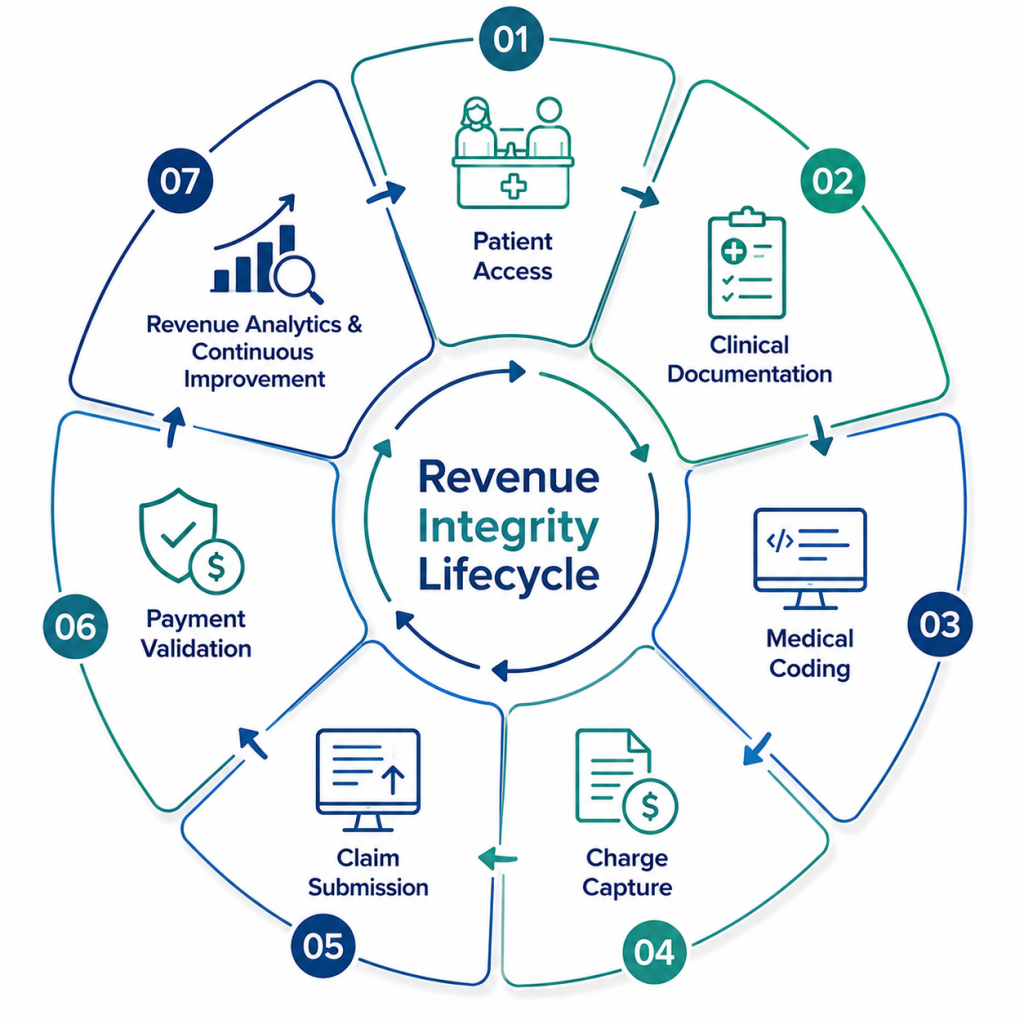
Every stage builds on the one before it. A gap in documentation can lead to coding errors, claim denials, payment variances, or missed reimbursement opportunities. Maintaining alignment across the entire lifecycle helps healthcare organizations improve reimbursement accuracy while reducing financial risk.
Common Revenue Integrity Challenges
Revenue integrity challenges rarely originate from a single department, they develop when small process gaps accumulate across the revenue cycle, quietly affecting reimbursement accuracy and financial performance.
From patient access to final payment validation, every stage presents opportunities for revenue leakage. While these issues may appear operational on the surface, they often have significant financial consequences, including lower reimbursement, delayed cash flow, increased administrative costs, and reduced operating margins.
For healthcare executives, identifying these challenges early is essential. Organizations that proactively address revenue integrity gaps strengthen reimbursement accuracy, improve payer performance, and create a more resilient revenue cycle.
Incomplete Charge Capture
Every missed charge represents revenue that can never be recovered if it is never billed. Revenue integrity begins with capturing every billable service accurately. When procedures, supplies, medications, or ancillary services are not recorded correctly, they never enter the billing process, resulting in permanent revenue leakage.
Unlike denied claims, missed charges rarely generate alerts because the payer never receives them. As a result, organizations may lose reimbursement without realizing that revenue was ever earned.
Common Causes
- Services performed but never charged
- Manual charge entry errors
- Disconnected clinical and billing workflows
- Delayed charge reconciliation
Business Impact
Missed charges directly reduce reimbursement while creating inaccurate financial reporting and understated service-line performance. Over time, even small charge capture gaps can significantly affect operating margins and reimbursement performance.
Inadequate Clinical Documentation
Strong documentation protects reimbursement before coding and billing even begin. Clinical documentation provides the foundation for accurate coding, compliant billing, and appropriate reimbursement.
When provider documentation lacks specificity or completeness, it becomes difficult to accurately represent the care delivered. Incomplete documentation not only limits reimbursement but also increases audit exposure and delays payment by creating medical necessity questions.
Common Documentation Gaps
✔ Missing clinical specificity
✔ Incomplete provider notes
✔ Unsupported diagnoses or procedures
✔ Inconsistent documentation across patient encounters
Business Impact
Documentation quality affects much more than reimbursement. It influences coding accuracy, payer reviews, compliance, quality reporting, and the organization’s ability to demonstrate the true complexity of patient care.
Coding Errors and Compliance Risks
Coding accuracy determines whether healthcare organizations receive the reimbursement they have earned. Medical coding translates clinical documentation into billable claims.
However, annual coding updates, evolving payer policies, and specialty-specific requirements make coding one of the most dynamic and highest-risk areas of the revenue cycle. Even small coding inconsistencies can create downstream reimbursement issues that extend far beyond claim submission.
| Coding Challenge | Potential Impact |
|---|---|
| Incorrect CPT code selection | Reduced reimbursement |
| ICD-10-CM inaccuracies | Medical necessity denials |
| Modifier errors | Claim edits and rework |
| Missed coding updates | Compliance and audit risk |
Business Impact
Coding accuracy directly influences reimbursement quality, compliance, and claim acceptance. Even small coding inconsistencies can create downstream financial and operational challenges.
Preventable Claim Denials
Many claim denials originate long before the claim reaches the payer. Weak front-end processes often create reimbursement problems that require significant effort to correct later. Errors in eligibility verification, authorization, documentation, or claim preparation frequently lead to denials that could have been avoided.
Frequently Preventable Denials
- Insurance eligibility verification errors
- Missing or expired prior authorizations
- Medical necessity documentation gaps
- Timely filing issues
- Incomplete or inaccurate claim information
Why It Matters
Every preventable denial increases administrative workload, delays reimbursement, and consumes resources that could otherwise be directed toward improving operational performance.
Unidentified Underpayments
A paid claim isn’t always paid correctly.
Receiving payment does not necessarily mean receiving the reimbursement that payer contracts require. Contract interpretation differences, reimbursement calculation errors, fee schedule discrepancies, and pricing variances can all result in healthcare organizations collecting less than they have contractually earned.
Because these claims appear paid, underpayments often remain hidden without structured payment validation.
Common Sources of Underpayments
- Contract pricing discrepancies
- Incorrect reimbursement calculations
- Missed payer adjustments
- Fee schedule variances
Business Impact
Underpayments quietly reduce reimbursement while remaining largely invisible within traditional revenue cycle reporting. Without systematic payment validation, organizations may unknowingly lose substantial revenue over time.
Fragmented Revenue Cycle Workflows
Revenue integrity depends on seamless coordination across clinical, operational, and financial teams. When departments operate independently, communication gaps often become reimbursement gaps. Every disconnected handoff increases the likelihood of errors, payment delays, and revenue leakage.
Business Impact
Cross-functional collaboration improves workflow consistency, strengthens accountability, and reduces reimbursement risk.
Limited Revenue Integrity Visibility
Healthcare organizations cannot improve what they do not measure.
Many organizations closely monitor traditional revenue cycle metrics such as cash flow, collections, denial rates, and Days in A/R. While these metrics remain valuable, they often identify problems only after financial performance has already been affected.
Leading organizations complement operational reporting with revenue integrity metrics that reveal hidden reimbursement risks before they become significant financial losses.
Traditional Revenue Cycle Metrics
- Days in A/R
- Denial rates
- Collections
- Cash flow
Revenue Integrity Metrics
- Charge capture accuracy
- Documentation quality
- Coding accuracy
- Payment validation
- Underpayment trends
- Revenue leakage patterns
Why It Matters
Greater operational visibility allows healthcare leaders to identify risks earlier, prioritize corrective actions, and make informed decisions that strengthen reimbursement performance.
Best Practices of a High-Performing Revenue Integrity Program
Solving individual reimbursement issues improves short-term performance. Building a structured revenue integrity program creates sustainable financial results by preventing reimbursement issues before they occur.
By strengthening collaboration, improving documentation and coding, validating payments, and using data to monitor performance, organizations create a revenue integrity program that protects reimbursement throughout the revenue cycle.
Each best practice below directly addresses one or more of the challenges discussed earlier, helping healthcare leaders shift from reactive problem-solving to proactive financial performance management.
See How Your Revenue Performance Measures Up
1. Build Cross-Functional Accountability
Revenue integrity improves when every department shares responsibility for reimbursement accuracy, not just the revenue cycle team.
Patient access, providers, clinical documentation specialists, coders, billing teams, finance leaders, and compliance professionals all influence reimbursement outcomes. When departments operate independently, small communication gaps often become larger financial issues.
Creating shared accountability helps organizations identify root causes earlier, improve workflow consistency, and reduce recurring reimbursement challenges
Organizations should
- Establish shared revenue integrity goals across departments.
- Conduct regular interdisciplinary performance reviews.
- Standardize workflows and escalation processes.
- Measure success using common operational and financial KPIs.
Business Outcome
Shared accountability directly counters fragmented workflows, the same disconnect that drives challenge #6 above, by giving every department a stake in the same outcome.
2. Strengthen Documentation and Coding Accuracy
Documentation and coding accuracy are the foundation of compliant reimbursement. Clinical documentation and medical coding work together to determine how services are represented on every claim.
Inconsistent documentation or coding increases the likelihood of denials, payment delays, audit findings, and reimbursement inaccuracies. Organizations that invest in documentation quality and coding excellence reduce rework while improving reimbursement accuracy.
Organizations should
- Improve clinical documentation specificity.
- Conduct routine coding audits and quality reviews.
- Train providers on documentation requirements.
- Monitor coding accuracy across specialties.
Business Outcome
Stronger documentation and coding discipline directly reduces the medical necessity denials and compliance risk described earlier, prevention here means less rework downstream.
3. Continuously Optimize Charge Capture
Charge capture should be monitored continuously, not reviewed only after revenue has already been lost. Every clinical service performed should be accurately reflected in the billing process.
Regular reconciliation between clinical documentation, provider orders, and billed services helps identify missing or inaccurate charges before claims are submitted. Automation and standardized workflows further reduce the likelihood of revenue leakage caused by manual processes.
Organizations should
- Reconcile documentation with billed services.
- Standardize charge entry processes.
- Perform periodic charge capture audits.
- Use automation to identify missing charges.
Business Outcome
Because missed charges rarely trigger payer responses, proactive charge capture optimization remains one of the most effective ways to prevent silent revenue leakage before claims are generated.
4. Validate Payments, Not Just Claims
Receiving payment should never be the final step in revenue integrity. Payment accuracy must also be verified. Many organizations consider the revenue cycle complete once a payer issues payment.
However, reimbursement accuracy should also be validated against negotiated contract terms to identify pricing discrepancies, fee schedule variances, and underpayments. Payment validation transforms reimbursement from a passive process into an actively monitored financial control.
Organizations should
- Compare payments against contracted reimbursement rates.
- Monitor payer-specific reimbursement trends.
- Perform routine underpayment analysis.
- Investigate recurring payment variances.
Business Outcome
Paid claims can still represent lost revenue. Organizations that routinely validate payments recover reimbursement opportunities that traditional denial management processes often overlook.
5. Turn Revenue Data Into Actionable Insights
Revenue integrity becomes a strategic advantage when organizations use data to predict problems not simply report them. Traditional revenue cycle reports often explain what has already happened.
Revenue integrity analytics help healthcare leaders understand why issues occur, where reimbursement is being lost, and which operational improvements will have the greatest financial impact. Rather than reacting to declining financial performance, organizations can proactively monitor trends and implement corrective actions before reimbursement suffers.
Organizations should
- Develop enterprise-wide revenue integrity dashboards.
- Monitor trends instead of isolated metrics.
- Use analytics to identify recurring process gaps.
- Measure the impact of improvement initiatives.
Business Outcome
Comprehensive revenue integrity reporting closes the visibility gap that often prevents healthcare leaders from identifying reimbursement risks until they have already affected financial performance.
Revenue Integrity KPIs Every Healthcare Organization Should Monitor
Measuring performance is just as important as improving it. A balanced set of revenue integrity KPIs helps healthcare leaders monitor reimbursement quality, identify operational risks, and evaluate financial performance before issues affect revenue.
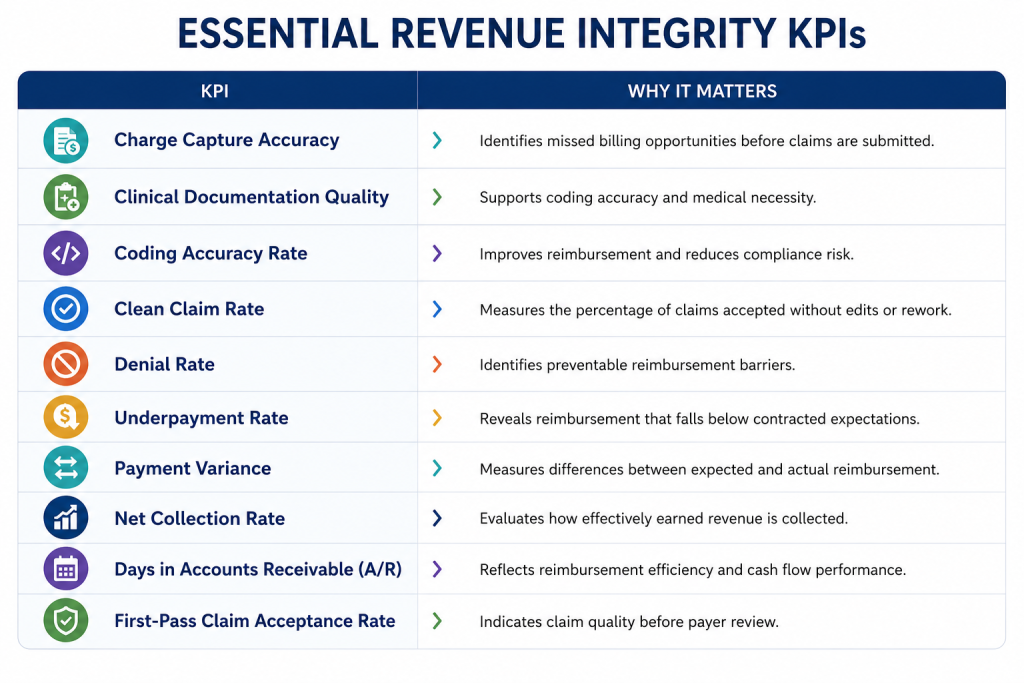
Together, these metrics provide a comprehensive view of reimbursement performance and support continuous operational improvement. Understanding revenue integrity challenges is only the first step. Sustained improvement requires the right expertise, processes, and technology to strengthen reimbursement performance across the entire revenue cycle.
Turn Revenue Integrity Into a Strategic Advantage
Revenue integrity is not a single function. It’s an operational discipline that requires alignment across clinical, financial, and administrative teams. Organizations that strengthen these processes proactively are better positioned to improve reimbursement accuracy, reduce revenue leakage, and build long-term financial resilience.
AnnexMed helps hospitals, health systems, physician groups, and specialty practices strengthen revenue integrity by improving the operational processes that influence reimbursement, from clinical documentation and coding through payment validation and revenue analytics.
Our Revenue Integrity Capabilities
Revenue Accuracy
- Clinical Documentation Improvement (CDI)
- Medical Coding
- Charge Capture Optimization
Revenue Protection
- Payment Validation
- Underpayment Analysis & Recovery
- Revenue Integrity Audits
Revenue Intelligence
- Revenue Cycle Analytics
Backed by experienced revenue cycle professionals, standardized processes, and data-driven insights, AnnexMed helps healthcare organizations improve reimbursement accuracy, strengthen compliance, reduce revenue leakage, and maximize earned revenue.
Whether you’re enhancing an existing revenue integrity program or building a more proactive reimbursement strategy, AnnexMed provides the expertise and operational support to help you achieve sustainable financial performance.
Build a Stronger Revenue Integrity Program
Improve documentation, coding, charge capture, payment validation, and reimbursement accuracy with AnnexMed’s comprehensive revenue integrity solutions.
Schedule a Revenue Integrity AssessmentFAQs
Revenue integrity is the process of ensuring that every healthcare service is accurately documented, correctly coded, appropriately billed, and reimbursed according to payer contracts and regulatory requirements. It brings together clinical, operational, and financial processes to help healthcare organizations reduce revenue leakage, strengthen compliance, and maximize reimbursement for the care they provide.
Revenue cycle management focuses on the operational processes involved in registering patients, submitting claims, collecting payments, and managing accounts receivable. Revenue integrity complements RCM by ensuring every stage of the revenue cycle supports accurate reimbursement through effective documentation, coding, charge capture, and payment validation.
Charge capture ensures that every billable service, procedure, medication, and supply is accurately recorded before a claim is submitted. Missing or inaccurate charges can result in unrecoverable revenue loss because services that are never billed cannot be reimbursed.
Healthcare organizations can reduce revenue leakage by improving clinical documentation, maintaining coding accuracy, optimizing charge capture, preventing avoidable denials, validating payer reimbursements, conducting regular revenue integrity audits, and monitoring key performance indicators across the revenue cycle.
Revenue integrity helps hospitals protect earned revenue by identifying and preventing issues that can lead to missed charges, coding errors, preventable denials, underpayments, and payment variances. A strong revenue integrity program improves reimbursement accuracy, supports regulatory compliance, strengthens cash flow, and provides greater visibility into the operational processes that influence financial performance.