

Last Updated on July 7, 2026
As healthcare organizations continue investing in automation, digital billing, patient portals, and revenue cycle optimization, one challenge continues to quietly impact financial performance: patient confusion around Explanation of Benefits (EOBs) and financial responsibility.
Most providers closely monitor denial rates, clean claim rates, days in A/R, and collection performance. Yet fewer organizations actively measure one of the underlying causes of delayed patient payments: whether patients actually understand what they owe and why they owe it.
As patient financial responsibility continues to increase, confusion around EOBs can create a ripple effect across the revenue cycle. Delayed payments, rising patient A/R, increased call volume, higher operational costs, and slower cash flow often begin with a simple problem: patients are unsure of their financial obligation.
The challenge is no longer just getting claims paid. It is ensuring patients understand their portion of the bill once the claim has been processed.
In this article, we’ll explore why patient confusion has become a hidden revenue cycle metric, how it affects financial performance, and what organizations can do to improve patient collections.
Table of contents
- Most Organizations Measure Denials. Fewer Measure Patient Confusion
- Four Ways Patient Confusion Impacts Revenue Cycle Performance
- Why EOB Confusion Matters More Than Ever
- The Revenue Cycle Cost of Patient Confusion
- Patient Responsibility Is Reshaping the Revenue Cycle
- Financial Clarity Has Become a Cash Flow Strategy
- How Revenue Cycle Leaders Can Improve Patient Collections
- Turning Patient Financial Clarity Into Revenue Cycle Performance
- FAQs
Most Organizations Measure Denials. Fewer Measure Patient Confusion
Healthcare organizations spend significant time monitoring:
- Denial rates
- Clean claim rates
- Net collection rates
- Days in accounts receivable
- Reimbursement trends
These metrics are critical to financial performance. However, many organizations overlook a factor that directly influences patient collections: patient understanding.
When patients do not understand their EOBs, provider statements, or financial responsibility, payment decisions are often delayed. What appears to be a patient experience issue quickly becomes a revenue cycle issue.
The reality is simple: confusion creates friction, and friction slows collections.
Patient confusion should be viewed as a revenue cycle metric, not simply a customer service concern.
Four Ways Patient Confusion Impacts Revenue Cycle Performance
1. Rising Patient A/R
When patients are uncertain about what they owe, payment often moves down their priority list.
Impact
- More balances aging into later buckets
- Increased collection efforts
- Greater risk of bad debt
- Longer payment cycles
Patient confusion today often becomes patient A/R tomorrow.
2. Increased Billing Inquiries
Unclear EOB information generates additional questions for billing teams. Common inquiries include:
- Why do I owe this amount?
- Didn’t my insurance already pay?
- Is this balance correct?
- Can someone explain my EOB?
- Why is my provider bill different from my EOB?
Impact
- Higher call volume
- Increased staff workload
- Reduced collection productivity
- Longer patient support interactions
Every clarification call represents time that could otherwise be spent on revenue-generating activities.
3. Higher Operational Costs
Confused patients often require additional statements, follow-up communications, payment reminders, manual account reviews, and repeated support interactions.
Impact
- Increased administrative expenses
- Higher cost-to-collect metrics
- Reduced operational efficiency
- Greater pressure on billing teams
The cost of confusion extends far beyond delayed payments.
4. Slower Cash Flow
Revenue is only realized when payments are collected. Even when insurance claims are processed successfully, organizations may struggle to collect the patient portion if financial responsibility is not clearly understood.
Impact
- Longer collection cycles
- Increased patient receivables
- Reduced cash flow predictability
- Delayed revenue realization
Confusion today often becomes delayed revenue tomorrow. Rising patient A/R, increased inquiries, higher costs, and slower cash flow are often symptoms of the same underlying issue: financial uncertainty.
Not Every Revenue Problem Starts With a Denial
AnnexMed helps healthcare providers identify hidden collection barriers and improve patient payment performance before they impact cash flow.
Talk to UsWhy EOB Confusion Matters More Than Ever
Most healthcare organizations actively monitor denial rates, collection performance, reimbursement trends, and payer behavior. However, today’s patient payment journey is becoming increasingly complex. Patients now receive information from multiple sources, including:
- Digital EOBs from payers
- Provider billing statements
- Patient portal notifications
- Text payment reminders
- Email communications
Despite greater digital access, many patients still struggle to:
- Distinguish between an EOB and a medical bill
- Interpret insurance terminology and benefit explanations
- Understand deductibles, copays, and coinsurance amounts
- Reconcile information across multiple communications
- Determine their next payment step
The result is often delayed payment decisions, increased billing inquiries, and growing patient receivables. Access to information does not automatically create understanding.
The Revenue Cycle Cost of Patient Confusion
Many payers have modernized the EOB experience through digital communications and online portals, highlighting digital trends that can inspire innovative online business ideas in the healthcare industry. However, digitization alone does not solve the problem.
The Real Issue Is the Gap Between Information and Understanding
Most patients receive the information they need. What many do not receive is clarity.
An EOB is not a bill, yet many patients interpret it as one. Others struggle to reconcile their EOB with the provider statement that arrives later. When those questions remain unanswered, payment decisions are frequently postponed.
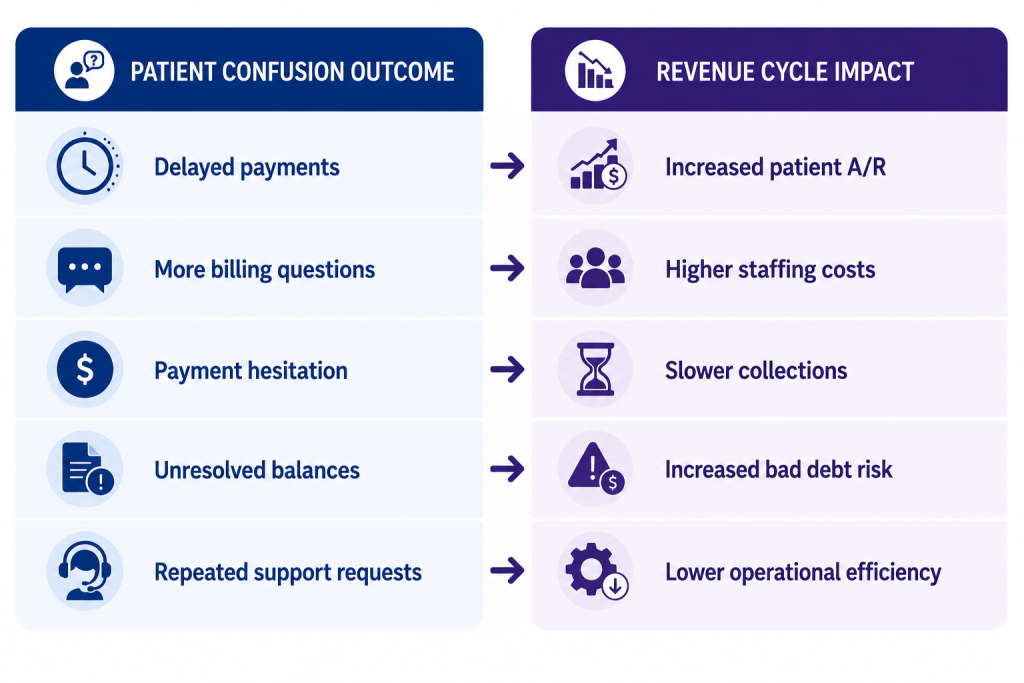
The problem is rarely the EOB itself, it is the lack of clarity surrounding it.
Patient Responsibility Is Reshaping the Revenue Cycle
Healthcare consumers are paying a larger share of their medical costs than ever before. Higher deductibles, coinsurance obligations, and out-of-pocket expenses have shifted more financial responsibility directly to patients.
As patient responsibility grows, collection success increasingly depends on whether patients understand:
- Why a balance remains after insurance processing
- How deductibles and coinsurance affect out-of-pocket costs
- Which charges are their responsibility versus the payer’s
- Available payment options and timelines
- The financial impact of delaying payment
Even when insurance claims are processed correctly, reimbursement remains incomplete until the patient portion is collected. Provider groups that improve financial clarity are often better positioned to reduce patient A/R and strengthen cash flow performance.
Patient financial understanding is becoming just as important as payer reimbursement performance.
Financial Clarity Has Become a Cash Flow Strategy
Historically, revenue cycle improvement focused heavily on payer-side performance. Today, patient collections represent a growing share of healthcare revenue.
Healthcare providers that prioritize financial transparency often experience:
- Faster patient payments
- Lower patient A/R
- Reduced call volume
- Improved collection rates
- Better patient satisfaction
- Stronger cash flow performance
Financial clarity is no longer simply a patient experience initiative, it is a collection strategy. Strong revenue cycle management is no longer just about getting claims paid. It is about collecting what is owed after the claim is processed.
Clear communication helps remove payment friction and accelerate patient collections.
How Revenue Cycle Leaders Can Improve Patient Collections
Healthcare providers looking to improve patient collection performance should consider the following strategies:
- Simplify Financial Communication – Avoid overly complex insurance terminology and billing language whenever possible.
- Align Patient Statements With EOB Information- Make it easier for patients to reconcile payer communications with provider balances.
- Monitor Billing Inquiry Trends – Rising patient questions often indicate financial communication gaps.
- Focus on Patient Financial Education – Helping patients understand financial responsibility can reduce payment friction throughout the collection process.
- Track Patient Confusion Like You Track Denials – Many organizations carefully monitor denial rates and collection performance. Fewer monitor EOB-related call volume, statement clarification requests, patient billing disputes, and payment delays linked to financial confusion.
These indicators can reveal hidden barriers to patient payment and help organizations address collection challenges proactively. What gets measured gets improved. Patient confusion deserves the same visibility as traditional revenue cycle metrics.
Turning Patient Financial Clarity Into Revenue Cycle Performance
As patient financial responsibility continues to increase, patient understanding has become a critical factor in revenue cycle success. Organizations that focus only on denials and payer reimbursement may overlook one of the most important drivers of patient collections: financial clarity.
At AnnexMed, we help healthcare organizations improve patient collection performance through revenue cycle strategies that reduce patient confusion, strengthen financial communication, lower patient A/R, and improve cash flow visibility. From patient payment workflows to end-to-end revenue cycle optimization, our team helps providers create a more efficient path from claim adjudication to payment collection.
The future of revenue cycle management isn’t just about getting claims paid, it’s about helping patients understand what they owe and making it easier for them to pay. By addressing confusion before it impacts collections, healthcare providers can improve financial performance while creating a better patient financial experience.
FAQs
- What is an EOB?
An Explanation of Benefits (EOB) is a statement from an insurance payer explaining how a claim was processed, what was paid, what was adjusted, and what portion may be the patient’s responsibility.
- Why do patients get confused by EOBs?
Patients often struggle to interpret insurance terminology, deductible information, coinsurance amounts, and payer adjustments, especially when receiving communications from both providers and insurers.
- How does EOB confusion affect revenue cycle performance?
Patient confusion can contribute to delayed payments, higher patient A/R, increased call volume, greater collection costs, and slower cash flow.
- Can better patient communication improve collections?
Yes. Clear financial communication helps patients understand their obligations, increasing payment confidence and reducing payment delays.
- Why should revenue cycle leaders focus on patient confusion?
As patient responsibility grows, patient understanding becomes increasingly important to collection performance, cash flow, and overall revenue cycle health.
- Should patient confusion be tracked as a revenue cycle metric?
Yes. Monitoring billing disputes, statement clarification requests, EOB-related inquiries, and payment delays can help organizations identify hidden barriers to patient collections.