

Last Updated on July 3, 2026
Your accounts receivable dashboard flashes red at 90 days. Numbers scream urgency. Your billing team scrambles, phones pile up, claim follow-ups become routine, and aging reports dominate every revenue cycle meeting.
But what if chasing every claim past 90 days is actually costing you revenue instead of recovering it?
This is what we call the 90-Day AR Illusion, the belief that older balances automatically represent the greatest recovery opportunity. The reality is far more complex. As claims age, documentation becomes harder to retrieve, appeal windows narrow, payer restrictions increase, and recovery efforts require significantly more time and resources.
At the same time, many organizations overlook claims in the 30–60 day range that often have stronger collection potential and require far less effort to resolve.
Not all AR dollars are equal.
A claim from 95 days ago with missing documentation may have little chance of recovery. Meanwhile, a claim from 60 days ago with complete documentation and a correct authorization may simply need targeted follow-up to convert into cash.
The question isn’t whether to work older balances. It’s whether you’re working the right balances.
Looking for an AR Partner That Understands Recovery Potential?
From aging claim reconstruction to strategic AR prioritization, AnnexMed helps practices recover revenue while protecting day-to-day cash flow.
Connect with us TodayTable of contents
- The Hidden Cost of Managing AR Past 90 Days
- Understanding the AR Collectibility Curve
- Why Aging AR Does Not Always Indicate Collectible Revenue
- How High-Performing Revenue Cycle Teams Prioritize AR Recovery
- How to Recognize the 90-Day AR Illusion
- Why Traditional AR Strategies Are Failing in 2026
- Checklist to Build a Recovery-First AR Strategy
- Shift From Aging AR to Collectible Cash
- FAQs
The Hidden Cost of Managing AR Past 90 Days
Many healthcare organizations operate under a simple rule: work the oldest accounts first.
While that sounds logical, it often creates an unintended consequence. Teams spend significant time investigating highly aged claims while newer accounts with stronger recovery potential receive less attention.
Consider two claims:
- A $150,000 balance sitting at 180 days with multiple denials and incomplete documentation
- A $50,000 balance at 15 days awaiting a corrected claim submission
The larger balance may look more important on an aging report, but the second claim may be far more likely to generate cash.
This is where opportunity cost enters the picture.
Every hour spent reconstructing a deeply aged claim is an hour not spent resolving accounts that could produce faster reimbursement. As claims continue to age, recovery becomes increasingly difficult due to documentation gaps, staff turnover, appeal limitations, and payer restrictions.
The goal of AR recovery is not simply to reduce aging balances. The goal is to maximize collectible cash.
Understanding the AR Collectibility Curve
A reality that many healthcare organizations overlook: claims don’t lose value overnight. Their collectibility declines gradually as they age.
Each additional day in AR introduces new barriers to reimbursement. Documentation becomes harder to retrieve, denial appeals become more complicated, payer requirements evolve, and staff may spend more time researching the claim than the claim is ultimately worth.
That’s why successful AR management isn’t about chasing the oldest claim first. It’s about identifying which claims still have the highest probability of becoming cash and allocating resources accordingly.
Key Insight: A claim’s age tells part of the story. Its recovery potential tells the rest.
Why Aging AR Does Not Always Indicate Collectible Revenue
One of the biggest misconceptions in healthcare accounts receivable management is that age alone determines recovery potential.
In reality, collectibility is influenced by multiple factors, including documentation quality, payer requirements, denial status, authorization history, and claim complexity.
- Documentation Matters More Than Age
A claim with complete clinical documentation, authorization records, and accurate coding may still be recoverable at 90 days.
Conversely, a 60-day claim missing operative notes, supporting documentation, or authorization details may already face significant barriers.
- Denials Create Different Recovery Paths
Not all denials carry the same recovery potential.
For example:
- Correctable coding denials often have strong recovery potential.
- Authorization-related denials may require extensive appeal efforts.
- Timely filing denials may have limited recovery options.
Understanding the underlying reason for non-payment is often more valuable than focusing on claim age alone.
- Payer Behavior Influences Recovery
Some payers allow straightforward claim corrections and reconsiderations, while others require extensive documentation reviews.
A claim’s likelihood of payment depends as much on payer behavior as it does on age.
The most successful AR recovery strategies evaluate both factors together.
How High-Performing Revenue Cycle Teams Prioritize AR Recovery
Leading healthcare organizations no longer prioritize AR solely based on aging buckets. Instead, they focus on recovery potential.
| Tier | Age Range | Priority Level | Focus | Actions | Best for |
|---|---|---|---|---|---|
| Tier 1 | 30-60 Days | High Priority | 89% recovery rate, minimal documentation fixes | Daily follow-ups, quick corrected claims | Simple denials, coding errors, missing modifiers |
| Tier 2 | 61-90 Days | Medium Priority, High Yield | 72% recovery rate, moderate documentation review | Prioritize high-value procedures | Complex procedures, bundling issues, modifier errors |
| Tier 3 | 91-120 Days | Selective Priority | 45% recovery rate, document completeness check first | Only pursue if documentation is complete | Claims with complete op notes, invoices, imaging |
| Tier 4 | 121+ Days | Low Priority, Exception-Based | 23% recovery rate, only pursue high-value (> $25K) with complete docs | Appeal packets for complex cases with missing prior auth | Medicare timely filing (12-month limit), commercial reconsiderations |
High-performing revenue cycle teams understand that not all AR dollars are equal. Instead of treating every aging claim the same, they prioritize accounts based on collectibility, claim value, payer responsiveness, and documentation readiness.
This approach improves collector productivity, accelerates reimbursement, and reduces wasted effort.
How to Recognize the 90-Day AR Illusion
Many practices know their AR balance. Far fewer know how much of that balance is realistically collectible.
Ask yourself:
- Is most of your team’s effort focused on claims over 90 days?
- Are collectors prioritizing accounts by age rather than recovery probability?
- Do you have visibility into which payers generate the highest recovery rates?
- Are you spending more time on appeals than prevention?
- Do aging reports drive your strategy more than recovery analytics?
If the answer is yes, your practice may be experiencing the 90-Day AR Illusion.
The challenge isn’t a lack of effort. The challenge is ensuring effort is directed toward the accounts most likely to convert into cash.
Is Your AR Team Focused on the Right Opportunities?
AnnexMed helps healthcare providers identify the most collectible accounts and prioritize recovery efforts for stronger cash flow.
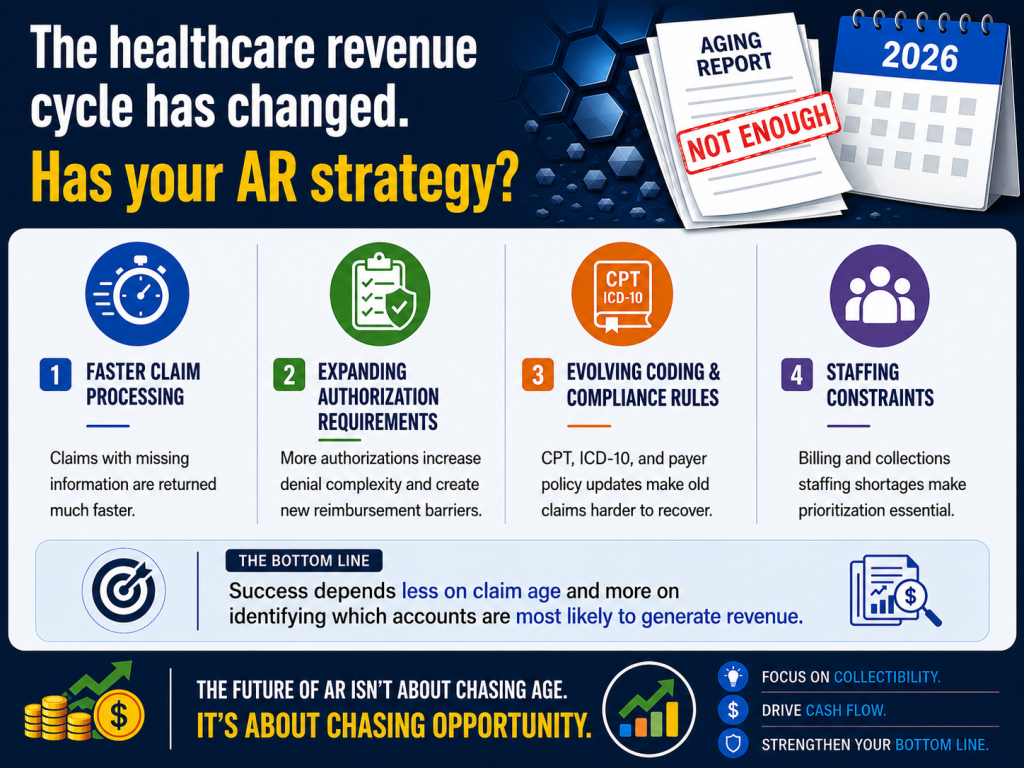
Talk to our ExpertsWhy Traditional AR Strategies Are Failing in 2026
Checklist to Build a Recovery-First AR Strategy
- Define recovery potential as a key AR metric
- Segment claims by collectibility, not just age
- Verify documentation readiness before follow-up
- Consider payer behavior and denial history
- Prioritize high-value, recoverable claims
- Minimize effort on low-probability accounts
- Align workflows with claim value and impact
- Use aging reports as a guide, not a strategy
- Track fastest-cash recovery opportunities
- Reassess priorities as payer rules evolve
Shift From Aging AR to Collectible Cash
The most successful revenue cycle teams don’t treat every aging claim equally.
They prioritize recovery based on documentation quality, payer behavior, claim value, denial status, and collection probability. When AR is viewed through the lens of collectibility rather than age alone, practices can recover revenue faster, improve collector productivity, and make better use of limited resources.
The 90-Day AR Illusion challenges a long-standing assumption in healthcare revenue cycle management: that older balances deserve the most attention.
In reality, not all AR dollars are equal.
A smaller claim with strong recovery potential can often deliver greater financial value than a much larger balance buried deep in aging buckets.
AnnexMed helps healthcare providers move beyond traditional aging reports by identifying recovery opportunities, prioritizing high-value accounts, and building AR strategies focused on collectible revenue, not just aging balances.
Is Your AR Strategy Maximizing Cash or Just Reducing Balances?
AnnexMed helps healthcare providers prioritize accounts with the highest recovery potential and maximize collectible revenue.
Get Your Free AR Recovery AssessmentFAQs
- What is considered a healthy AR aging profile?
While benchmarks vary by specialty, many practices aim to keep the majority of accounts receivable under 90 days and minimize balances in aging buckets beyond 120 days.
- Why do older claims have lower collection rates?
Older claims often face documentation challenges, appeal limitations, payer restrictions, and increased administrative complexity, all of which can reduce recovery potential.
- How should healthcare organizations prioritize accounts receivable?
AR should be prioritized based on recovery potential, claim value, denial status, documentation completeness, and payer behavior—not solely by age.
- What percentage of AR should be under 90 days?
Many revenue cycle leaders aim to maintain at least 80–85% of total AR within the first 90 days to support healthier cash flow.
- What factors have the biggest impact on AR recovery?
Documentation quality, coding accuracy, payer responsiveness, authorization compliance, and timely follow-up all play significant roles in determining collectibility.
- When should a practice consider outsourcing AR recovery?
Outsourcing may be beneficial when aging AR continues to grow, internal resources are limited, or specialized expertise is needed to recover complex claims and reduce revenue leakage.