

Last Updated on November 2, 2026
Switching radiology billing companies involves more than transferring patient accounts and assigning claims to a new vendor. Imaging centers and radiology groups must preserve the connection between completed studies, radiologist interpretations, billing charges, payer information, and outstanding receivables.
A poorly coordinated transition can leave completed studies unbilled, duplicate claims, disrupt payment posting, or make older accounts difficult to recover.
A successful radiology billing transition requires two coordinated workstreams: RIS/PACS data handover and open accounts receivable (AR) reconciliation. Both must be validated before the outgoing billing company loses system access.
This guide explains how radiology practices can prepare for a vendor change, transfer essential records, establish open-AR ownership, and verify that claims continue moving through the revenue cycle.
Changing Radiology Billing Partners? Protect Claim Continuity.
AnnexMed supports radiology billing operations with coding, claims management, and receivables follow-up.
Why Radiology Billing Transitions Require Specialized Planning
Radiology billing depends on information moving between multiple clinical and administrative systems.
A single imaging encounter may involve scheduling information, an accession number, procedure details, radiologist interpretation, referring provider information, authorization records, and professional or technical billing components.
When these records do not align, claims may be delayed or incorrectly generated.
Three risks deserve particular attention:
- Unbilled completed studies: Examinations performed before the transition may not yet have reached the billing workqueue.
- Incomplete charge data: Procedure changes, contrast administration, modifiers, or professional and technical components may be missing.
- Unassigned receivables: Older claims may remain unresolved because neither vendor has clear responsibility for follow-up.
Radiology groups evaluating a change in radiology billing services should assess a prospective partner’s ability to manage clinical-to-claim workflows, coding accuracy, and historical receivables, not only claim submission.
How RIS/PACS Data Moves Into the Radiology Billing Workflow
The first step is documenting how examination data currently moves from the radiology information system (RIS) and picture archiving and communication system (PACS) into the billing platform.
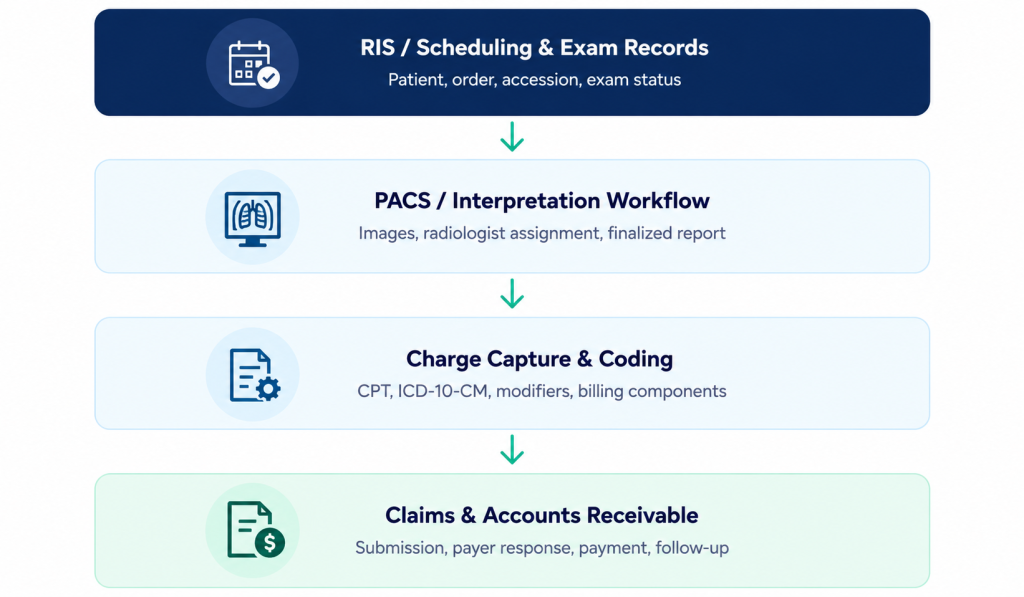
RIS and PACS serve different functions. The RIS commonly manages scheduling, examination status, and operational records. PACS primarily supports image storage and retrieval, while reporting may occur within PACS, RIS, or a separate reporting application.
Billing data may reach the vendor through HL7 interfaces, workqueues, batch files, or practice management integrations. The handover should document the actual source of each billing field, rather than assuming the incoming vendor can reconstruct every charge from PACS records.
RIS/PACS Handover Checklist: What Must Be Transferred?
A structured inventory helps practices identify missing records before the outgoing vendor’s access ends.
| Data category | Required handover checks |
|---|---|
| Patient and encounter | Patient identifiers, demographics, encounter references, service dates |
| Imaging study | Accession number, modality, procedure performed, examination status |
| Clinical documentation | Finalized interpretation, relevant orders, supporting documentation |
| Coding and charges | CPT/HCPCS, ICD-10-CM, modifiers, units, charge status |
| Provider information | Rendering, supervising, referring, and billing provider details as applicable |
| Payer information | Coverage, eligibility, authorization references, claim routing |
| Interface configuration | Data mappings, feeds, error queues, transmission schedules |
| Billing history | Submitted claims, rejections, denials, payments, adjustments |
Validate accession numbers and procedure records
The accession number is a useful reconciliation identifier because it links imaging activity with the corresponding examination record.
However, one accession does not necessarily equal one separately billable claim line. Practices must account for multiple procedures, combined examinations, and site-specific workflows.
Reconcile completed examinations against billing workqueues to identify studies that have not generated charges.
Confirm report availability and authentication
The incoming billing team needs access to the documentation supporting code assignment.
Check whether reports are finalized, signed, corrected, or pending. Establish how amended reports will reach the new billing workflow after the transition.
Review charge and modifier mappings
Confirm that procedure mappings reflect the services performed and the applicable billing arrangement.
Professional and technical component reporting requires particular attention. Confirm which entity is responsible for each component, the applicable billing arrangement, and whether modifier 26 or TC is appropriate under current coding and payer requirements. The distinction between professional and institutional claims should also be considered when validating claim formats and billing entities.
During the handover, existing radiology coding guidelines should remain consistent with current code sets, applicable edits, documentation requirements, and payer policies.
Open-AR Handover Checklist: Establish Claim Ownership
Open AR is frequently the most difficult part of a billing vendor transition because outstanding accounts may be at different stages of resolution.
Some claims have never been submitted. Others are awaiting adjudication, require corrections, or have entered the denial management process, while certain accounts contain unapplied payments.
Every outstanding account needs a documented owner, current status, and next action.
A defined AR management process helps establish follow-up ownership, escalation responsibilities, and reporting expectations for accounts transferred between billing vendors.
| Open-AR category | What the incoming team must verify |
|---|---|
| Unbilled studies | Completed exams without released claims |
| Unsubmitted charges | Charges held for coding, documentation, or authorization review |
| Submitted claims | Payer, submission date, claim number, acknowledgment |
| Rejected claims | Rejection reason, correction status, resubmission deadline |
| Denied claims | Denial category, appeal status, applicable deadlines |
| Underpaid claims | Expected reimbursement, payment variance, follow-up status |
| Credit balances | Refund obligations, unapplied payments, reconciliation status |
| Aged AR | Aging bucket, collectible balance, previous actions, next follow-up |
Reconcile Open-AR Balances Before Transfer
Before transferring responsibility, the practice should establish an agreed open-AR balance as of the cutoff date.
Reconcile the outgoing vendor’s claim-level export with the AR aging report, including payer and patient balances, payments, contractual adjustments, credit balances, and unresolved transactions.
Any differences should be documented and assigned for resolution before the incoming team accepts responsibility.
Decide who owns pre-transition receivables
Three arrangements are common:
- Outgoing vendor retains legacy AR: The previous company continues follow-up while the new company handles new claims.
- Incoming vendor assumes open AR: Historical accounts transfer with supporting records and follow-up responsibility.
- Shared transition model: Responsibilities are divided by claim status, service date, payer, or an agreed cutoff.
The arrangement should specify who can correct, appeal, refund, or adjust historical claims.
It should also address how both parties will prevent duplicate submissions and conflicting payer communications.
When older balances require dedicated follow-up, a structured legacy AR recovery process can help distinguish historical account resolution from ongoing billing responsibilities.
Reconcile Completed Studies, Charges, and Claims
A handover is incomplete until the practice can reconcile imaging activity with charge and claim records.
| Radiology Transition Reconciliation | ||
|---|---|---|
| Study Status | Billing Status | Required Action |
| Completed | No charge | Investigate missing charge |
| Completed, report finalized | Claim held | Identify and resolve the billing hold |
| Completed | Submitted | Confirm acknowledgement |
| Completed | Denied | Assign appeal owner |
| Cancelled | Charge generated | Verify whether a billable service occurred; correct unsupported charges |
Effective charge capture and CDM management can support reconciliation between completed examinations, documented procedures, and the charges generated for billing.
Protect Timely Filing, Appeals, and Payment Posting
A vendor change does not reset payer deadlines. Before the cutoff date, identify claims approaching timely filing limits and denials with active reconsideration or appeal deadlines.
Prioritize these accounts based on the applicable payer contract, claim status, and remaining response window. Payment posting requires equal attention. Electronic remittance advice (ERA), electronic funds transfer (EFT), clearinghouse routing, and bank deposit arrangements must be coordinated to avoid missing or misapplied payments.
Key controls include:
- Confirming the effective dates of new claim submission and remittance routing.
- Retaining access to historical remittance files and payment records.
- Reconciling deposits against posted transactions during the transition.
- Tracking payments received for claims submitted by the outgoing vendor.
- Reviewing unapplied cash, takebacks, refunds, and credit balances.
Practices experiencing recurring claim delays should also assess whether radiology revenue cycle audits can identify unresolved coding, charge capture, or payment reconciliation issues.
Know Which Denials Need Attention Before Handover
Unresolved denials can carry documentation gaps, missed follow-ups, and approaching appeal deadlines into the next billing arrangement. Use AnnexMed’s denial root cause guide to identify recurring claim issues and prioritize corrective action.
30-Day Radiology Billing Vendor Transition Plan
A phased plan helps avoid transferring incomplete data or activating new workflows before testing.
| Illustrative 30-Day Transition Plan | |||
|---|---|---|---|
| Days 1–7 | Days 8–14 | Days 15–21 | Days 22–30 |
| Inventory and ownership Confirm systems, interfaces, contracts, data access, AR ownership, and transition contacts. | Export and reconcile Transfer sample records, compare completed studies with charges, and validate open-AR balances. | Test and correct Test coding workqueues, claim files, clearinghouse acknowledgments, and remittance handling. | Cutover and monitor Activate agreed routing, track exceptions daily, and confirm legacy AR follow-up. |
The practice should maintain a transition issue log with an assigned owner, resolution date, and escalation path. A short parallel validation period may be useful, but it must not allow both vendors to submit the same claims.
Final Radiology Billing Cutover Checklist
The incoming billing team should track exceptions after activation to confirm that claims and payments continue moving correctly.
Use these checks as the release criteria.
Final Cutover Checklist
Common Mistakes When Switching Radiology Billing Companies
- Transferring only the AR aging summary. An aging report does not contain enough detail to support individual claim corrections, appeals, or payment reconciliation.
- Assuming PACS access solves billing documentation gaps. Image availability does not replace finalized reports, coding information, or charge records.
- Failing to reconcile completed examinations. Claims can be missed when completed studies never reach the charge queue.
- Overlooking professional and technical components. Incorrect billing entity or component mapping can create denials or duplicate billing.
- Removing outgoing vendor access too early. Historical claim information and audit trails may become inaccessible before the new team completes reconciliation.
- Leaving legacy AR without an owner. Outstanding accounts can age unnecessarily when follow-up responsibilities are unclear.
These risks should be addressed through documented controls that maintain continuity across revenue cycle management, rather than relying solely on vendor assurances
A Controlled Handover Protects Radiology Revenue
Switching radiology billing companies should be managed as a coordinated revenue cycle transition, not simply a change in service providers. RIS/PACS data mapping, completed-study reconciliation, claim-level AR visibility, and clearly assigned responsibilities are essential to maintaining billing continuity.
The transition should also establish who owns unresolved claims, how historical payments will be reconciled, and which exceptions require follow-up after cutover. Without these controls, billing discrepancies can remain unresolved even after the new vendor begins processing claims.
AnnexMed supports radiology practices through specialty billing, coding, denial management, AR follow-up, and revenue cycle reporting. By coordinating these functions around documented handover responsibilities, AnnexMed can help practices identify outstanding billing activity, manage historical receivables, and maintain visibility into claim processing during a vendor transition..
Make Your Next Radiology Billing Transition More Accountable
AnnexMed supports radiology practices with coordinated billing, denial follow-up, and AR management during operational changes.
FAQs
Practices should transfer relevant patient, examination, charge, coding, claim, payment, denial, and AR records, along with supporting documentation and interface specifications.
Not necessarily. The required access depends on where finalized reports and billing-supporting documentation reside. The incoming team needs authorized access to the information required for its responsibilities.
The outgoing vendor, incoming vendor, or both may manage open AR depending on the transition agreement. Every account should have one clearly designated follow-up owner.
Reconcile completed RIS examinations against finalized reports, charge records, and claim statuses. Investigate unmatched studies before and after cutover.
A coordinated transition can minimize disruption, but uninterrupted submission should not be assumed. Interface testing, routing validation, and exception monitoring are necessary.