

Last Updated on August 20, 2026
AI is becoming easier to deploy across revenue cycle workflows. The harder decision is determining where it can create the greatest financial leverage. Reducing denials can protect revenue before it becomes harder to collect. Recovering underpayments can capture revenue that has already been earned but was not fully reimbursed.
Both create value. But they do not create value in the same way. That is why the right AI question is not simply,
“What can we automate?”
It is:
“Where can AI create the greatest financial leverage?”
Build AI Around the Revenue Opportunity
AnnexMed helps connect technology with the operational expertise needed to turn AI insights into prevention, recovery, and measurable financial results.
Partner With UsTable of contents
- AI ROI Starts With the Financial Opportunity
- Denial Prevention vs. Underpayment Recovery
- Volume Alone Can Mislead AI Investment
- Four Factors That Determine AI ROI
- When Denial Prevention Has the Advantage
- When Underpayment Recovery Has the Advantage
- Connecting Prevention and Recovery Creates Greater Value
- Where Should AI Go First?
- Turning AI Investment Into Measurable Financial Impact
- FAQs
AI ROI Starts With the Financial Opportunity
AI is often evaluated through operational metrics.
- How many claims can it review?
- How many accounts can it prioritize?
- How much manual work can it eliminate?
These metrics matter, but they do not tell the entire financial story. A workflow can have thousands of transactions and still represent a relatively small financial opportunity. Another workflow may involve fewer accounts but expose significantly more revenue.
This creates an important distinction:
High automation potential does not always mean high financial ROI. The starting point should be the size and nature of the revenue opportunity.
Ask:
- How much revenue is exposed?
- How frequently does the leakage occur?
- Can the organization influence the outcome?
- What does intervention cost?
- Can the improvement be repeated?
These questions provide a stronger foundation for AI investment decisions.
Denial Prevention vs. Underpayment Recovery
Prevention and recovery can both improve revenue performance, but they do so in very different ways.
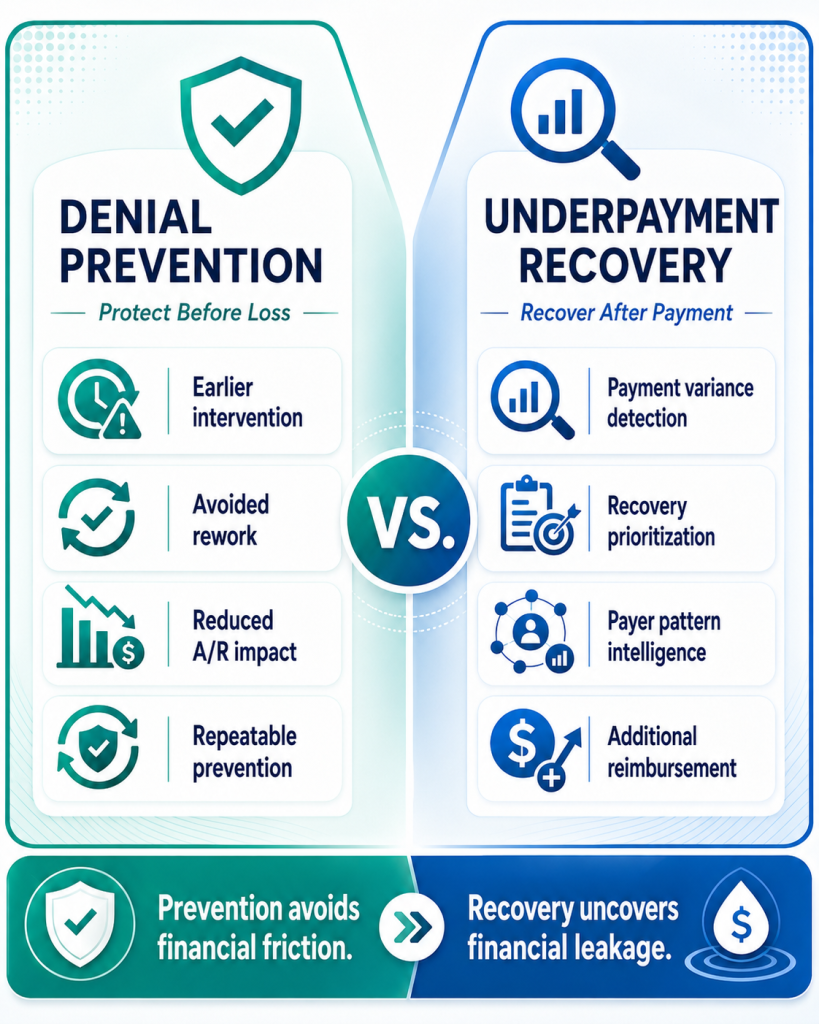
Denial prevention protects revenue earlier
AI can identify patterns associated with preventable denials, such as authorization gaps, documentation issues, coding inconsistencies, missing information, and payer-specific behaviors.
The value is not limited to preventing one denied claim.
If the same issue affects hundreds or thousands of claims, identifying the pattern early can reduce:
- Rework
- Appeals
- Follow-up
- Delayed reimbursement
- A/R growth
- Staff intervention
The real advantage is preventing recurring leakage.
Underpayment recovery finds revenue that was missed
Underpayment recovery looks at the revenue cycle from a different direction. The question is:
Was the organization paid what it should have been paid?
A claim can be submitted correctly, processed successfully, and paid without being fully reimbursed. That creates a different type of revenue leakage. AI can help identify payment variances, recurring payer patterns, reimbursement discrepancies, and accounts where recovery activity is financially worthwhile. This can be particularly valuable when underpayments are difficult to identify through traditional account-by-account review.
Volume Alone Can Mislead AI Investment
Consider two hypothetical opportunities.
Opportunity A:
AI reduces a large number of lower-value preventable denials.
Opportunity B:
AI identifies a smaller number of recurring, high-value underpayments.
Opportunity A may generate significant operational savings.
Opportunity B may generate greater direct financial recovery.
But the opposite could also be true. A recurring denial pattern affecting a high-value service line could create substantial downstream revenue and capacity benefits if addressed upstream.
The lesson is:
The largest workflow is not necessarily the largest financial opportunity.
AI investment should follow the economics of the problem, not simply the number of transactions involved.
Four Factors That Determine AI ROI
The strongest AI opportunities share four characteristics that determine whether insight can translate into measurable return
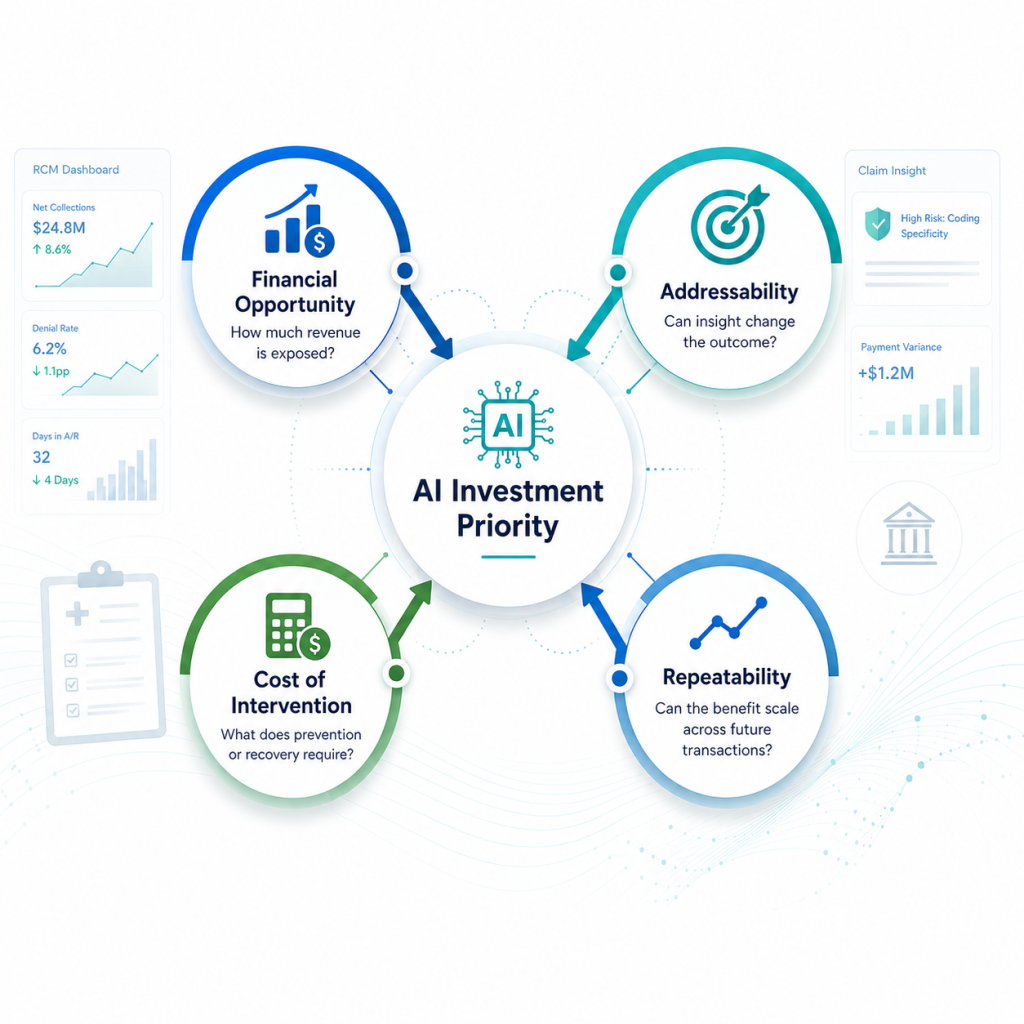
1. Financial Opportunity
Start with the dollars at risk. A 15% improvement means very little without understanding the underlying revenue opportunity. The same percentage improvement can produce dramatically different results depending on the financial base.
2. Addressability
AI can identify an opportunity, but the organization still needs to act on it. An insight becomes more valuable when it can lead to a specific intervention such as correcting documentation, addressing coding, resolving authorization issues, escalating payer discrepancies, or changing a workflow.
3. Cost of intervention
Gross recovery is not the same as net value. The organization should consider the labor, technology, follow-up, escalation, and operational resources required to prevent or recover the revenue. An opportunity with slightly lower gross value may deliver greater net ROI if it requires substantially less effort.
4. Repeatability
This may be one of the most important factors. Recovering a single underpayment creates value once. Identifying a recurring underpayment pattern can potentially improve future recovery across multiple claims.
The same principle applies to denials. Correcting one denied claim solves one problem. Identifying why hundreds of similar claims are being denied can change the economics of the entire workflow. Repeatable intelligence can create more value than one-time intervention.
When Denial Prevention Has the Advantage
AI-driven denial prevention may be the stronger investment when:
- Preventable denials are growing
- The same root causes appear repeatedly
- Denials consume significant staff capacity
- Revenue is delayed because of avoidable issues
- Problems can be corrected before claim submission
- Upstream workflow changes can prevent recurrence
The value comes from moving the intervention earlier. The organization is not simply recovering revenue. It is reducing the probability that the revenue will become difficult to collect in the first place.
Run a 90‑Day Denial Prevention ROI Assessment
See how much revenue your current denial rate is costing and what a 20–30% reduction would mean for your margin.
Talk to Our ExpertsWhen Underpayment Recovery Has the Advantage
Underpayment-focused AI may provide greater value when:
- Payment variance is significant
- Payer-specific discrepancies repeat
- Manual payment review is inconsistent
- High-value claims require extensive investigation
- Contractual reimbursement is difficult to monitor
- Existing workflows capture only obvious payment discrepancies
Here, the opportunity is different. The revenue may already be sitting behind a completed transaction. The challenge is recognizing that the payment does not match the expected financial outcome.
AI can help surface those patterns at a scale that manual review may struggle to achieve. That provides a more disciplined basis for deciding where the next AI investment belongs.
Connecting Prevention and Recovery Creates Greater Value
The strategy may not be choosing between denials and underpayments. It may be connecting the intelligence generated by both. An underpayment pattern can reveal payer behavior, reimbursement variance, or a potential contract-management issue. A denial pattern can reveal documentation, authorization, coding, or workflow problems. Those insights can then move through a continuous cycle:
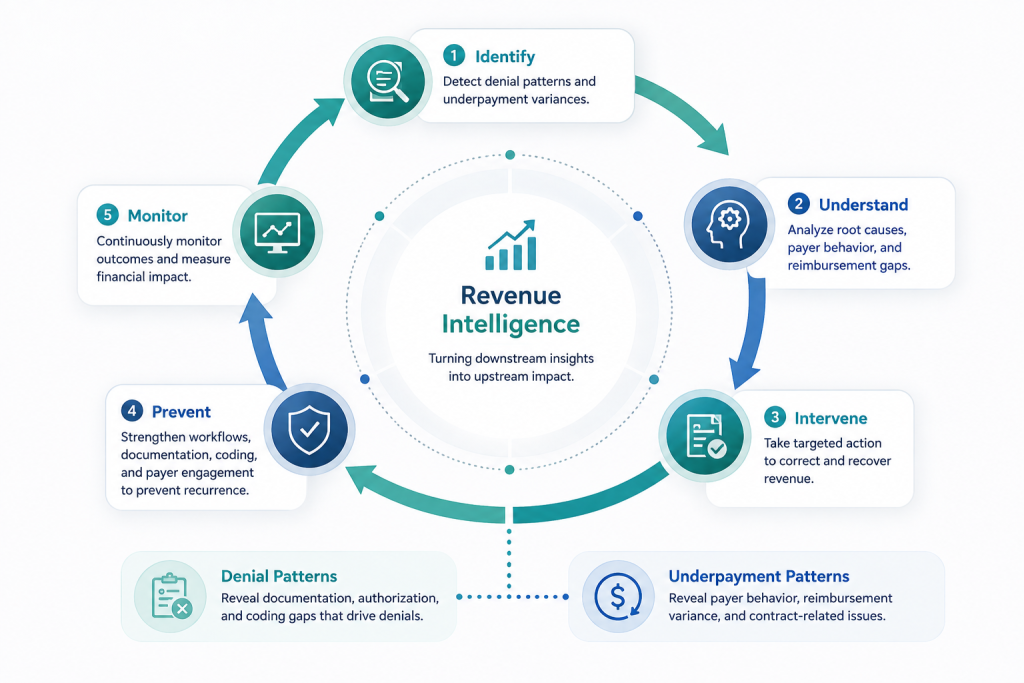
That changes the role of AI. Instead of simply processing more accounts, AI becomes a mechanism for understanding where revenue leakage originates and where intervention can have the greatest downstream impact. This creates an important feedback loop.
Recovery intelligence can inform prevention. Prevention intelligence can reduce future recovery demand. The result is a revenue cycle that becomes more financially intelligent over time.
Where Should AI Go First?
There is no universal answer. The right starting point depends on the organization’s leakage profile.
- If preventable denials represent a major source of lost revenue, delayed cash, and manual work, denial prevention may deliver the stronger initial ROI.
- If payment variance represents a significant and recurring source of missed revenue, underpayment recovery may offer the greater opportunity.
If both are material, the decision should compare them using the same financial framework:
Financial impact + Addressability + Cost efficiency + Repeatability
This creates a more disciplined way to prioritize AI. It also prevents a common mistake: investing in the workflow that is easiest to automate rather than the one that matters most financially.
Turning AI Investment Into Measurable Financial Impact
AI does not create ROI simply because it is deployed into an RCM workflow. The return comes from where intelligence is applied and what financial outcome it changes.
For some organizations, that opportunity may be denial prevention. For others, it may be underpayment recovery. For more mature revenue cycles, the greater opportunity may be connecting both into a continuous feedback loop that identifies leakage, improves intervention, and prevents recurrence.
That is where AnnexMed brings value. With deep RCM expertise across billing, coding, denial management, payment integrity, and revenue recovery, AnnexMed helps organizations identify where financial leakage is occurring and determine where technology, automation, and specialized expertise can create the greatest impact.
The goal is not to automate more. It is to invest where AI can move revenue, cost, and capacity in the right direction.
Turn AI Insight Into Measurable Revenue Impact
AnnexMed combines RCM expertise, analytics, and technology-enabled workflows to help organizations focus AI where measurable revenue impact is greatest.
Talk to Our RCM ExpertsFAQs
AI reduces manual effort, speeds claim resolution, and lowers costs.This translates into faster collections and stronger ROI.
Denial prevention, underpayment recovery, and coding accuracy show the biggest gains. These areas directly protect revenue and reduce leakage.
AI predicts denial risks and flags coding or documentation gaps early. It also identifies underpayments by comparing payer rules with actual remits.
Key metrics include denial rate reduction, clean claim percentage, and A/R days. Cost‑to‑collect improvements confirm ROI impact.
Front‑end AI prevents errors before submission, while back‑end AI recovers missed revenue. ROI depends on where the hospital’s biggest risks lie.