

Last Updated on November 5, 2026
Revenue leakage in ambulatory surgery center billing can be reduced by correcting missed surgical charges, authorization discrepancies, coding errors, contractual underpayments, and unresolved claim denials. The key is to identify these issues before they become permanent financial losses.
For ambulatory surgery centers (ASCs), the challenge extends beyond denied claims. A surgical claim may be accepted and paid, yet the center may receive less than the reimbursement supported by its payer agreement. Similarly, a completed procedure may never be fully reflected in the submitted charges.
Reducing ASC revenue leakage requires a connected approach to preoperative clearance, surgical charge capture, coding validation, payment reconciliation, and denial recovery.
An effective ambulatory surgery center billing process should therefore connect surgical documentation, claim preparation, and payment validation rather than treating each as an isolated activity.
Where ASC Revenue Leakage Occurs
Revenue leakage can originate at any point between surgical scheduling and final payment. Understanding where it occurs helps ASC administrators prioritize corrective action.
| Revenue cycle stage | Where revenue is at risk |
|---|---|
|
01
Before surgery
|
Missing authorization, eligibility discrepancies, or incorrect coverage assumptions |
|
02
During surgery
|
Unrecorded procedures, incomplete implant documentation, or missed charges |
|
03
Before claim submission
|
Incorrect procedure codes, modifiers, or bundling decisions |
|
04
After payer adjudication
|
Contractual underpayments or incorrectly calculated reimbursement |
|
05
During AR follow-up
|
Unresolved denials, missed appeal deadlines, or recoverable balances left outstanding |
These issues require different corrective actions. A missing charge cannot be resolved through denial appeals, while an underpayment may remain undetected unless the ASC compares actual reimbursement with its contractual expectations.
Understanding where leakage occurs is only the first step. The greater impact comes from applying targeted controls at each stage of the revenue cycle, starting before the patient enters the operating room.
Identify Revenue Leakage Before It Reaches the Claim
Assess how missed surgical charges, coding discrepancies, and authorization gaps affect ASC reimbursement.
Prevent Revenue Loss Before Surgery
Revenue protection begins when the procedure is scheduled, not when the claim is submitted.
An authorization may be obtained for the planned surgery, but changes to the procedure, facility, or payer requirements can affect reimbursement eligibility.
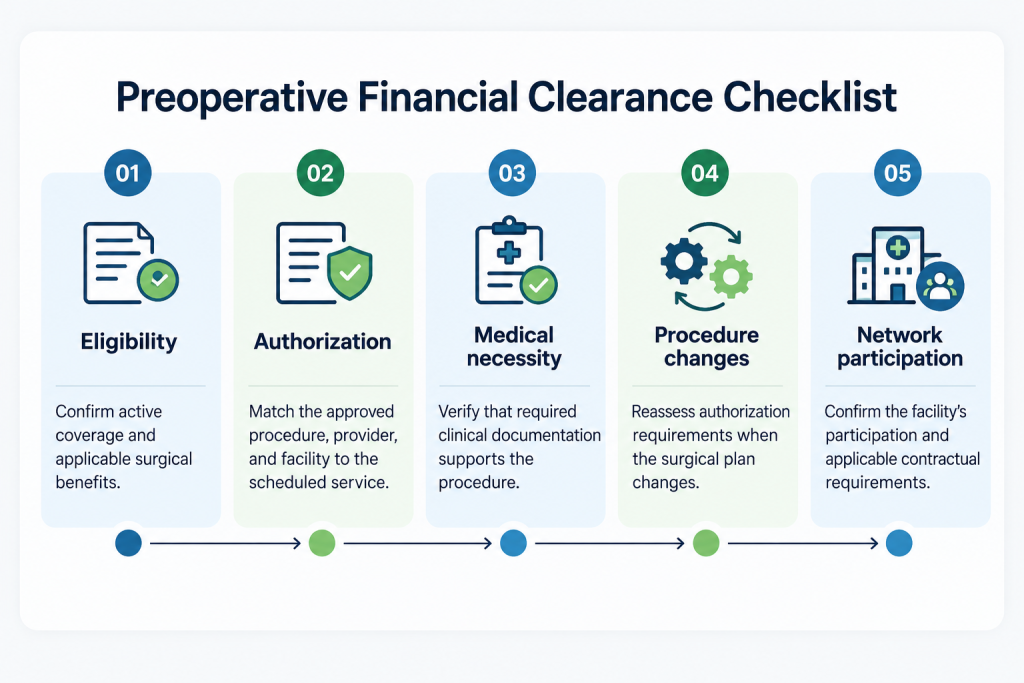
Example
Consider an orthopedic ASC encounter. A patient is initially scheduled for one procedure, but the surgeon changes the operative plan after reviewing updated clinical findings. If the authorization is not reassessed, the completed procedure may not match the approved service.
The issue is not necessarily the absence of authorization. It is the mismatch between the authorized and performed procedures.
Coordinating surgical scheduling with prior authorization support helps billing teams identify discrepancies between the authorized and performed procedures before the claim reaches the payer.
Capture and Code Surgical Services Accurately
Charge capture and coding errors can affect ASC reimbursement even when the procedure is clinically appropriate and fully documented.
The challenge is ensuring that the final claim reflects the services performed while complying with ASC-specific reimbursement rules.
Reconcile Surgical Documentation With Reportable Charges
A practical charge validation process follows four steps:
1. Review the operative record
Confirm the procedures performed, anatomical site, laterality, and relevant operative details.
2. Reconcile surgical supplies and implants
Compare operative documentation, nursing records, implant logs, and the charge record to identify missing or inconsistent information.
3. Validate reportable services
Determine which procedures, devices, or ancillary services are separately reportable, packaged, or subject to payer-specific payment rules.
4. Resolve discrepancies before billing
Route incomplete documentation or charge inconsistencies to the appropriate clinical or coding team before claim submission.
Not every item used during surgery qualifies for separate reimbursement. Medicare ASC payment rules distinguish separately payable procedures and services from packaged items.
CMS publishes ASC payment indicators and quarterly payment updates through its ASC payment rate addenda.
A structured approach to charge capture and CDM management can help identify missing charges and documentation discrepancies before they affect reimbursement.
Validate ASC Coding and Payment Rules
Surgical coding errors may lead to denials, reduced payments, or compliance exposure. ASC billing teams must distinguish facility claims from surgeon professional claims and apply the appropriate coding and payment requirements.
| Coding area | Potential revenue risk | Validation requirement |
|---|---|---|
|
Multiple procedures
|
Incorrect payment reductions or sequencing | Verify applicable ASC multiple-procedure rules |
|
Modifiers
|
Missing, incorrect, or unsupported modifiers | Match modifiers to operative documentation and payer requirements |
|
Device-related reporting
|
Incorrect device or payment classification | Confirm applicable payment indicators and reporting rules |
|
Facility versus professional billing
|
Incorrect claim classification | Validate billing entity and applicable reimbursement methodology |
For Medicare, certain ASC procedures are subject to multiple-procedure payment reductions, while others follow different payment methodologies. Applying the same reimbursement assumption to every surgical service can therefore produce inaccurate payment expectations.
Consistent facility coding review should include operative documentation checks, code-set validation, and applicable payer edits.
How Proactive Audits Helped Reduce Payer Denials by 60%
See how AnnexMed’s targeted claim audits helped address recurring billing discrepancies and reduce payer denials.
Detect Hidden Underpayments in ASC Reimbursement
A paid claim does not always mean an ambulatory surgery center has received the correct reimbursement. Contractual underpayments can go unnoticed when the payer’s allowed amount is not compared with the expected reimbursement under the applicable agreement.
Unlike denied claims, these discrepancies may never enter the denial work queue, making payment reconciliation essential for identifying potential revenue leakage.
Illustrative ASC Payment Reconciliation
| Payment component | Amount |
|---|---|
| Expected contractual allowed amount | $4,800 |
| Actual payer allowed amount | $4,200 |
| Potential payment variance | $600 |
The $600 difference is a potential underpayment, not automatically recoverable revenue. Before pursuing recovery, the ASC must validate the expected amount against contract terms, effective dates, multiple-procedure adjustments, and applicable payment provisions.
Validate the Payment Variance Before Recovery
1. Contract accuracy
Verify that expected reimbursement reflects the correct payer agreement, fee schedule, and effective date.
2. Adjudication accuracy
Compare the payer’s allowed amount and adjustments against the applicable reimbursement methodology.
3. Recovery eligibility
Determine whether the validated discrepancy qualifies for correction, reconsideration, or appeal within payer deadlines.
Focused underpayment analysis and recovery helps distinguish legitimate contractual adjustments from payment discrepancies that require further investigation.
Reduce Denials and Recover Outstanding Revenue
Denied claims create collection risk, but not every denial represents permanent revenue loss. Many claims remain recoverable when the underlying issue is identified and corrected within payer requirements.
The priority is to distinguish preventable billing errors from documentation issues, coverage restrictions, and disputes requiring payer reconsideration.
| Denial category | Common issue | Corrective action |
|---|---|---|
|
Authorization and coverage
|
Approved procedure or facility does not match the claim | Verify authorization details and available reconsideration options |
|
Coding and documentation
|
Modifier, bundling, or medical necessity discrepancy | Review operative documentation and applicable coding rules |
|
Administrative and filing
|
Eligibility, claim routing, or filing deadline issue | Correct workflow errors and validate timely filing requirements |
A denied claim should not automatically be resubmitted with a different code. Coding changes must be supported by the documented service and applicable rules.
For recurring issues, stronger denial management processes connect payer responses with corrections to authorization, documentation, and claim preparation workflows.
Track ASC Revenue Leakage With the Right KPIs
Revenue leakage cannot be measured accurately through collections or denial rates alone.
ASC finance leaders need metrics that distinguish missing charges, payment discrepancies, preventable denials, and outstanding balances requiring intervention.
| KPI | What it measures | Management priority |
|---|---|---|
|
Charge reconciliation completion
|
Percentage of surgical encounters with reconciled charges | Identify missing charge documentation |
|
Initial denial rate
|
Claims denied during initial adjudication | Reduce preventable claim failures |
|
Contractual payment variance
|
Differences between expected and actual allowed amounts | Investigate potential underpayments |
|
Denial recovery rate
|
Value recovered from denied claims | Evaluate recovery effectiveness |
|
AR over 90 days
|
Outstanding balances requiring follow-up | Prioritize aging and collection risk |
A useful monthly review should identify the largest validated revenue discrepancies, investigate their root causes, assign corrective actions, and check whether the same problems recur.
For multi-specialty and multi-location ASCs, revenue cycle KPI analytics can help segment performance by payer, surgeon, specialty, and procedure category to identify recurring financial discrepancies.
A low denial rate does not necessarily indicate strong revenue integrity. An ASC may still experience missed charges or contractual underpayments, while aged AR may include balances that remain recoverable. These measures should be evaluated separately before estimating revenue leakage.
Strengthening ASC Reimbursement With Better Revenue Cycle Controls
Revenue leakage in ambulatory surgery centers often goes unnoticed when procedures are incompletely charged, payer payments are not reconciled, or recoverable claims remain unresolved. Addressing these issues requires identifying the specific billing and reimbursement gaps affecting each surgical encounter.
AnnexMed helps ambulatory surgery centers address these gaps through ASC-specific facility coding, surgical charge reconciliation, payer payment validation, denial resolution, and underpayment recovery. By connecting these functions, AnnexMed helps identify where reimbursement is being missed, correct recurring billing errors, and pursue recoverable revenue.
Address Revenue Leakage at Every Stage of ASC Billing
From missed surgical charges to contractual underpayments, AnnexMed helps ASCs identify billing gaps, resolve discrepancies, and recover eligible revenue.
FAQs
01 What causes revenue leakage in ambulatory surgery center billing?
Common causes include missed surgical charges, authorization discrepancies, incorrect procedure coding, unsupported modifiers, contractual underpayments, and unresolved claim denials. Revenue leakage may occur before claim submission or after payer adjudication.
02 How can ambulatory surgery centers identify hidden revenue leakage?
ASCs can identify potential leakage by reconciling operative records with charges, validating coding accuracy, comparing expected reimbursement with actual allowed amounts, and reviewing denial and AR patterns by payer and specialty.
03 How does charge capture affect ASC reimbursement?
Incomplete charge capture can result in omitted procedures or other reportable services. However, separate reimbursement depends on ASC payment rules and payer contracts. Not every supply, implant, or ancillary service is separately payable.
04 How can ASCs reduce preventable claim denials?
ASCs can reduce preventable denials through preoperative eligibility and authorization checks, accurate operative documentation, coding validation, and systematic review of recurring payer denial reasons.
05 What is the difference between ASC underpayments and claim denials?
A claim denial occurs when payment is refused or a billed service is not approved. An underpayment occurs when reimbursement is received but may be lower than the amount supported by the applicable contract or payment rules.
06 Which KPIs help measure ASC revenue leakage?
Important measures include charge reconciliation completion, initial denial rate, contractual payment variance, denial recovery rate, and AR over 90 days. These metrics