Last Updated on September 29, 2026
Dental procedures do not always stay within the dental insurance pathway. When treatment involves an oral lesion, medically necessary surgery, pathology, or another qualifying condition, a dental practice may need to determine whether the service should also be evaluated for medical billing.
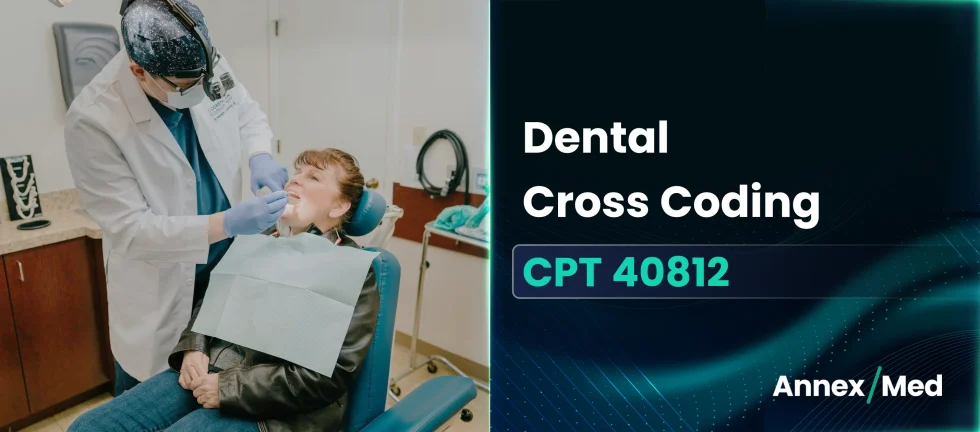
CPT code 40812 describes the excision of a lesion involving the mucosa and submucosa of the vestibule of the mouth with simple repair. Accurate cross-coding requires the actual procedure, anatomical site, diagnosis, documentation, repair, medical necessity, and payer policy to support the medical claim, not a simple CDT match.
This guide explains CPT 40812, its role in dental-medical cross coding, documentation requirements, related CPT codes, and common billing issues.
Managing Dental and Medical Coding for the Same Procedure?
AnnexMed supports dental practices with coding, documentation review, and medical-dental cross coding.
Explore Dental Coding SupportTable of contents
What Is CPT Code 40812
CPT 40812 falls within the CPT family for excision and destruction procedures involving the vestibule of the mouth. It applies when a provider excises a lesion involving the mucosa and submucosa and performs a simple repair of the surgical wound.
The vestibule of the mouth refers to the area of the oral cavity outside the dentoalveolar structures and includes mucosal and submucosal tissues of the lips and cheeks.
Three elements are therefore central to CPT 40812:
- The lesion involves the vestibule of the mouth
- Mucosal and submucosal tissue is excised
- The resulting wound receives a simple repair
If the operative documentation describes a different anatomical site, no repair, a complex repair, or excision involving underlying muscle, another CPT code may be more appropriate.
Is There a Dental CDT Cross Code for CPT 40812
There is no universal one-to-one CDT cross code that should automatically replace or correspond to CPT 40812.
CDT and CPT describe services within different coding systems. A dental procedure should not be converted to CPT 40812 simply because both codes appear to involve oral surgery or lesion removal. The documentation must support the medical procedure being reported.
The coding decision should consider:
- Exact location of the lesion
- Tissue involved
- Whether the lesion was biopsied, excised, or destroyed
- Whether a repair was performed
- Complexity of the repair
- Diagnosis or clinical reason for treatment
- Medical necessity
- Dental and medical payer requirements
The applicable CDT code, when one is required for the dental claim, should be selected independently from the documented dental service rather than through a simple code substitution.
For a broader overview of CDT-to-CPT translation, diagnosis linkage, and medical-claim requirements, explore AnnexMed’s guide to dental-medical cross-coding for wisdom tooth removal.
CPT 40812 vs 40810 vs 40814 vs 40816
One of the most important coding considerations is distinguishing CPT 40812 from the related codes in the same family.
| CPT Code | Procedure Distinction |
|---|---|
| 40810 |
Excision involving mucosa and submucosa of
the mouth vestibule without repair
|
| 40812 |
Excision involving mucosa and submucosa
with simple repair
|
| 40814 |
Excision involving mucosa and submucosa
with complex repair
|
| 40816 |
Complex excision involving underlying muscle
|
The key differentiators are repair and depth of excision. The operative report should clearly establish what happened after the lesion was removed. Documentation stating only that an “oral lesion was excised and the site closed” may not provide enough detail. The anatomical location, tissues involved, and nature of the repair should be documented.

For CPT 40812, the repair is not a minor documentation detail. It is one of the elements that distinguishes the code from neighboring procedures in the same CPT family. Coding teams should therefore review the complete operative note rather than selecting the code based solely on “oral lesion excision.”
Documentation Requirements for CPT 40812
Documentation supporting CPT 40812 should allow the coder and payer to understand exactly what was treated and how the procedure was performed.
Depending on the clinical situation and payer, relevant documentation may include:
- Location of the lesion
- Clinical description of the lesion
- Indication for removal
- Mucosal and submucosal involvement
- Description of the excision
- Description of the repair
- Diagnosis or suspected condition
- Operative or procedure note
- Pathology information when applicable
- Relevant clinical history
The operative note is particularly important when differentiating between CPT 40810, 40812, 40814, and 40816.
Is Documentation Supporting the Code Being Submitted?
AnnexMed helps dental practices review coding and clinical documentation together, supporting accurate dental and medical claim submission.
Review Your Dental Coding WorkflowWhen Can CPT 40812 Be Billed to Medical Insurance
A medical claim involving CPT 40812 generally requires an ICD-10-CM diagnosis that reflects the documented condition being treated. There is no single diagnosis code that automatically accompanies CPT 40812. Diagnosis selection depends on the clinical findings and documentation.
Before submitting the claim, the practice should verify the patient’s medical benefits, provider eligibility, medical necessity requirements, applicable diagnosis coding, prior authorization requirements, payer policies, and supporting documentation.
Because medical coverage can differ from a patient’s dental benefits, a structured benefits review is essential before routing the claim. See AnnexMed’s guide to eligibility and benefit verification for healthcare claims.
A valid CPT code does not by itself establish medical coverage. The documented procedure, diagnosis, medical necessity, and individual health plan requirements determine whether medical billing is appropriate.
These same principles apply to other dental services that may qualify for medical reimbursement, including oral biopsies, trauma care, TMJ treatment, and craniofacial procedures. Learn more about dental coding and claims processing for medical-dental crossover services.
Common CPT 40812 Coding and Billing Errors
Most problems around CPT 40812 are better understood as documentation, code-selection, or payer-pathway issues rather than simply “wrong code” problems. When these issues recur, reviewing denial trends and payment variance by payer, procedure, and claim type can help identify broader workflow gaps. AnnexMed’s dental analytics and revenue optimization services help practices monitor billing performance and identify opportunities to improve revenue visibility.
Common issues include:
- Using 40812 when no repair was performed: If the documentation supports excision without repair, the neighboring code 40810 may be relevant instead.
- Not distinguishing simple and complex repair: CPT 40812 and 40814 describe different levels of repair. The documentation should support the procedure selected.
- Ignoring the anatomical site: CPT 40812 specifically concerns the vestibule of the mouth. A lesion involving another oral structure may belong to another CPT family.
- Treating cross coding as direct code conversion: A CDT procedure and CPT procedure should not be assumed to be interchangeable.
- Submitting an unsupported diagnosis: The ICD-10-CM code should reflect the documented condition rather than being chosen simply to support payment.
- Assuming medical coverage: A CPT code indicates how a service may be reported. It does not determine whether a particular health plan covers that service.
These risks are not limited to CPT 40812. Incorrect CDT-to-CPT mapping, unsupported medical necessity, missing operative notes, and modifier errors are recurring issues in dental-medical claims. Review the common dental cross-coding mistakes that can lead to denials.
Improving Accuracy in Dental Medical Cross Coding
CPT 40812 is used for a specific clinical scenario involving excision of a lesion from the mucosa and submucosa of the mouth vestibule with simple repair. The presence or absence of repair, complexity of the closure, tissue depth, anatomical site, diagnosis, and documentation can all affect code selection.
For dental practices, the larger lesson is that CPT cross coding should not be handled as a direct conversion from a CDT code. Each claim should be supported by the procedure performed, clinical documentation, diagnosis, medical necessity, benefits, and payer requirements.
AnnexMed helps dental practices and DSOs connect dental coding, medical cross coding, documentation review, claims processing, and payer requirements so eligible claims are routed and coded appropriately.
For practices that need support beyond coding and claim submission, dental payment posting and reconciliation services can help verify remittance accuracy, route denial issues, and reconcile payments against expected reimbursement.
Practices managing oral lesions, biopsies, trauma-related procedures, or other medically billable oral surgery may also benefit from specialty support across the surgical revenue cycle.
Complex Dental Medical Claims Need More Than Code Matching
AnnexMed supports dental practices and DSOs with dental coding, medical cross coding, documentation review, and claims processing aligned with payer requirements.
Talk to a Dental RCM SpecialistFAQs
CPT 40812 reports excision of a lesion involving the mucosa and submucosa of the vestibule of the mouth when the procedure includes simple repair.
There should not be an automatic one-to-one CDT conversion for CPT 40812. The CDT code should reflect the documented dental procedure, while CPT 40812 should only be reported when the medical procedure documentation supports its requirements.
Both involve excision of a lesion from the mucosa and submucosa of the mouth vestibule. CPT 40810 describes the procedure without repair, while CPT 40812 includes simple repair.
CPT 40812 involves simple repair after lesion excision, while CPT 40814 involves complex repair.
It may be submitted to medical insurance when the documented procedure, diagnosis, medical necessity, provider status, benefits, and payer requirements support medical billing. Reporting a valid CPT code alone does not establish coverage or guarantee reimbursement.