
Last Updated on September 22, 2026
Revenue rarely disappears at the point where a claim is denied.
More often, the financial impact starts much earlier with an eligibility error, an authorization gap, incomplete documentation, missed charge, coding variance, or disconnected handoff.
By the time that issue becomes a denial, delayed payment, or underpayment, the original cause may be several steps upstream.
That makes healthcare revenue cycle management (RCM) more than a billing function. It is an interconnected financial architecture where decisions made at one stage can influence revenue performance several steps downstream.
Table of Contents
- Why Revenue Problems Start Before the Claim
- The Six Layers Behind Revenue Performance
- Where Revenue Leakage Enters the Cycle
- From Reactive RCM to Revenue Intelligence
- What Healthcare Leaders Should Measure
- Building a More Resilient Revenue Architecture
- The AnnexMed Approach: Connect the Layers, Not Just the Tasks
- FAQs
Why Revenue Problems Start Before the Claim
A claim is the visible output of dozens of upstream decisions.
Was the patient registered correctly?
Was eligibility verified?
Was authorization obtained?
Was the service documented sufficiently?
Was the charge captured?
Was the correct code assigned?
Was the claim validated against payer requirements?
A weakness at any of these points can travel downstream, creating rework, delaying reimbursement, or increasing the likelihood of denials.
The real opportunity, therefore, is not simply to fix claims faster, but to understand where the conditions for those claims were created.
This is why organizations looking to improve revenue cycle performance need to look beyond individual billing functions and examine how the entire system connects.
Where Is Your Revenue Cycle Losing Value?
AnnexMed connects the critical layers of RCM to identify revenue leakage, strengthen controls, and improve financial performance.
Identify Your Revenue GapsThe Six Layers Behind Revenue Performance
Think of revenue as a structure built layer by layer. Each layer influences the next, and a weakness early in the cycle can create consequences much later.
1. Data & Systems: The Foundation
Accurate patient, payer, clinical, and financial data forms the foundation of the revenue cycle.
When foundational data is incomplete or inconsistent, downstream teams spend time correcting information instead of moving claims toward payment. Connecting these data points through RCM data and analytics can help organizations identify denial patterns, coding gaps, payer behavior, and cash-flow trends across the revenue cycle.
2. Policies & Controls: The Guardrails
Payer rules, coding guidelines, authorization requirements, compliance policies, and internal controls determine whether revenue processes are executed consistently.
Strong controls help prevent recurring errors from becoming recurring losses.
This is where revenue integrity becomes critical: keeping the services delivered, documented, coded, billed, and reimbursed aligned throughout the revenue cycle.
3. Workflows & Handoffs: Where Gaps Multiply
Revenue moves across departments, from patient access and authorization to clinical documentation, coding, billing, and AR.
Every handoff creates an opportunity for information to be lost, delayed, or interpreted differently.
A connected workflow makes ownership clearer and problems easier to identify. More importantly, it helps organizations trace downstream revenue issues back to the upstream process where they originated.
4. Clinical Documentation: Where Care Becomes Billable
Documentation connects the care delivered with the services reported.
Incomplete or nonspecific documentation can affect coding accuracy, medical necessity, charge capture, and ultimately reimbursement.
That makes clinical documentation improvement an important part of revenue integrity, not simply a compliance exercise.
In practice, moving documentation controls upstream can directly affect downstream revenue performance. AnnexMed’s Pre-Bill Documentation Controls case study illustrates this in practice. By moving documentation review earlier in the billing process, a plastic and reconstructive surgery practice reported 34% fewer reconstructive denials, 27% fewer documentation requests, and 24% less claim rework.
5. Billing & Claims: The Visible Layer
This is where upstream decisions become a claim.
But billing teams can only work with the information that reaches them.
A clean claim therefore depends on much more than an efficient billing department. It depends on accurate information flowing into the billing process from patient access and authorization through documentation, coding, and charge capture.
When those upstream inputs are inconsistent, billing becomes the point where problems become visible rather than the point where they originated.
6. Financial Performance: The Outcome
Collections, denial rates, AR, reimbursement accuracy, and cash flow are ultimately the visible outcomes of everything happening beneath them.
AnnexMed’s Revenue Cycle Management Services approach connects patient access, coding, charge capture, claims, denials, AR, and payment processes as one revenue cycle rather than disconnected functions.
Where Revenue Leakage Enters the Cycle
Revenue leakage rarely comes from one dramatic failure. It often accumulates through smaller gaps:
- An authorization that was not verified
- A charge that was never captured
- A code that lacked required specificity
- Documentation that did not support the billed service
- A claim submitted with an avoidable error
- A denial that was corrected without addressing its root cause
- An underpayment that was accepted without reconciliation
Individually, these may appear manageable. At scale, they can materially affect financial performance. This is why revenue integrity needs to extend across the entire cycle. Organizations need visibility into where revenue is being lost, why it is happening, and whether the same issue is recurring elsewhere.
of net revenue may be at risk from revenue leakage. Across front-end, mid-cycle, and back-end processes.
AnnexMed’s Revenue Integrity Audits evaluate documentation, coding, charge capture, reimbursement, and payer compliance to identify potential leakage and strengthen the controls behind revenue performance.
Revenue Leakage Is Often Hiding in Plain Sight
AnnexMed’s revenue integrity approach helps healthcare organizations examine the points where value can be lost across the revenue lifecycle.
Find Your Revenue GapsFrom Reactive RCM to Revenue Intelligence
The difference is not just how denials are resolved, but how the insight from them is used.
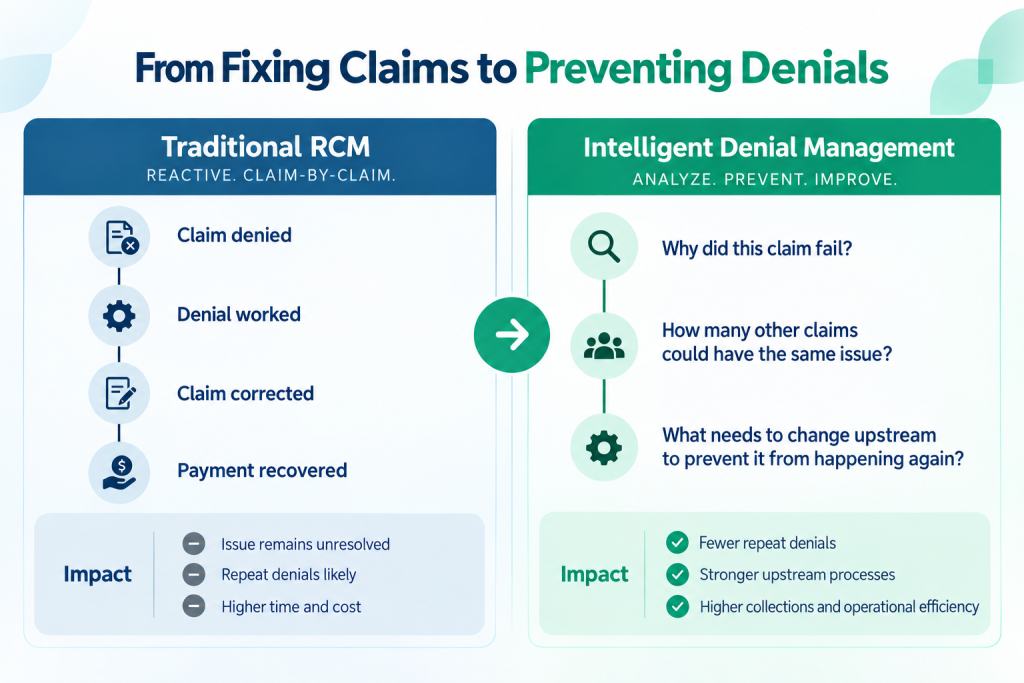
That shift turns denial management from a recovery function into a source of operational intelligence, using what went wrong in the claim to improve what happens before the claim.
AnnexMed’s Denial Management & Prevention Services combine recovery with root-cause analysis and prevention, connecting denial trends back to eligibility, authorization, coding, documentation, and billing workflows.
What Healthcare Leaders Should Measure
Revenue cycle performance cannot improve consistently without visibility. Beyond collections, leadership should monitor metrics such as:
- Clean claim rate
- Initial denial rate
- Denial write-offs
- Days in AR
- Net collection rate
- Charge lag
- Underpayment recovery
- Coding accuracy
- First-pass resolution
HFMA identifies clean claim rate, remittance denial rate, denial write-offs, and charge lag among its industry-standard revenue cycle KPIs.
The key is not simply having more dashboards. A metric becomes strategically useful when leaders can connect it to the process driving it. Revenue cycle analytics can help connect operational metrics with denial patterns, coding gaps, payer behavior, and cash-flow trends, giving leadership greater visibility into where performance is breaking down.
Building a More Resilient Revenue Architecture
A stronger revenue cycle starts by moving upstream.
Instead of asking only:
“How do we recover this revenue?”
Organizations can also ask:
“What allowed this revenue to become recoverable in the first place?”
That question changes the operating model from recovering revenue after problems occur to building processes that reduce the likelihood of those problems occurring in the first place.
It encourages organizations to strengthen
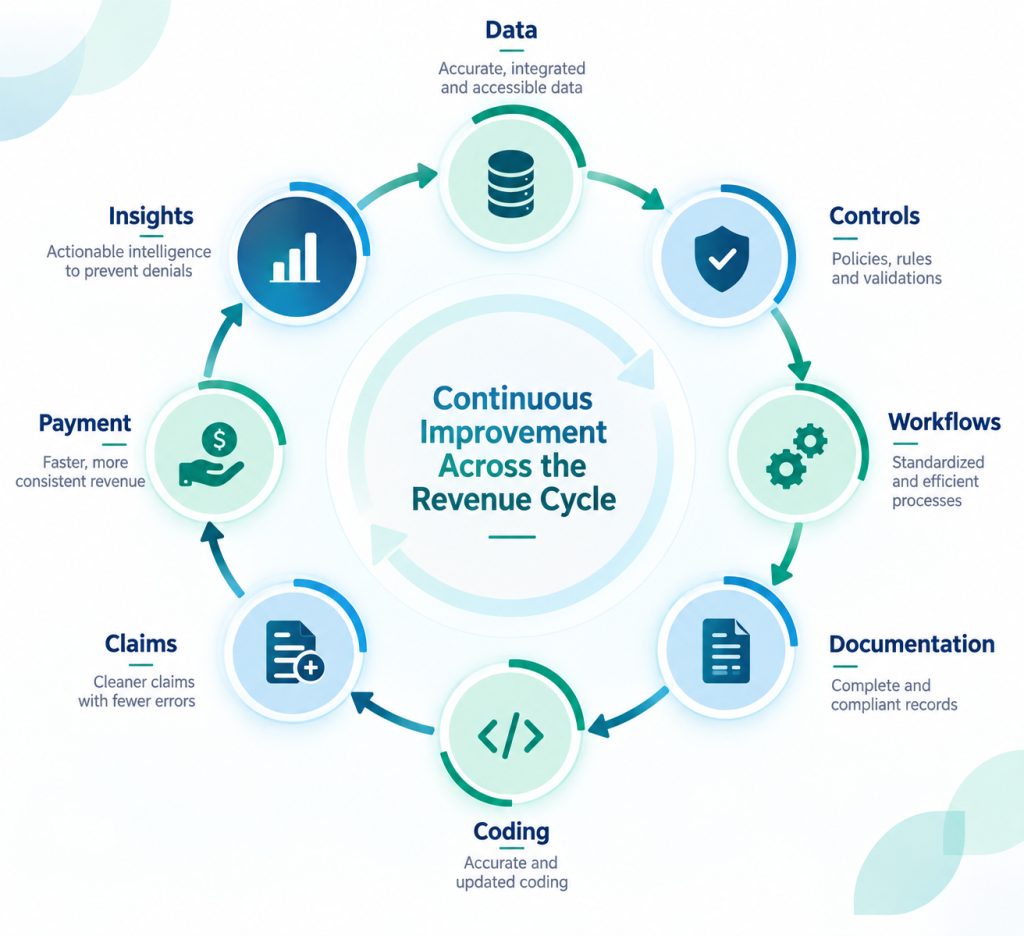
Each layer feeds the next. Each outcome creates information that can improve the layer before it. That creates a continuous improvement loop rather than a one-way billing process.
The AnnexMed Approach: Connect the Layers, Not Just the Tasks
Revenue performance is rarely improved by optimizing one isolated function.
It requires visibility across the revenue lifecycle and accountability for how each layer affects the next.
AnnexMed combines RCM operations, coding, clinical documentation, charge capture, claims management, denial prevention, AR, analytics, and revenue integrity within a connected operating model.
The objective is straightforward: identify where revenue performance is being constrained, address the underlying causes, and build stronger processes that continue delivering improvement.
Financial performance is rarely created at the final step of the revenue cycle. It is built into every layer that comes before it.
Is Your Revenue Cycle Built for Sustainable Performance?
AnnexMed connects RCM operations, revenue integrity, coding, documentation, denials, AR, and analytics to strengthen the revenue lifecycle.
Schedule an RCM AssessmentFAQs
Revenue leakage occurs when healthcare organizations fail to capture, bill, collect, or reconcile the full value of services delivered. It can result from gaps in eligibility, authorization, documentation, coding, charge capture, claims, denials, underpayments, or payment reconciliation.
A claim reflects decisions made across multiple upstream processes. Errors in patient access, eligibility, authorization, documentation, charge capture, or coding can create downstream claim errors, denials, delayed payments, and rework.
Clinical documentation provides the foundation for accurate coding, medical necessity, charge capture, and reimbursement. Incomplete or inconsistent documentation can increase documentation requests, claim rework, and denials.
Revenue integrity helps ensure that the services provided are accurately documented, coded, billed, and reimbursed. It brings together areas such as documentation, coding, charge capture, reimbursement, and payer compliance to identify and address potential revenue leakage.
Organizations can analyze denial trends to identify recurring root causes and connect them to upstream processes such as eligibility, authorization, documentation, coding, and billing. Addressing these causes can help prevent similar denials from recurring.