Last Updated on September 22, 2026
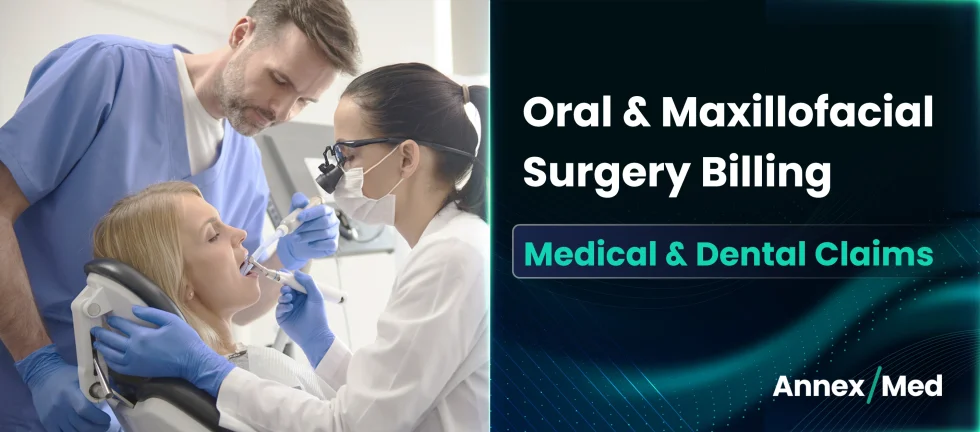
Oral and maxillofacial surgery billing is different from most dental billing because treatment can cross the boundary between dentistry and medicine. An impacted tooth extraction, facial fracture repair, TMJ surgery, biopsy, orthognathic procedure, or reconstructive surgery may involve dental benefits, medical benefits, or coordination between both.
The clinical procedure alone does not determine where the claim belongs. Diagnosis, medical necessity, payer policy, accident history, benefit structure, and coordination of benefits can all affect the billing path.
For U.S. oral and maxillofacial surgery practices, accurate billing therefore starts before a CPT or CDT code is selected, with determining whether the encounter belongs under dental insurance, medical insurance, or a coordinated workflow.
That distinction affects coding, authorization, documentation, claim forms, reimbursement, and ultimately how quickly the account reaches resolution.
Table of contents
- Why Oral and Maxillofacial Surgery Billing Is Different
- Medical Claims Vs. Dental Claims in OMS
- OMS Procedures That May Require Medical Billing
- Coding Oral and Maxillofacial Surgery Claims
- Documentation Requirements for OMS Billing
- Prior Authorization and Benefits Verification
- Oral Surgery Claim Submission Workflow
- Common OMS Billing Denials
- Medicare Dental and Medical Billing Considerations
- Improving OMS Revenue Cycle Performance
- FAQs
Why Oral and Maxillofacial Surgery Billing Is Different
A general dental claim typically follows a relatively defined dental benefit structure. OMS billing can require a more complex determination. A practice may need to evaluate:
- What condition caused the procedure
- Whether treatment is considered dental or medically necessary
- Whether trauma or an accident is involved
- Which payer is primary
- Whether medical benefits must be exhausted before dental benefits apply
- Whether prior authorization is required
- Which CDT, CPT, HCPCS, and ICD-10-CM codes are appropriate
- Whether anesthesia is separately reportable
- What clinical records the payer requires
This is why treating medical and dental billing as two independent workflows can create problems.
AnnexMed observation: In OMS revenue cycles, one of the highest-risk points is often the handoff between benefit verification and coding. If payer responsibility has not been established before the claim reaches the coder, even technically accurate coding may be placed on the wrong claim pathway.
Medical Claims Vs. Dental Claims in OMS
The correct payer depends on the procedure, diagnosis, benefit plan, and payer policy. A procedure should not automatically be classified as medical simply because it is complex.
| Billing Factor | Dental Claim | Medical Claim |
|---|---|---|
| Primary code set |
CDT
|
CPT or HCPCS |
| Diagnosis coding |
Dental claim requirements vary
|
ICD-10-CM |
| Common claim format |
ADA dental claim
|
CMS-1500 or 837P |
| Coverage basis |
Dental benefit provisions
|
Medical necessity and medical benefit |
| Authorization |
Dental predetermination or authorization when required
|
Medical prior authorization when required |
| Supporting records |
Narratives, radiographs, periodontal records, clinical notes
|
Medical necessity documentation, diagnosis, imaging, operative notes and other requested records |
Medical and dental plans can also interact through coordination of benefits. The billing team should verify payer sequencing rather than assuming the same order applies to every patient or procedure.
CMS specifically instructs providers not to submit the same claim simultaneously to multiple primary payers.
Getting coverage right before treatment starts is critical. AnnexMed’s Patient Access and Insurance Verification team verifies medical and dental benefits, identifies coordination rules, and secures authorizations, so your claims submit cleanly the first time.
OMS Procedures That May Require Medical Billing
Several oral surgery services can potentially qualify for medical insurance when the clinical circumstances and payer coverage criteria support medical necessity.
| OMS Service | Potential Medical Billing Trigger |
|---|---|
|
Third molar extraction
|
Pathology, infection, trauma, or another qualifying medical condition
|
|
Facial fracture treatment
|
Accident or traumatic injury
|
|
Orthognathic surgery
|
Documented functional impairment or qualifying medical condition
|
|
TMJ surgery
|
Functional impairment and medical necessity under the plan
|
|
Oral biopsy or lesion removal
|
Evaluation or treatment of disease or suspected pathology
|
|
Oral cancer surgery
|
Medically necessary diagnosis and treatment
|
|
Reconstructive surgery
|
Trauma, tumor treatment, congenital condition, or other covered indication
|
|
Complex anesthesia
|
Coverage depends on procedure, patient condition, setting, and payer rules
|
These examples do not guarantee medical coverage. The payer’s medical policy, benefit design, authorization rules, and documentation requirements remain controlling.
Wisdom tooth procedures demonstrate the issue particularly well. The extraction itself may appear dental, but the underlying diagnosis and clinical circumstances can change the billing pathway. For a deep dive on this scenario, see AnnexMed’s guide on dental medical cross coding for wisdom tooth removal.
If OMS cases are routinely defaulted to dental insurance without evaluating medical eligibility, eligible crossover opportunities can be missed. A structured medical and dental review before claim creation helps establish the correct payer path earlier.
Not sure which procedures in your practice qualify for medical billing?
AnnexMed’s team can review your top OMS procedure codes and identify crossover opportunities you may be missing.
Request a Free Procedure Code ReviewCoding Oral and Maxillofacial Surgery Claims
OMS practices may work across several coding systems.
CDT Codes
CDT codes are used for dental procedures and are updated annually. Code selection should reflect the service actually documented rather than relying only on the scheduled procedure.
CPT Codes
CPT codes may apply when a medically covered OMS service is submitted to a medical payer. Examples can include procedures involving the jaws, facial structures, TMJ, oral cavity, reconstruction, and other surgical services.
ICD-10 CM Codes
Medical claims generally require diagnosis coding that establishes the condition being treated and supports medical necessity.
The diagnosis and procedure should tell the same clinical story. A technically correct surgical code paired with insufficient diagnosis information can still lead to payer review or denial.
HCPCS Codes and Modifiers
HCPCS codes and modifiers may also apply depending on the service and payer. Modifier selection should be based on the specific reporting requirement and current payer guidance rather than applied routinely.
Proper coding starts with complete documentation. For practices managing high OMS claim volume, AnnexMed’s Dental Coding and Claims Processing service includes CDT coding, clinical record review, cross coding, claim scrubbing, and submission.
Documentation Requirements for OMS Billing
Strong OMS documentation needs to support more than the fact that surgery occurred. It should establish why the procedure was required and provide the information the payer needs to adjudicate the claim.
Depending on the case, documentation may include:
- Chief complaint and diagnosis
- Clinical findings
- Symptoms and functional limitations
- Duration and progression of the condition
- Relevant medical history
- Imaging and radiographs
- Operative or procedure notes
- Previous conservative treatment when applicable
- Referral or physician documentation
- Trauma or accident details
- Pathology findings
- Anesthesia records
- Medical necessity narrative
For complex procedures such as orthognathic or TMJ surgery, documentation of functional impairment can be especially important when medical coverage criteria require more than an anatomical finding.
- 1 Operative note with clear procedure details
- 2 Diagnosis-supported imaging/radiographs
- 3 Medical necessity narrative linking condition to treatment
For medically necessary surgical claims, documentation gaps are often easier to correct before submission than after a payer denial. In an AnnexMed engagement with a reconstructive surgery practice, introducing pre-bill documentation controls reduced denials by 34% by identifying missing medical necessity support earlier in the billing process.
Prior Authorization and Benefits Verification
Authorization should not be treated as the last administrative step before surgery. For higher-cost OMS procedures, the verification process should establish:
- Active dental and medical coverage
- Provider network status
- Primary and secondary payer responsibility
- Applicable exclusions
- Medical necessity criteria
- Prior authorization requirements
- Required documentation
- Patient deductible and cost sharing
- Dental annual maximums when relevant
- Authorization validity dates
Predetermination or authorization also does not guarantee final payment. Eligibility can change, documentation may not support the billed service, or the final procedure may differ from what was authorized.
Oral Surgery Claim Submission Workflow
A cleaner OMS billing process can be organized around a single claim pathway rather than separate medical and dental billing queues.
Patient and procedure review → Medical and dental benefit verification → Payer responsibility determination → Authorization → Documentation review → Coding → Claim submission → Payment and denial reconciliation
The critical control is the payer determination before coding and submission. Once the primary payer adjudicates the claim, the billing team can determine whether a secondary claim is appropriate and what information must accompany it.
This also makes payment posting important. Payments from medical and dental carriers should be reconciled against the same patient account so contractual adjustments, patient responsibility, secondary balances, and duplicate payments are identified correctly.
Common OMS Billing Denials
OMS denials often point back to an earlier revenue cycle step.
| Denial Issue | Likely Workflow Gap |
|---|---|
|
Medical necessity denial
|
Diagnosis or documentation does not satisfy payer criteria
|
|
Missing authorization
|
Requirement was not identified before treatment
|
|
Coordination of benefits denial
|
Incorrect payer sequence
|
|
Coding mismatch
|
Procedure and diagnosis do not align
|
|
Missing records
|
Required imaging, notes, narrative, or operative documentation absent
|
|
Anesthesia denial
|
Time, medical necessity, or reporting requirement unsupported
|
|
Duplicate claim
|
Medical and dental billing were not properly coordinated
|
|
Timely filing denial
|
Claim or crossover follow-up exceeded payer limits
|
Repeated OMS denials should therefore be analyzed by root cause, not simply corrected one claim at a time.
AnnexMed’s dental AR and denial management services focus on this connection between denial recovery and upstream prevention.
When medical and dental denials are worked in separate queues, the complete history of an OMS account can be missed. AnnexMed helps practices connect payer responses, documentation, coding, and follow-up so the next action is based on the full claim history.
Medicare Dental and Medical Billing Considerations
Medicare generally excludes routine dental services, but CMS covers dental services when they are inextricably linked to the clinical success of another Medicare-covered service.
Examples include certain dental services associated with organ transplantation, cardiac valve procedures, cancer treatment, and treatment of head and neck cancer. CMS also requires documented coordination between the medical and dental providers when coverage depends on this relationship.
Commonly Covered OMS Procedures Under Medicare:
- Orthognathic surgery for obstructive sleep apnea (when conservative treatment failed)
- Jaw reconstruction following tumor resection
- Facial fracture repair from accident/trauma
- Biopsy/removal of suspicious lesions
Note: Medicare Advantage plans may have different coverage rules than traditional Medicare. Always verify plan-specific policies. Additionally, Medicaid coverage for OMS procedures varies significantly by state, check state-specific medical necessity criteria before submitting.
OMS practices treating Medicare beneficiaries should therefore avoid assuming that every oral procedure is automatically excluded or covered. The clinical relationship to the covered medical service and the supporting documentation matter.


Improving OMS Revenue Cycle Performance
Effective oral and maxillofacial surgery billing requires visibility across the entire account, not simply a clean individual claim.
Useful performance measures include:
- Medical versus dental payer mix
- Authorization denial rate
- First submission acceptance
- Medical necessity denials
- Documentation related denials
- Coordination of benefits denials
- Days in accounts receivable
- Accounts requiring secondary billing
- Appeal recovery
- Underpayments by payer
The goal is to identify where the OMS billing workflow is breaking down before those issues become aged receivables.
For larger groups and multi-location organizations, AnnexMed’s dental revenue cycle services for dental practices and DSOs provide a broader internal link for centralized dental RCM, insurance optimization, coding, AR management, and reporting.
Building a More Reliable OMS Claim Pathway
Oral and maxillofacial surgery billing requires more than selecting the right procedure code. Practices need a reliable process for deciding which benefit applies, confirming payer order, documenting medical necessity, obtaining authorization, translating the encounter into the correct code set, and following both medical and dental claims through final payment.
When benefit verification, documentation, coding, claim submission, and denial management operate as one connected process, practices gain better control over complex cases and reduce the risk that legitimate reimbursement is delayed simply because the claim entered the wrong pathway. The result is fewer denials, faster payment, and stronger cash flow.
Ready to Streamline Your OMS Billing?
AnnexMed’s OMS billing specialists handle benefit verification, medical-dental coordination, coding, and denial management, so your team can focus on patient care.
Get a Free OMS Billing AuditFAQs
Yes, when procedures meet medical necessity criteria. Common examples include facial fracture repair, orthognathic surgery for functional impairment, TMJ surgery, oral biopsy for suspected pathology, and reconstructive surgery following trauma or tumor removal. Coverage depends on the payer’s medical policy and documentation, not just the procedure.
CDT codes are for dental claims; CPT codes are for medical claims. OMS practices need both: CDT for routine dental procedures (e.g., simple extractions) and CPT for medically necessary services (e.g., jaw reconstruction, trauma repair). Using the wrong code set causes denials.
Typically because documentation doesn’t link the diagnosis to the procedure or meet payer criteria. Common gaps: missing operative notes, insufficient imaging, no functional impairment documentation, or lack of medical necessity narrative. Review payer policies before submission.
Medicare excludes routine dental but covers OMS procedures linked to covered medical services, orthognathic surgery for sleep apnea, jaw reconstruction post-cancer treatment, and facial fracture repair. Medicare Advantage plans may have different rules; documentation is critical.
Key metrics: clean claim rate (≥95%), denial rate (<5%), days in A/R (<40), first-pass acceptance (>90%), and net collection rate (95-99%). Also track medical vs. dental payer mix and authorization denial rates to identify workflow issues.