

Last Updated on September 7, 2026
Healthcare organizations invest significant effort in improving revenue cycle performance. Denials are reduced, collections are accelerated, and executive dashboards reflect healthier financial trends. Yet one important question often goes unanswered:
“Has every dollar your organization earned actually been reimbursed?”
Unlike denied claims, payer underpayments rarely interrupt operations. Claims are processed, payments are received, and accounts are closed, creating the impression that the reimbursement cycle has been completed successfully. In reality, payment received does not always represent the full reimbursement an organization is contractually entitled to receive.
While individual reimbursement variances may appear insignificant, their cumulative impact across thousands of claims, payer contracts, and service lines can quietly reduce cash flow, weaken operating margins, and affect broader financial performance.
As healthcare organizations strengthen revenue integrity and financial governance, visibility into payer underpayments is becoming an executive priority rather than only a revenue cycle responsibility.
Table of contents
Is Your Organization Recovering Every Dollar It Earns?
Gain a clearer view of payer reimbursement performance and identify opportunities to strengthen financial outcomes with AnnexMed’s underpayment recovery expertise.
Schedule a ConsultationLooking Beyond Traditional Revenue Cycle Metrics
Most executive dashboards track collections, denial rates, net collection rates, and days in A/R because these metrics show how efficiently revenue moves from charge to cash. What they do not always confirm is whether the organization received the full reimbursement expected under its payer contracts.
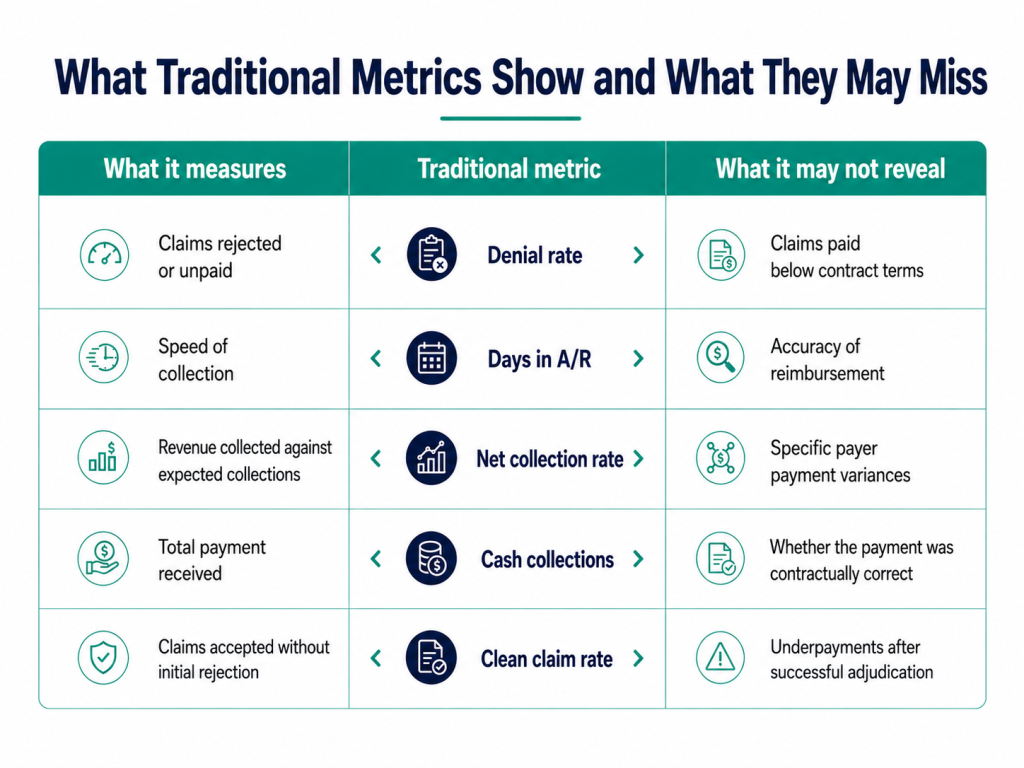
Improving collections or reducing denials can indicate stronger operational performance, but these results should be evaluated alongside reimbursement accuracy. Comparing expected reimbursement with actual payment gives CFOs and revenue cycle leaders a clearer view of payer performance, contract compliance, and revenue that may still be recoverable.
True revenue cycle performance depends not only on how much an organization collects, but also on whether payer payments align with contractual expectations.
The Hidden Cost of Payer Underpayments
Denied claims naturally attract attention because they interrupt the revenue cycle, create work queues, delay cash, and require immediate follow-up.
Underpayments behave differently. The claim is paid, so the process appears complete. Without consistent payment validation, reimbursement variances may remain unnoticed and gradually accumulate across payers, contracts, and service lines.
This lack of visibility makes underpayments particularly difficult to manage. Unless expected reimbursement is compared with actual payment, organizations may begin treating reduced reimbursement as normal financial performance.
How Underpayments Affect Financial Health
Payer underpayments extend far beyond individual claims. While they originate within the revenue cycle, their impact reaches every major financial outcome executive leaders monitor, including cash flow, operating margin, revenue integrity, contract compliance, financial visibility, and reimbursement performance. .
Cash Flow
Every unrecovered underpayment represents cash that should already be available to fund clinical operations, workforce investments, technology, and growth. Recovering earned revenue improves liquidity without requiring more patient volume or new service lines.
Operating Margin
As reimbursement models change and costs rise, margins are under pressure. Consistent underpayments reduce top‑line revenue that was already earned, making it harder to sustain profitability even when operational metrics look strong.
Revenue Integrity
Revenue integrity isn’t only about coding accuracy and clean claims. It also means validating that payer reimbursements match contracted expectations. Monitoring underpayments strengthens confidence that earned revenue is fully realized across the revenue cycle.
Contract Compliance
Payer agreements define what organizations should be paid for the services they deliver. Identifying systemic payment variances helps determine whether contracts are being applied correctly and informs future negotiation strategy.
Financial Visibility
Executive decisions are only as reliable as the financial data that supports them. While collections and denial metrics provide valuable operational insight, they do not always indicate whether payer reimbursements accurately reflect contractual agreements. Improving visibility into reimbursement performance helps healthcare leaders make more informed budgeting, forecasting, investment, and growth decisions with greater financial confidence.
Reimbursement Performance
Receiving payment is only one measure of success. Receiving the correct payment provides a more accurate view of revenue cycle performance and enables organizations to evaluate payer performance with greater confidence.
Because these areas fall directly under executive oversight, underpayment recovery belongs in CFO and boardroom discussions, not just in billing worklists.
From Revenue Recovery to Revenue Protection
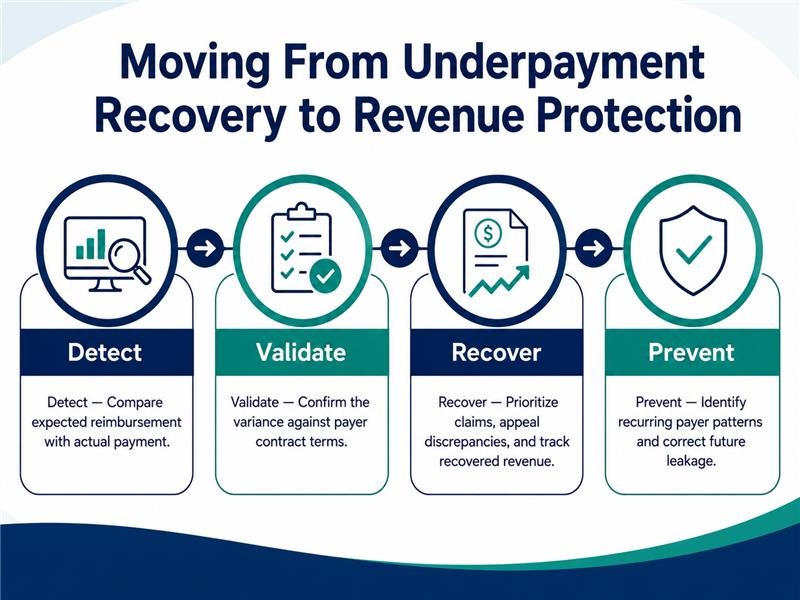
Healthcare organizations typically begin revenue cycle improvement by strengthening coding accuracy, reducing denials, accelerating collections, and improving operational efficiency. As these functions mature, leadership attention should also extend to protecting revenue that has already been earned.
Underpayment recovery supports this shift by helping organizations identify payer payment patterns, validate contract compliance, and address recurring reimbursement gaps before they become accepted as normal performance.
The goal is to move from isolated recovery efforts toward long-term revenue protection through:
- Improving visibility into reimbursement patterns
- Detecting recurring payer trends earlier
- Validating payment accuracy against contract terms
- Strengthening financial governance across the revenue cycle
When underpayment recovery is connected with revenue integrity and contract management, it becomes a proactive financial strategy rather than a claim-by-claim correction process. Understanding where payment variances originate allows organizations to recover current revenue while reducing future leakage.
Executive Questions That Should Guide Action
Moving underpayment recovery into executive focus requires leadership teams to ask questions that go beyond collections and denial performance:
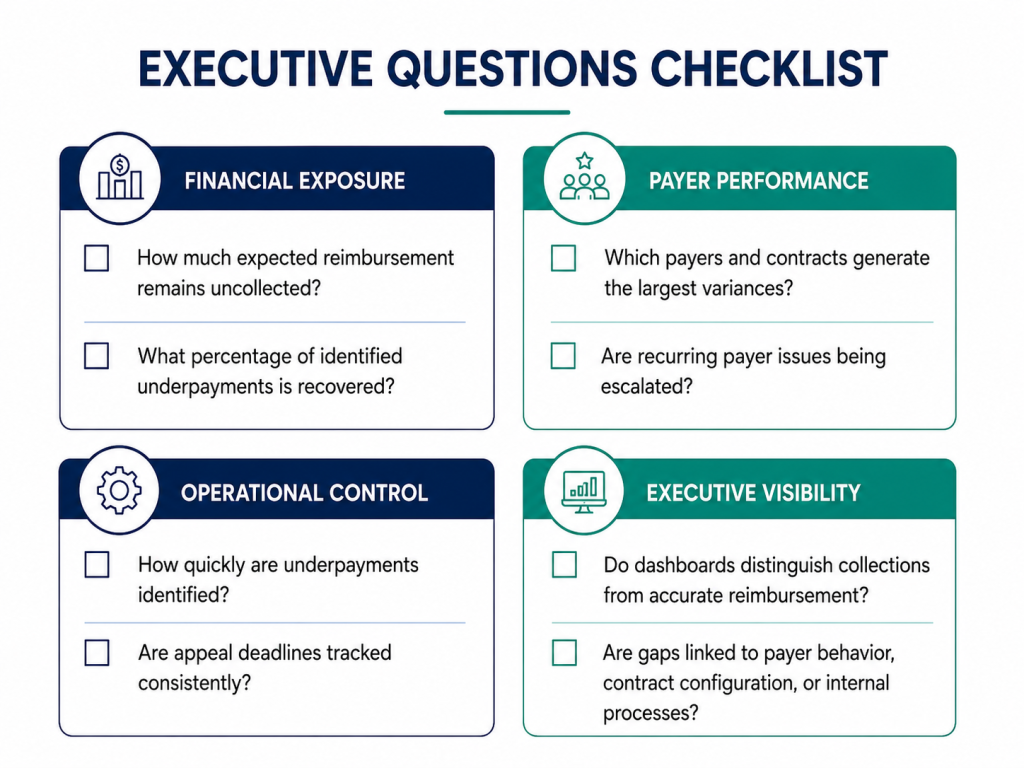
These questions reveal more about true financial performance than collection totals alone. They help CFOs and revenue cycle leaders identify where analytics, governance, payer escalation, and operational improvement can produce the greatest financial impact.
Strengthening Revenue Integrity Through Underpayment Recovery
Healthcare organizations often have the claim, payment, and contract data required to identify underpayments. Turning that information into measurable financial outcomes, however, requires reimbursement expertise, contract interpretation, structured follow-up, and continuous monitoring.
AnnexMed helps hospitals and health systems build a structured underpayment recovery program by:
Identifying underpaid claims at scale – Comparing expected reimbursement with actual payments across payers, contracts, procedures, and service lines.
Validating payments against contract terms – Applying loaded fee schedules, reimbursement methodologies, and contract rules to identify payments that do not align with negotiated expectations.
Driving targeted recovery actions – Prioritizing underpaid claims, preparing corrected claims or appeals, coordinating payer follow-up, and tracking recovered revenue.
Maintaining ongoing visibility – Incorporating underpayment trends, recovery results, and recurring payer patterns into revenue integrity reporting and executive reviews.
By combining reimbursement expertise with structured recovery workflows, AnnexMed helps healthcare organizations move beyond isolated claim corrections and establish a proactive underpayment recovery strategy. This approach strengthens payer accountability, improves reimbursement visibility, and helps protect contractually earned revenue.
Turn Underpayment Recovery Into a Financial Advantage
Gain greater visibility into payer payment performance, recover missed reimbursement, and protect earned revenue with AnnexMed’s underpayment recovery expertise.
Talk to Our RCM ExpertsFAQs
Underpayment recovery is the process of identifying, validating, and recovering reimbursement that is lower than the amount contractually expected from a payer. It helps healthcare organizations recover earned revenue, evaluate payer performance, and improve financial visibility.
Payer underpayments can quietly reduce cash flow, margins, and reimbursement performance without creating the same visibility as denied claims. Monitoring underpayments helps healthcare leaders protect earned revenue and improve financial oversight.
Organizations compare expected reimbursement based on payer contracts with actual payments received. Payment variance analysis, contract validation, and reimbursement reviews help identify underpayment opportunities.
Revenue integrity focuses on ensuring healthcare organizations receive accurate reimbursement for the services they provide. Underpayment recovery supports this objective by validating payment accuracy, improving financial visibility, and protecting earned revenue.
Claim denials prevent reimbursement until issues are resolved, while payer underpayments occur when claims are paid for less than the expected contractual amount. Both affect financial performance, but underpayments often remain hidden because the claim appears to be successfully paid.
Revenue cycle leaders should review underpayment trends regularly alongside denial analytics, reimbursement performance, and financial reporting. Ongoing monitoring helps identify recurring payer patterns and supports timely recovery efforts.