

Last Updated on September 2, 2026
Looking for a Cardiology Billing Partner?
From specialty coding and payer compliance to denial analytics and appeals management, AnnexMed helps cardiology practices improve reimbursement with proactive revenue cycle strategies.
Talk to Our ExpertsCardiology claim denials happen when coding complexity, documentation gaps, and payer rule mismatches block reimbursement for high-value procedures. These denials are not just administrative headaches; they translate into direct revenue loss, extended A/R days, and increased rework for cardiology billing teams.
A single denied cath or PCI can cost a cardiology practice thousands of dollars in lost or delayed revenue. When multiple high-cost procedures are denied, the impact can stretch into tens of thousands, straining cash flow and limiting investment in new technology or staff. At the same time, lower-cost but high-volume services like stress tests and echo accumulate smaller denials that add up to significant losses over time.
When cardiology claims a denial compound, providers end up chasing payments instead of focusing on patient care. This guide explains why cardiology claims are denied more often than other specialties, shows real scenarios that trigger denials, and outlines practical fixes to recover lost revenue and prevent future denials on high-value procedures.
Table of contents
What Does a Denied Cardiology Claim Look Like in Practice
Denied cardiology claims are not always obvious from the front desk. Providers complete procedures, documentation is finalized, and claims are submitted with the expectation that reimbursement will follow. However, the financial side of the practice often tells a different story. Claims move through the payer’s review process only to be denied for documentation deficiencies, coding issues, missing authorizations, or medical necessity concerns.
In practice, cardiology claim denials often appear as:
- Claims denied for medical necessity, bundling edits, modifier issues, or missing documentation.
- High-value procedures such as cardiac catheterization, PCI, echocardiography, and stress tests remaining in appeals for weeks or even months.
- Repeated denials for the same CPT codes or the same payer, creating an ongoing cycle of corrections and resubmissions.
- Increasing days in accounts receivable (A/R) for cardiology services despite consistent patient volume.
- Billing teams spend more time appealing denied claims than improving overall reimbursement performance.
Example
Consider a mid-sized cardiology group that performs approximately 20 stress tests each week. Claims are submitted promptly, but 4 to 5 are consistently denied because documentation does not fully support medical necessity or required modifiers are applied incorrectly. Each denial requires additional documentation, appeal preparation, and payer follow-up before reimbursement can be recovered.
Although every denied claim represents a separate reimbursement issue, the combined impact is much greater. Payment is delayed, administrative workload increases, accounts receivable continue to grow, and revenue that should already be supporting the practice remains tied up in the appeals process.
90-Day Legacy AR Recovery Plan
Common Causes of Cardiology Claim Denials
Cardiology combines high-cost procedures, detailed clinical documentation, and evolving payer requirements, making reimbursement more complex than many other medical specialties. A single patient encounter may involve diagnostic testing, imaging, interventional procedures, multiple modifiers, and strict medical necessity requirements, all of which must align before a payer approves payment.
Unlike routine office visits, many cardiovascular services undergo additional payer scrutiny because of their higher reimbursement value and clinical complexity. As procedure volumes increase, even minor coding or documentation inconsistencies can result in recurring denials across multiple claims.
Procedural Complexity
Cardiology includes a wide range of diagnostic, interventional, and surgical procedures that require precise code selection and accurate reporting. Many CPT codes appear similar but represent different services depending on the procedure performed, physician intent, and supporting clinical documentation.
Common coding challenges include:
- Confusion between diagnostic and interventional cardiac catheterization procedures.
- Selecting the correct CPT codes for PCI, electrophysiology studies, echocardiography, and cardiac imaging.
- Reporting multiple cardiovascular procedures performed during the same encounter.
- Incorrect application of modifiers such as 26, TC, 50, 51, 52, and 53.
- Bundling edits that affect reimbursement when procedures are reported incorrectly.
Even a small coding inconsistency can trigger payer edits, downcoding, or outright claim denial.
Documentation Requirements
Cardiology claims depend heavily on documentation that clearly demonstrates the clinical need for every diagnostic or interventional service. Payers often require detailed evidence showing why a procedure was medically necessary before reimbursement is approved.
Documentation should consistently include:
- Patient symptoms and presenting condition.
- Relevant clinical history and cardiovascular risk factors.
- Prior diagnostic test results supporting the procedure.
- Physician assessment and treatment plan.
- Procedure findings and interpretation.
- Medical necessity supporting the selected CPT code.
Missing clinical details even something as simple as an incomplete indication for a stress test or imaging study can result in denial or requests for additional documentation.
Payer Rule Sensitivity
Many cardiology procedures are governed by payer-specific coverage policies that extend beyond standard coding guidelines. Medicare, Medicaid, and commercial insurers frequently apply different reimbursement rules based on procedure type, diagnosis, and clinical indication.
Common payer-related denial risks include:
- Prior authorization requirements for advanced cardiac imaging and structural heart procedures.
- Frequency limitations on diagnostic testing.
- Medicare Local Coverage Determinations (LCDs) and National Coverage Determinations (NCDs).
- Medical necessity criteria for stress testing, echocardiography, cardiac CT, and PCI.
- Payer-specific documentation requirements for high-cost cardiovascular services.
Practices that rely on a single billing workflow across all payers often experience inconsistent reimbursement because each payer applies different review standards.
Revenue Cycle Workflow Gaps
Not every denial is caused by coding or documentation. Internal revenue cycle processes can also contribute when billing workflows lack standardized quality controls before claims are submitted.
Common workflow gaps include:
- Delayed or incomplete prior authorization verification.
- Missing pre-bill documentation reviews.
- Inconsistent coding quality checks.
- Limited claim validation before submission.
- Delayed follow-up on payer edits and pending claims.
Recover More Revenue From Every Cardiology Claim
Reduce preventable denials, improve coding accuracy, and strengthen payer performance with specialty-focused cardiology revenue cycle management.
Schedule a CallStrategies to Recover Revenue from Cardiology Claim Denials
Reducing cardiology claim denials requires more than correcting rejected claims after they occur. The most effective approach is to strengthen the revenue cycle before claims are submitted. Standardized documentation, accurate coding, payer-specific validation, and continuous performance monitoring help practices reduce preventable denials while improving reimbursement consistency.
The following strategies create a stronger foundation for denial prevention and long-term revenue recovery.
Standardize Clinical Documentation
Use standardized documentation templates to capture medical necessity, clinical findings, physician assessment, and supporting evidence consistently across providers. This reduces coding variation and improves claim accuracy.
Documentation should consistently include:
- Presenting symptoms and clinical indications.
- Relevant cardiac history and risk factors.
- Prior diagnostic test results supporting the procedure.
- Physician assessment and treatment plan.
- Procedure findings and interpretation.
- Medical necessity supporting the selected CPT code.
Standardize clinical documentation using structured templates that consistently capture medical necessity, physician assessment, procedure findings, and supporting clinical evidence before coding begins.
Implement Pre-Bill Reviews for High-Risk Procedures
Many denials can be prevented before claims are submitted. A structured pre-bill review process allows billing teams to identify documentation or coding issues while corrections can still be made efficiently.
Prioritize reviews for high-value procedures such as:
- Cardiac catheterization.
- Percutaneous coronary intervention (PCI).
- Echocardiography.
- Stress testing.
- Cardiac CT and advanced imaging.
- Structural heart procedures.
During the review, verify:
- CPT code selection.
- Modifier usage.
- Diagnosis-to-procedure linkage.
- Supporting clinical documentation.
- Prior authorization status.
Apply Cardiology-Specific Claim Validation
General claim edits do not always identify the billing complexities associated with cardiovascular services. Cardiology-specific claim validation helps detect coding conflicts and payer-specific issues before claims are submitted.
Before submission, validate claims against NCCI edits, diagnosis-to-procedure coding, modifier accuracy, documentation completeness, authorization status, and payer-specific billing rules.
Validating claims before submission helps reduce unnecessary payer review and accelerates reimbursement.
Strengthen Denial Management Workflows
Not every denied claim can be prevented. A structured denial management process helps practices recover reimbursement more efficiently while identifying the root causes behind recurring denials.
Effective denial management includes:
- Categorizing denials by reason, such as medical necessity, authorization, coding, or eligibility.
- Prioritizing appeals for high-value cardiovascular procedures.
- Using standardized appeal templates supported by clinical documentation.
- Tracking appeal turnaround times and success rates.
- Performing root-cause analysis to prevent recurring denial patterns.
Rather than treating each denial as an isolated event, practices should use denial trends to improve future billing performance.
Monitor Cardiology Revenue Cycle KPIs
Measuring performance helps practices identify reimbursement issues before they significantly affect cash flow. Monitoring cardiology-specific metrics provides visibility into denial trends and operational performance.
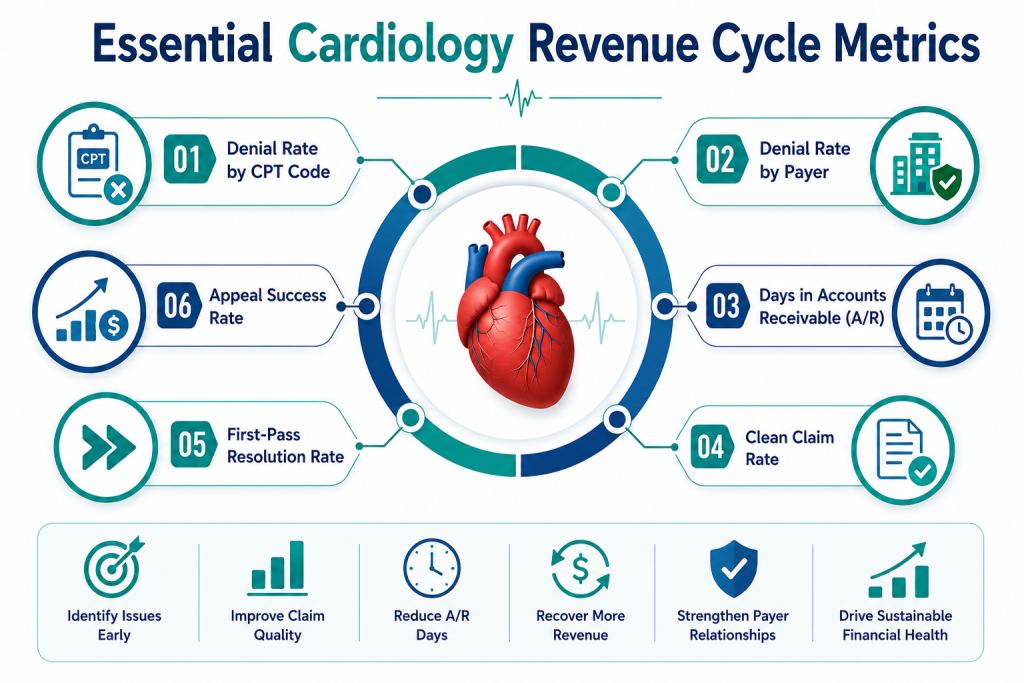
Regular KPI reviews help practices identify denial patterns early and continuously improve reimbursement performance.
Specialized Cardiology Denial Management That Improves Reimbursement
Cardiology claim denials often involve high-value diagnostic tests, interventional procedures, complex coding requirements, and payer-specific medical necessity reviews. Recovering this revenue requires more than traditional billing support, it requires specialized denial management expertise.
AnnexMed helps cardiology practices strengthen reimbursement through:
- Specialized cardiology coding expertise for diagnostic, interventional, electrophysiology, and cardiovascular imaging services.
- Denial trend analysis that identifies recurring root causes and revenue recovery opportunities.
- Dedicated appeals management focused on recovering reimbursement from high-value denied claims.
- Prior authorization and payer compliance support to reduce preventable denials.
- Revenue cycle analytics and denial reporting that improve visibility into reimbursement performance and financial outcomes.
Rather than simply resolving individual denials, AnnexMed partners with cardiology practices to strengthen denial prevention, improve appeal success, accelerate reimbursement, and build a more resilient revenue cycle.
Turn Cardiology Denials Into Revenue Opportunities
AnnexMed helps cardiology providers strengthen coding accuracy, reduce denial risk, and improve reimbursement across the entire revenue cycle.
Request a Complimentary Revenue Cycle AssessmentFAQs
Cardiology claim denials are commonly caused by incorrect CPT coding, incomplete clinical documentation, missing prior authorizations, modifier errors, and payer-specific medical necessity requirements. Reviewing denial trends regularly helps identify recurring issues before they affect reimbursement performance.
High-value procedures such as cardiac catheterization, PCI, echocardiography, stress testing, advanced cardiac imaging, and structural heart procedures often experience higher denial rates because of their documentation, authorization, and medical necessity requirements.
Practices should ensure documentation clearly supports the clinical indication for every procedure by including symptoms, patient history, prior diagnostic findings, physician assessment, and treatment rationale. Standardized documentation templates also improve consistency across providers.
Important metrics include denial rate by CPT code, denial rate by payer, clean claim rate, first-pass resolution rate, appeal success rate, and days in accounts receivable. Monitoring these KPIs helps practices identify reimbursement trends and improve revenue cycle performance.
Yes. Cardiology-specific claim validation identifies coding inconsistencies, modifier issues, missing documentation, and payer-specific edits before claims are submitted. When combined with pre-bill reviews, it significantly reduces preventable denials and improves first-pass payment rates.