
Last Updated on July 29, 2026
Accurate procedure coding plays a vital role in orthopedic and pain management billing. Among musculoskeletal procedure codes, CPT Code 20610 represents one of the most frequently reported services.
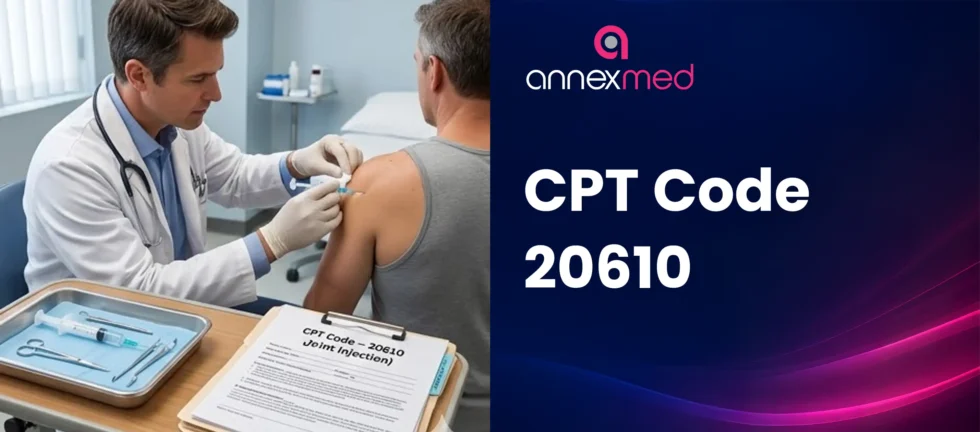
CPT Code 20610 describes: Arthrocentesis, aspiration, and/or injection of a major joint or bursa.
The procedure involves inserting a sterile needle into a joint space or bursa to either remove fluid, inject medication, or perform both actions during the same encounter.
Healthcare providers perform this procedure to evaluate joint conditions, manage inflammation, and deliver therapeutic medications directly into the joint space. Because the procedure appears frequently in orthopedic clinics, pain management practices, and ambulatory care settings, clear documentation and structured coding practices support efficient claim submission and transparent reimbursement.
Table of Contents
Major Joints Included in CPT 20610 Procedures
CPT Code 20610 applies specifically to major joints or bursae within the musculoskeletal system.
These joints include several commonly treated areas in orthopedic and pain management care.
Shoulder Joint
The glenohumeral joint of the shoulder qualifies as a major joint under CPT 20610.
Physicians perform arthrocentesis in the shoulder for conditions such as:
- Rotator cuff-related inflammation
- Joint degeneration
- Synovial fluid accumulation
Joint injections often support improved shoulder mobility and symptom management.
Hip Joint
The hip represents another major joint frequently treated through arthrocentesis.
Hip injections commonly support:
- Osteoarthritis management
- Diagnostic fluid collection
- Targeted anti-inflammatory medication delivery
Because the hip joint lies deeper within the body, imaging guidance often assists with accurate needle placement.
Knee Joint
The knee is one of the most frequently injected joints in orthopedic practice.
Physicians perform knee arthrocentesis to:
- Remove excess synovial fluid
- Deliver corticosteroid injections
- Support management of inflammatory joint conditions
The knee’s accessibility makes it one of the most commonly documented procedures under CPT 20610.
Subacromial Bursa
The subacromial bursa, located near the shoulder joint, also falls under CPT 20610.
Bursal injections commonly support treatment of:
- Bursitis
- Shoulder impingement
- Rotator cuff inflammation
Delivering medication into the bursa supports targeted treatment of localized inflammation.
CPT 20610 Compared With Related Arthrocentesis Procedure Codes
Joint aspiration and injection procedures fall within a group of related arthrocentesis codes. Accurate code selection depends on the size and classification of the joint treated.
Quick Comparison Table
| Code | Joint Type | Examples |
| 20600 | Small joints | Fingers, toes |
| 20605 | Intermediate joints | Wrist, elbow, ankle |
| 20610 | Major joints | Shoulder, hip, knee |
| 20611 | Major joints with ultrasoundguidance | Image-guided joint injection |
Understanding joint classification helps ensure consistent code selection across musculoskeletal procedures.
Documentation Requirements for CPT 20610 Procedures
Consistent documentation and structured coding workflows support accurate reporting of CPT Code 20610.
A well-documented procedure note for CPT 20610 typically includes several essential elements.
Procedure Indication
The documentation should clearly state the clinical reason for the procedure.
Examples may include:
- Joint inflammation
- Degenerative joint disease
- Diagnostic fluid evaluation
Clear indication connects the procedure with the patient’s clinical condition.
Joint Location
The physician must specify the exact joint or bursa treated.
Examples include:
- Right knee
- Left shoulder
- Hip joint
- Subacromial bursa
Precise anatomical documentation supports accurate coding.
Medication Injected
The procedure note should include details about the medication administered during the injection.
Documentation typically specifies:
- Medication name
- Dosage
- Injection site
This information supports clear procedural reporting.
Fluid Aspiration Details
When aspiration occurs, documentation should include:
- Volume of fluid removed
- Appearance of synovial fluid
- Laboratory analysis orders
These details support diagnostic evaluation.
Imaging Guidance
If imaging guidance supports the procedure, the documentation should include:
- Imaging modality used
- Confirmation of needle placement
- Imaging interpretation
This information helps determine whether an imaging-specific CPT code applies.
Consent and Sterile Preparation
Procedure documentation typically includes confirmation of:
- Informed patient consent
- Sterile preparation of the injection site
- Use of sterile technique
These steps demonstrate standard procedural protocols.
Practical Coding Scenarios for CPT 20610
Real-world scenarios illustrate how CPT Code 20610 appears in everyday clinical documentation and billing workflows.
Case Scenario 1 – Knee Corticosteroid Injection
A patient visits an orthopedic clinic for knee discomfort related to degenerative joint disease.
The physician performs a right knee joint injection using a corticosteroid medication after preparing the site with sterile technique.
The procedure note includes:
- Indication for joint inflammation
- Right knee identification
- Medication name and dosage
Coding Outcome:
- CPT 20610 with RT modifier
Case Scenario 2 – Hip Joint Aspiration
A patient presents with joint swelling and limited hip movement.
The physician performs aspiration of the hip joint to collect synovial fluid for laboratory analysis.
Documentation includes:
- Diagnostic indication
- Fluid aspiration details
- Joint identification
Coding Outcome:
- CPT 20610 reported for major joint aspiration.
Case Scenario 3 – Bilateral Knee Joint Injections
A patient with bilateral knee inflammation receives injections in both knee joints during the same encounter.
The physician administers medication into each knee after sterile site preparation.
Documentation includes:
- Bilateral knee treatment
- Medication dosage for each joint
- Procedural technique
Coding Outcome:
- CPT 20610 with Modifier 50 indicating a bilateral procedure.
FAQs
1) How frequently can CPT 20610 be reported for the same joint during ongoing treatment?
The reporting frequency depends on the patient’s clinical condition and the physician’s medical judgment. Many payers review repeated injections carefully, so treatment plans and supporting documentation should clearly demonstrate the clinical need for each procedure.
2) Are medications injected during a CPT 20610 procedure billed separately?
In many cases, the medication administered during the joint injection may be reported separately using the appropriate drug code. Billing teams typically reference payer policies to determine when separate reporting applies.
3) Do payer policies influence how CPT 20610 claims are processed?
Yes. Individual payers may maintain specific coverage guidelines, frequency limitations, or documentation expectations for joint injection procedures. Reviewing payer policies helps ensure consistent claim processing.
4) Can CPT 20610 be performed in outpatient and office-based settings?
Yes. Arthrocentesis procedures are commonly performed in physician offices, outpatient clinics, ambulatory care centers, and specialty practices depending on the patient’s clinical needs.
5) Does the specialty of the provider affect how CPT 20610 is billed?
Various specialties perform joint injections, including orthopedics, rheumatology, sports medicine, and pain management. The billing code remains the same when the procedure performed meets the CPT code definition.
Optimize CPT 20610 Coding with Certified Experts
Minimize documentation gaps and coding inconsistencies by partnering with certified coders who ensure accurate reporting of CPT 20610 across providers, specialties, and payer requirements. Improve claim accuracy and reduce unnecessary denials with standardized coding support.
Partner With Us