Last Updated on September 1, 2026
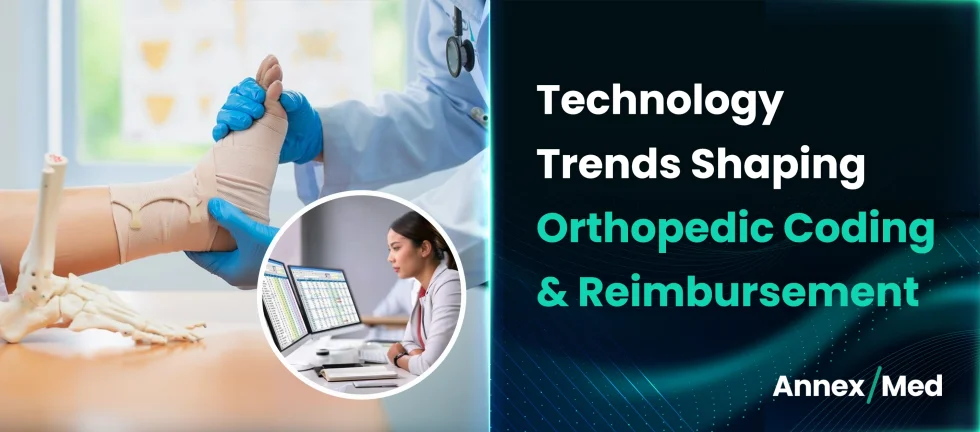
Orthopedic practices often get overwhelmed by the constant battle between coding updates and maintaining accuracy. However, technological advancements are revolutionizing orthopedic coding by offering simple solutions to streamline workflow and improve accuracy.
From artificial intelligence to machine learning algorithms, these innovations are transforming how orthopedic coding is handled. By embracing these tools, practices can enhance efficiency, reduce errors, and stay ahead of industry standards.
Nowadays, technology is becoming a necessity. As orthopedic coding grows increasingly complex due to payer scrutiny, documentation requirements, and evolving reimbursement policies, practices must leverage technology to remain financially and operationally successful.
This article explores the pivotal role technology plays in reshaping orthopedic coding practices and how it can benefit both coding accuracy and practice collections.
Table of contents
- The Challenges in Manual Orthopedic Coding Process
- Benefits of Technology in Orthopedic Coding
- How Technology is Transforming Orthopedic Coding and RCM
- Emerging Technologies in Orthopedic Coding
- Technology Investments for Accurate Orthopedic Coding
- Outsourcing to Specialized Providers Like AnnexMed
- Advancing Orthopedic Coding Excellence Through Innovation and Expertise
- FAQs
The Challenges in Manual Orthopedic Coding Process
Time-Consuming
Manual orthopedic coding is a meticulous process that demands significant time and effort. Coders must sift through extensive medical records, interpret complex procedures, and assign appropriate codes. This time-intensive task often leads to backlogs and delayed reimbursements, impacting the financial health of healthcare providers.
High Risk of Human Error
The intricate nature of orthopedic procedures makes them particularly susceptible to coding errors. Even experienced coders can misinterpret documentation or overlook crucial details, resulting in claim denials or compliance issues. These mistakes can be costly, both financially and in terms of patient care quality.
Keeping Up with Frequent Updates
Orthopedic coding guidelines and regulations are subject to frequent changes. Staying current with these updates while managing daily coding tasks is challenging for many coders. This constant need for education and adaptation can lead to inconsistencies in coding practices and increased stress for coding professionals.
90-Day Legacy AR Recovery Plan
Difficulty in Handling Complex Cases
Orthopedic procedures often involve multiple components, making accurate coding particularly challenging. Cases with multiple diagnoses, comorbidities, or intricate surgical techniques require a deep understanding of both medical procedures and coding guidelines. This complexity can slow down the coding process and increase the likelihood of errors.
Increasing Audit and Compliance Pressure
As payer scrutiny continues to increase, orthopedic practices face growing pressure to maintain coding accuracy and documentation integrity. Even minor coding errors can trigger claim denials, reimbursement delays, audits, or compliance concerns.
Technology is increasingly helping practices identify and address these risks before claims are submitted.
Benefits of Technology in Orthopedic Coding
Technology is helping orthopedic practices move beyond basic coding efficiency.
- Improved Coding Accuracy – Advanced coding platforms help identify coding inconsistencies and documentation gaps before claims are submitted.
- Faster Coding Turnaround – Automation reduces manual data entry and accelerates coding workflows.
- Reduced Claim Denials – Real-time claim validation tools help identify errors before submission.
- Stronger Compliance – Technology helps practices stay aligned with changing coding regulations and payer requirements.
- Better Reimbursement Outcomes – Accurate coding and cleaner claims improve payment rates and reduce revenue leakage.
- Reduced Administrative Burden – Automation allows coding and billing teams to focus on higher-value tasks rather than repetitive administrative work.
How Technology is Transforming Orthopedic Coding and RCM
Technology is helping orthopedic practices manage increasingly complex coding requirements while improving accuracy and efficiency. Modern orthopedic RCM platforms use AI, automation, and analytics to reduce manual workloads and minimize coding errors.
AI-Powered Operative Note Analysis
Orthopedic operative reports are typically detailed and documentation-heavy, often including multiple procedures, implant details, laterality, and modifier requirements. AI-powered coding systems analyze these surgical notes to extract relevant coding elements and suggest accurate ICD-10 and CPT codes.
These tools help coding teams:
- Identify applicable procedure and diagnosis codes
- Detect missing or incomplete documentation
- Validate laterality and procedure specificity
- Flag potential modifier requirements
- Improve coding consistency across providers
For complex procedures such as joint replacements, arthroscopy, spinal surgeries, and fracture repairs, AI significantly reduces manual review time while improving coding accuracy and compliance.
Automated Modifier Validation
Modifiers play a critical role in orthopedic billing, especially for bilateral procedures, multiple surgeries, and global surgical packages. Incorrect modifier usage can quickly lead to denials or compliance risks.
Automated coding systems validate modifier usage by:
- Detecting missing or incorrect modifiers
- Identifying modifier conflicts
- Ensuring documentation supports modifier use
- Aligning claims with NCCI guidelines
This reduces preventable billing errors and improves claim accuracy before submission.
Enhanced EHR and Documentation Integration
Modern EHR systems now integrate directly with coding and billing platforms, allowing seamless flow of clinical documentation, operative notes, imaging reports, and implant records into the coding workflow.
This integration helps:
- Reduce manual chart review
- Improve documentation completeness
- Strengthen medical necessity support
- Increase coding efficiency
For orthopedic practices, this is especially valuable due to the multi-source nature of surgical documentation.
Real-Time Claim Validation
Pre-submission claim validation tools review claims before they are sent to payers, identifying issues that could lead to denials or delays.
These systems detect:
- Missing or incomplete documentation
- Coding inconsistencies
- NCCI edit conflicts
- Payer-specific rule violations
- Medical necessity gaps
As a result, practices achieve cleaner claims and higher first-pass acceptance rates.
Robotic Process Automation (RPA)
Robotic Process Automation uses software “bots” to handle repetitive administrative tasks that traditionally consume staff time.
In orthopedic RCM, RPA is commonly used for:
- Eligibility verification
- Authorization tracking
- Claim status checks
- Document retrieval
- Work queue management
By reducing administrative workload, staff can focus more on coding accuracy and denial management.
Emerging Technologies in Orthopedic Coding
As payer scrutiny increases and coding regulations evolve, several emerging technologies are reshaping orthopedic coding operations.
Ambient AI Documentation
Ambient AI tools automatically capture physician-patient conversations and generate structured clinical notes. For orthopedic specialists, this improves documentation of fracture classifications, joint conditions, functional limitations, and treatment plans while reducing physician documentation time.
Predictive Denial Analytics
Predictive analytics helps orthopedic practices move from reactive denial management to proactive prevention. By analyzing historical claims and payer behavior, these tools identify patterns that signal potential reimbursement risks.
This enables practices to:
- Detect high-risk claims before submission
- Reduce preventable denials
- Improve cash flow predictability
- Optimize coding decisions
AI Compliance Monitoring
AI-driven compliance tools continuously evaluate claims against payer rules, coding guidelines, and regulatory updates.
These systems help:
- Identify compliance risks early
- Monitor coding accuracy in real time
- Reduce audit exposure
- Ensure alignment with evolving payer policies
This is especially important in orthopedic billing due to frequent changes in CPT and modifier rules.
Orthopedic-Specific AI Models
Unlike generic healthcare AI tools, orthopedic-specific models are trained on musculoskeletal documentation, surgical workflows, and procedure data.
These systems improve coding accuracy for:
- Joint replacement surgeries
- Sports medicine procedures
- Arthroscopy cases
- Spine surgeries
- Trauma and fracture care
They deliver more precise code suggestions and better documentation interpretation.
Fracture Coding Intelligence
Fracture coding is one of the most challenging areas in orthopedics due to variations in classification, healing stages, and anatomical specificity.
AI-powered fracture coding tools analyze:
- Open vs. closed fractures
- Anatomical location and laterality
- Encounter type (initial vs. follow-up)
- Healing status
- Injury complexity
This improves ICD-10 accuracy, reduces variability, and speeds up coding workflows.
Implant and Device Billing Automation
Orthopedic procedures frequently involve implants, prosthetics, and surgical hardware that require detailed documentation for reimbursement.
Automation tools help:
- Match implant invoices with claims
- Verify implant usage documentation
- Link surgical logs to billing records
- Identify missing implant data
This reduces implant-related denials and strengthens audit readiness.
Technology Investments for Accurate Orthopedic Coding
To improve coding accuracy and reimbursement performance, orthopedic practices should consider investing in the following technologies:
AI-Assisted Coding Platforms
AI coding platforms analyze orthopedic documentation and recommend accurate diagnosis and procedure codes in real time.
Key benefits:
- Faster coding turnaround
- Improved accuracy
- Reduced audit risk
- Better alignment between documentation and coding
Computer-Assisted Coding (CAC) Solutions
CAC tools use natural language processing (NLP) to extract coding data directly from clinical documentation and operative reports.
Benefits:
- Increased coder productivity
- Reduced manual coding effort
- Improved consistency across claims
Advanced Claim Scrubbing Software
Claim scrubbers validate claims against payer rules, coding guidelines, and NCCI edits before submission.
Benefits:
- Lower denial rates
- Improved clean claim rates
- Reduced revenue leakage
Compliance Monitoring Platforms
These tools continuously track coding accuracy and documentation quality across the revenue cycle.
Benefits:
- Real-time compliance oversight
- Reduced audit exposure
- Improved documentation integrity
Integrated EHR and RCM Systems
Integrated platforms connect clinical documentation with billing workflows to eliminate data gaps and manual entry.
Benefits:
- Improved charge capture
- Faster claim submission
- Reduced administrative burden
Prior Authorization Automation Tools
Automation platforms streamline authorization workflows by tracking approvals and payer communication in real time.
Benefits:
- Fewer authorization-related denials
- Faster treatment approvals
- Improved patient scheduling efficiency
By adopting the right mix of AI-powered coding tools, automated validation systems, and integrated RCM platforms, orthopedic practices can significantly enhance operational efficiency while protecting long-term revenue performance.
Outsourcing to Specialized Providers Like AnnexMed
Outsourcing orthopedic coding to experts like AnnexMed ensures unparalleled accuracy and efficiency. AnnexMed’s team of certified coders specializes in orthopedic procedures, leveraging advanced tools and comprehensive knowledge to deliver precise coding and compliance.
By partnering with AnnexMed, practices can
- Reduce administrative burdens
- Improve coding accuracy
- Minimize claim denials
- Strengthen compliance
- Optimize reimbursement
Allowing providers to focus on patient care while improving financial performance.
Advancing Orthopedic Coding Excellence Through Innovation and Expertise
In this dynamic landscape of orthopedic coding, embracing technological advancements is crucial for success. By leveraging AI-powered coding assistance and machine learning for predictive analytics, practices can significantly enhance accuracy, efficiency, and compliance.
While technology offers immense benefits, it should complement rather than replace human expertise. Staying informed about the latest innovations, investing in ongoing training, and maintaining a balance between technological integration and professional judgment can help practices thrive in the rapidly changing field of orthopedic coding.
Beyond improving day-to-day coding operations, the right combination of technology and expertise can help practices identify documentation gaps, reduce coding inconsistencies, minimize claim denials, and support stronger revenue cycle performance. As payer requirements and coding guidelines continue to evolve, adopting a proactive approach to coding management becomes increasingly important for maintaining compliance and optimizing reimbursement outcomes.
AnnexMed helps orthopedic practices stay ahead of these challenges with coding support designed to improve accuracy, reduce denials, and strengthen reimbursement performance. By combining specialized orthopedic coding expertise with technology-enabled workflows, we help practices navigate complexity with greater confidence while supporting long-term operational and financial success.
Ready to Combine Technology and Expertise for Better Coding Outcomes?
Speak with Our Orthopedic Coding Expert
FAQs
AI helps analyze clinical documentation, suggest codes, identify errors, and improve coding accuracy while reducing manual effort. It also helps coders review large volumes of documentation more efficiently while supporting compliance.
Yes. Coding automation, claim-scrubbing tools, and predictive analytics can identify errors before claims are submitted, helping reduce denials. This allows practices to address issues proactively and improve first-pass claim acceptance rates.
Computer-assisted coding uses AI and natural language processing to analyze medical records and recommend appropriate CPT and ICD-10 codes. These tools help improve productivity while supporting coding consistency across teams.
No. AI supports coders by improving efficiency and accuracy, but human expertise remains essential for complex cases, compliance decisions, and documentation review. The most effective approach combines technology with experienced coding professionals.
Many practices benefit from coding software, CAC solutions, NLP tools, denial analytics platforms, revenue cycle dashboards, and electronic prior authorization systems. The right technology mix depends on the practice’s size, specialty focus, and operational goals.