






Suite 1300
Salt Lake City, UT 84111
Block-1 3rd Floor, Perungudi Bypass Rd, Perungudi,
Chennai - 600096
MGR Main Rd,
Perungudi, Chennai - 600096
Villupuram,
Tamil Nadu – 605602
General Acute Care Hospital
High-volume institutional billing, DRG optimization, and multi-payer contract management
End-to-end coding, billing, and revenue cycle management designed specifically for anesthesia providers
~5,100
Acute Care Hospitals
$1.1T+
Annual Hospital Revenue
10–15%
Average Denial Rate
3–5%
Revenue Lost to
Overview
Why RCM performance matters here?
For general acute care hospitals, RCM is not simply a back-office billing function — it is a direct driver of organizational financial health. A 1% improvement in denial rate or a 2-day reduction in Days in A/R can translate to millions of dollars in recovered revenue for a mid-size hospital. Yet most hospitals operate with significant untapped revenue improvement potential: suboptimal DRG capture due to documentation gaps, charge leakage in high-volume departments, underpayment from commercial payers, and preventable denials from authorization and medical necessity failures.
Key RCM challenges
DRG Optimization & Clinical Documentation
The MS-DRG system assigns reimbursement based on the principal diagnosis, secondary diagnoses (CCs and MCCs), and procedures performed. Hospitals that lack robust Clinical Documentation Improvement (CDI) programs routinely under-capture comorbidities and complications, resulting in lower DRG assignment and significant revenue loss. AnnexMed's CDI specialists work concurrently with coders to query physicians on documentation gaps and ensure the assigned DRG accurately reflects the true clinical complexity of every patient.
Observation vs. Inpatient Status
One of the most contested and financially significant decisions in hospital billing is whether a patient is admitted as inpatient (Medicare Part A — DRG reimbursement) or held in observation status (Medicare Part B — outpatient reimbursement, typically lower). The Two-Midnight Rule provides the framework, but applying it consistently across emergency, hospitalist, and specialist teams is a persistent challenge. Incorrect status assignment leads to claim denials, RAC audit recoveries, and patient financial liability disputes.
Chargemaster (CDM) Management & Charge Leakage
The Chargemaster (CDM) is the master price list for every service, supply, and drug a hospital provides. An outdated or inaccurately coded CDM results in charge leakage — services performed but not billed, or billed under the wrong revenue code, leading to NCCI edit failures, claim rejections, and systematic revenue loss. Industry research consistently finds that hospitals lose 3–5% of gross revenue annually to charge capture failures.
High-Volume Denial Management
Large acute care hospitals receive thousands of claim denials monthly across inpatient, outpatient, and emergency settings. Without a structured denial management program — stratified by payer, denial category, clinical department, and root cause — denial rates creep upward and overturn rates remain suboptimal. AnnexMed's denial analytics platform provides real-time stratification and routes appeals to the appropriate clinical or billing resource automatically.
Payer Contract Underpayment
Most hospitals have 200 or more active payer contracts, each with complex fee schedules, carve-outs, and reimbursement methodologies. Systematic underpayment — payers reimbursing below contracted rates — is common and often goes undetected without dedicated contract monitoring. AnnexMed's underpayment detection program compares remittance data against contracted rates on every single claim, flagging variances for recovery.
Authorization & Medical Necessity Documentation
Prior authorization failures are the fastest-growing cause of hospital claim denials, particularly for elective surgeries, advanced imaging, and inpatient admissions. Medical necessity documentation must simultaneously satisfy clinical, payer, and regulatory standards. AnnexMed manages the full prior authorization lifecycle and provides concurrent medical necessity review to prevent retrospective denials.
Two-Midnight Compliance & Case Management
Medicare's Two-Midnight Rule requires that a physician certify an expectation of at least two midnights of medically necessary hospital care for an inpatient admission. Case management teams must actively monitor patient status throughout the stay. Failure to comply results not only in denials but in increased RAC audit vulnerability. AnnexMed provides Case Management billing support and concurrent status review.
Price Transparency & Patient Financial Experience
CMS price transparency mandates now require hospitals to publish a machine-readable file of all standard charges and a consumer-friendly shoppable services display. Non-compliance carries significant financial penalties. Simultaneously, patients are increasingly cost-conscious and expect clear, upfront financial communication. AnnexMed manages price transparency compliance and provides patient financial counseling services that improve satisfaction while reducing self-pay write-offs.
Clinical services offered by AnnexMed
UB-04 Institutional Billing
End-to-end claim preparation, submission, and follow-up for all inpatient and outpatient facility claims using the UB-04 claim form with accurate TOB, revenue codes, and condition codes.
Inpatient DRG Coding & Optimization
Expert ICD-10-CM/PCS coding with concurrent CDI review to ensure MS-DRG assignment reflects true clinical complexity, maximizing appropriate reimbursement.
Outpatient APC/OPPS Billing
Ambulatory Payment Classification billing under OPPS, including packaging rule compliance, modifier application, and comprehensive APC optimization.
Clinical Documentation Improvement
Concurrent and retrospective CDI queries to physicians, ensuring documentation supports CC/MCC capture, CC/MCC groups, and accurate DRG assignment.
Chargemaster (CDM) Management
Periodic CDM audits, revenue code mapping, HCPCS/CPT updates, and charge reconciliation to eliminate charge leakage and ensure billing accuracy.
Prior Authorization Management
Full PA lifecycle management — initiation, tracking, peer-to-peer coordination, and retrospective authorization for emergent admissions.
Denial Management & Appeals
Root-cause denial analytics, stratified appeals management, clinical documentation support for medical necessity appeals, and payer escalation.
Payer Contract Underpayment Recovery
Automated contract rate comparison on every remittance, flagging underpayments for recovery with payer-specific dispute resolution workflows.
Observation Status Management
Two-Midnight Rule compliance support, observation billing, MOON notice tracking, and Condition Code 44 management.
Revenue Integrity Auditing
Proactive internal audits of charge capture, coding accuracy, and billing compliance to prevent RAC and OIG audit recoveries.
Medical Necessity Review
Concurrent and prospective medical necessity documentation review aligned with InterQual/Milliman criteria and payer-specific policies.
Self-Pay & Charity Care Processing
Presumptive eligibility screening, Medicaid conversion, financial assistance determination, and patient payment plan management.
Patient Financial Counseling
Upfront cost estimation, insurance verification, financial assistance navigation, and post-service billing support for patients.
Case Management Billing Support
Status determination coordination, discharge planning billing, readmission avoidance documentation, and SNF/home health transition billing.
Price Transparency Compliance
Machine-readable file preparation, shoppable services display management, and ongoing CMS compliance monitoring.
Key billing & coding reference
Billing Dimension
Detail & AnnexMed Approach
Claim Form
UB-04 (CMS-1450) — institutional claim form for all hospital facility billing
Inpatient Reimbursement
MS-DRG under IPPS; 758 DRG groups; outlier payments for high-cost cases
Outpatient Reimbursement
Ambulatory Payment Classifications (APCs) under OPPS; packaging rules apply
Key Revenue Codes
010X–099X; room & board, ICU, pharmacy, lab, imaging, therapy, OR, etc.
Core Coding Systems
ICD-10-CM (diagnoses), ICD-10-PCS (inpatient procedures), CPT, HCPCS Level II
Condition Codes
18 = leave of absence; 44 = inpatient to outpatient conversion; 41–48 series
Value Codes
Used for deductibles, coinsurance, MSP, transplant costs; required for specific scenarios
Quality Programs
VBP, HRRP, HAC Reduction Program — collectively can adjust Medicare payment ±4%
Payer Mix (National Avg)
Medicare ~45%, Medicaid ~20%, Commercial ~30%, Self-Pay/Uninsured ~5%
Top Audit Programs
RAC, MAC, OIG Work Plan, CERT — targeting DRG coding, status, medical necessity
Key Denial Types
Medical necessity, inpatient status, authorization failures, duplicate claims, coding errors
Price Transparency
Machine-readable file (MRF) + 300 shoppable services required by CMS; penalties $10/day+
Why AnnexMed for this facility type?
AnnexMed's implementation approach
Assessment and
Baseline
90-day current state audit: denial analysis, CDM review, CDI gap, A/R aging
Infrastructure
Setup
Workflow integration, system access, payer enrollment, team onboarding
Concurrent
Optimization
CDI, charge capture, PA management active alongside billing operations
Denial Reduction Program
Root-cause stratification, targeted appeals, payer escalation protocols
Reporting and
Governance
Monthly KPI review, quarterly strategy sessions, annual contract renegotiation
Ready to optimize your general acute care hospital revenue cycle?
Discover how much revenue you may be leaving on the table and get a customized improvement plan from our anesthesia billing experts.
Dedicated hospital RCM specialists standing by
Case Studies
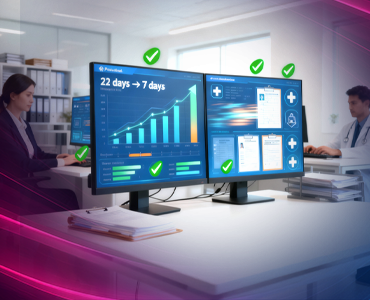
See the impact we deliver
Discover how AnnexMed reduces denials, accelerates reimbursements, and strengthens financial performance. Backed by measurable outcomes and proven RCM expertise, we deliver operational excellence, revenue stability, and sustainable growth you can trust.
Client Voices
See how our clients succeed
Alina Lora
Alina Lora
Alina Lora
Proven RCM expertise. Delivered at Scale.
For over 20 years, AnnexMed has delivered RCM solutions nationwide, combining expert billing, coding, and AR support to drive measurable results and growth.
- 20+ years of proven healthcare RCM experience
- 1,500+ professionals supporting billing, coding & AR
- 500+ certified coders across multiple specialties
- 99%+ compliance with HIPAA and security standards
- All 50 states served with consistent, scalable operations

