
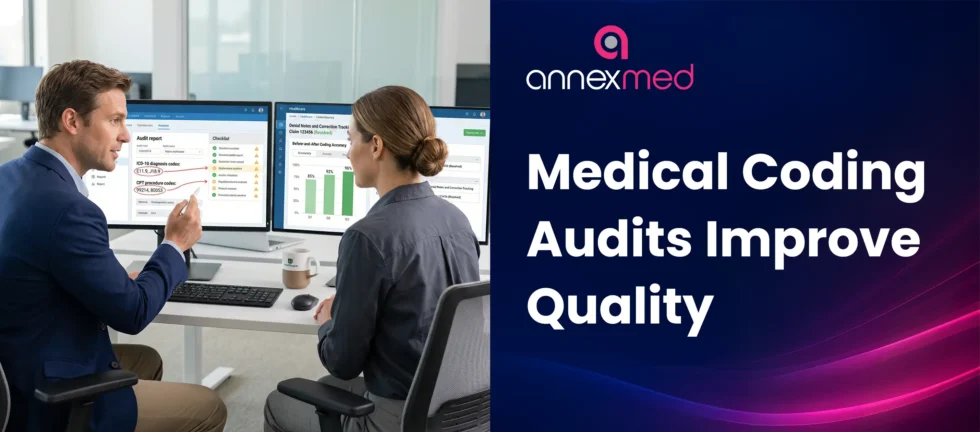
Medical coding accuracy is more than a compliance checkbox; it’s a critical driver of revenue integrity, operational efficiency, and regulatory risk management. Even minor coding errors can lead to claim denials, delayed reimbursements, and potential penalties.
While staff training and internal guidelines establish a baseline, systematic medical coding audits are the only mechanism that ensures consistent, long-term improvement in coding quality. Practices relying solely on reactive fixes often experience repeated errors, administrative backlogs, and revenue leakage. Audits, when properly implemented, transform coding from a risk area into a strategic advantage.
Table of contents
- Why Coding Errors Persist in Healthcare Practices
- Medical Coding Audits: What They Really Do
- How Audits Improve Workflow Accuracy
- Embedding a Culture of Compliance Through Audits
- Financial Impact of Long-Term Coding Quality
- Integrating Audits Into Daily Operations
- The Role of Technology in Coding Audits
- Conclusion: Audits as a Strategic Investment
Why Coding Errors Persist in Healthcare Practices
Even experienced coders encounter challenges. Coding errors arise from several sources: complex clinical documentation, frequent updates to CPT and ICD codes, varying payer policies, and human oversight.
These errors have measurable financial and operational consequences. Denied claims create rework cycles that occupy billing teams, slow cash flow, and increase administrative costs. In clinical workflows, errors can manifest as:
- Delayed claim submissions due to incomplete documentation
- Misapplied CPT codes leading to payer denials
- Inconsistent modifier usage affects reimbursement
- Recurring manual corrections that reduce staff efficiency
A single overlooked error can cascade, resulting in lost revenue and operational inefficiency.
Medical Coding Audits: What They Really Do
Medical coding audits are structured evaluations of submitted claims, assessing coding accuracy against clinical documentation, coding guidelines, and payer requirements. Audits are diagnostic tools; they reveal patterns and prevent mistakes rather than punish staff.
Audits typically identify:
- Misapplied or outdated CPT codes
- Overlooked or incorrectly applied modifiers
- Documentation gaps affecting reimbursement
- Variability in coder performance and adherence to internal policies
By highlighting systemic patterns, audits help practices move from reactive error correction to proactive coding improvement. They also ensure practices remain compliant with ever-evolving payer rules, reducing the risk of post-payment audits or regulatory scrutiny.
How Audits Improve Workflow Accuracy
Beyond error detection, coding audits drive operational improvements. They highlight workflow inefficiencies and provide the foundation for targeted interventions.
For instance, when recurring errors are detected:
- Coders receive focused training on high-risk codes or frequently misapplied modifiers
- Clinicians receive guidance on proper documentation practices
- Workflow templates and claim submission protocols are updated to reduce repetitive mistakes
Audits also reduce manual oversight. Over time, teams spend less time double-checking claims and more time processing new submissions, improving throughput and cash flow.
Embedding a Culture of Compliance Through Audits
Medical coding audits help foster a culture of compliance and continuous improvement. Coders and clinicians internalize standards, which reduces errors before claims reach payers.
Key behaviors reinforced through audits include:
- Accurate CPT code application based on complete documentation
- Correct use of modifiers to capture clinical nuance
- Awareness of payer-specific rules and policy changes
- Consistent and thorough documentation practices
Over time, these habits make coding workflows resilient, even amid staffing changes or frequent updates to regulatory guidance. Audits serve as both a coaching mechanism and a compliance checkpoint, ensuring long-term coding quality.
Financial Impact of Long-Term Coding Quality
The financial benefits of robust coding audits are substantial. High coding accuracy reduces:
- Claim denials and resubmissions
- Administrative overhead associated with rework
- Delays in cash flow due to rejected claims
Even small reductions in error rates can have an outsized impact in high-volume or high-cost service lines, translating into faster reimbursements, improved forecasting, and stronger financial stability.
Integrating Audits Into Daily Operations
For coding audits to deliver meaningful results, they must be embedded into everyday workflows rather than treated as sporadic compliance checks.
Best practices for integration include:
- Periodic reviews of high-risk codes and services
- Random sampling to assess overall coding quality
- Structured feedback loops between auditors, coders, and clinicians
- Documentation of recurring issues to inform workflow improvements
Leveraging technology-assisted audits can highlight discrepancies automatically, allowing coders to focus on corrective actions rather than labor-intensive reviews.
Over time, these processes create a self-reinforcing system: audits inform workflow enhancements, which reduce future errors and improve overall coding performance.
Common Audit Approaches and Strategies
Healthcare organizations can adopt different audit strategies depending on size, resources, and risk tolerance.
1. Internal Audits
Performed by trained staff within the organization, internal audits allow continuous monitoring, quick feedback, and low cost.
2. External Audits
Third-party audits provide objective insights and benchmarking against industry standards. External auditors often uncover systemic issues that internal teams may overlook.
3. Risk-Based Audits
Target audits on high-risk codes, procedures, or departments with historically high denial rates. This strategy maximizes ROI by focusing on areas with the greatest financial impact.
4. Continuous Auditing Programs
Ongoing audits embedded into the workflow, coupled with automated tools, ensure real-time feedback, prevent recurring mistakes, and reduce the need for large-scale post-submission reviews.
The Role of Technology in Coding Audits
Technology can enhance audit effectiveness and efficiency. AI-assisted coding audits, for example, automatically flag inconsistencies between documentation and billed codes, highlight high-risk claims, and generate actionable insights.
Benefits include:
- Reduced manual review time
- More accurate identification of systemic errors
- Real-time feedback for coders and clinicians
- Enhanced reporting and performance tracking
When combined with human expertise, technology-assisted audits accelerate the improvement of coding quality and support scalable workflows.
Conclusion: Audits as a Strategic Investment
Medical coding audits are far more than a compliance requirement; they are a strategic investment in operational efficiency, revenue integrity, and long-term coding quality.
By detecting errors, refining workflows, reinforcing coder behavior, and integrating technology, audits ensure coding accuracy improves progressively. Practices that implement structured auditing experience fewer denials, faster reimbursements, and sustained performance improvements across all service lines.
Optimize Your Coding Operations
Contact our team to design a tailored medical coding audit program for your practice.
FAQ
Audits are most effective when scheduled regularly. Many practices conduct monthly or quarterly reviews, with high-risk codes checked more frequently.
No, audits complement training. They pinpoint areas for improvement, enabling targeted, actionable education.
ROI varies by practice size and baseline error rate, but audits often recover thousands in lost revenue per month through improved accuracy and reduced denials.
If integrated thoughtfully, audits can be minimally disruptive, especially with technology-assisted sampling and structured feedback mechanisms.
Yes, audits ensure coding and documentation compliance, reducing the risk of penalties during external reviews.