Last Updated on September 2, 2026
Radiology practices are quietly losing revenue on one of their most frequently billed procedures, CPT code 70450 (CT head without contrast). Industry benchmarks from organizations like AAPC indicate that 15–20% of these claims are denied, often due to vague documentation, nonspecific diagnosis coding, and weak medical necessity narratives.
This translates into 6–9% annual revenue leakage, compounded by payer audits and delayed reimbursements that push accounts receivable beyond 45 days, even in otherwise efficient revenue cycle environments.
The issue isn’t utilization. It’s visibility, documentation precision, and coding alignment.
This guide breaks down how to:
- Strengthen medical necessity for CPT 70450
- Optimize documentation for audit defense
- Improve ICD-10 coding accuracy
- Apply modifiers correctly
- Reduce denials and improve first-pass yield
Table of Contents
What Is CPT Code 70450?
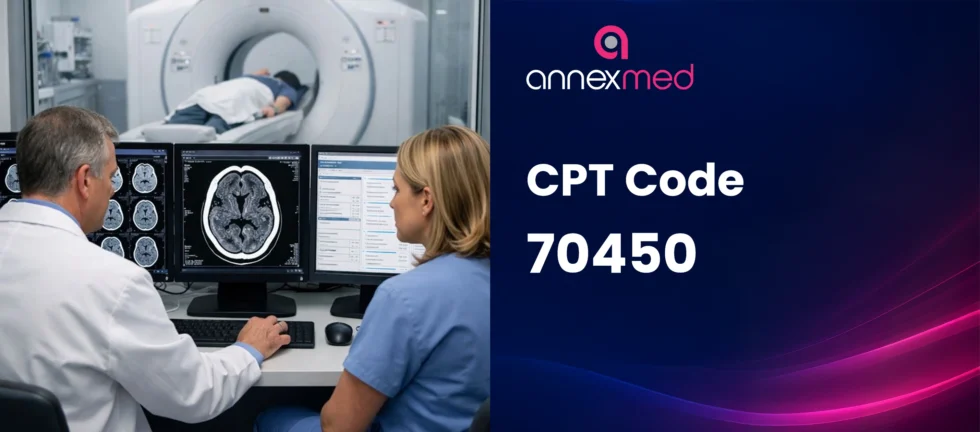
CPT code 70450 refers to a computed tomography (CT) scan of the head or brain performed without contrast material.
Key Details:
- Procedure type: Non-contrast CT scan
- Common settings: Emergency departments, trauma centers, outpatient imaging
- Primary purpose: Rule out intracranial hemorrhage, fractures, or acute abnormalities
Because it is fast, accessible, and clinically essential, payers no longer question whether it should be used, but rather whether it was justified in each case.
Medical Necessity for CPT Code 70450: What Payers Expect
Medical necessity is the #1 driver of denials for CT head without contrast claims.
Payers require clear, specific, and risk-based clinical justification, not generic statements like “rule out pathology” or “headache evaluation.”
The Benchmarks High-Performing Hospitals Achieve in 2026
Common Approved Indications
Claims are more likely to be approved when documentation includes:
- Acute head trauma with loss of consciousness (include duration)
- Altered mental status following a fall or injury
- Focal neurologic deficits (e.g., weakness, vision changes)
- Syncope with head impact
- Severe (thunderclap) headache with red-flag symptoms
- Suspected intracranial hemorrhage
Critical Insight: – In emergency scenarios, non-contrast CT is preferred for speed and safety, but this urgency must be explicitly documented.
Failure to do so often triggers:
- Pre-payment denials
- Post-payment audits
- Large-scale recoupments (often exceeding $2,500 per audit batch)
CPT Code 70450 Documentation Requirements for Audit Defense
Strong documentation is essential to avoid denials and ensure clean claims for CPT code 70450. Every case should clearly support medical necessity with specific, auditable details.
- Include objective clinical indicators (e.g., GCS score: “GCS 13 post-MVC rollover”)
- Clearly document the mechanism of injury or event (fall, motor vehicle collision, trauma type)
- Capture neurologic symptoms (confusion, weakness, altered mental status)
- Record anticoagulant use due to increased bleeding risk
- Specify the reason for non-contrast imaging (hemodynamic instability, contrast allergy, renal impairment, need to rapidly exclude hemorrhage)
- Restate the clinical indication clearly in the radiology report
- Ensure findings align with the patient’s acuity
- Avoid vague impressions like “no acute intracranial abnormality” without contex
ICD-10 Coding Accuracy for CT Head Without Contrast Billing
ICD-10 specificity plays a decisive role in clean claim performance for CPT code 70450. High-denial diagnoses such as R51 headache, R42 dizziness, and R55 syncope are not inherently non-covered, but when submitted without context, they trigger secondary review rates approaching 40%.
Payers interpret these codes as routine complaints unless augmented by specificity that reflects neurologic risk. Codes such as G44.1 vascular headache with neurologic deficit, R41.82 altered mental status following trauma, or Z79.01 long-term anticoagulant use better align claims with CMS LCD criteria and NCD 220.1 guidance.
HFMA data confirms that diagnosis refinement alone can improve clean claim rates by nearly 30%, underscoring that coding precision is not cosmetic but foundational to reimbursement stability.
Modifier 26, TC, and 59 Usage for CPT 70450 Compliance
Incorrect modifier usage is a common audit trigger.
- Modifier 26 (Professional Component) – Use when billing interpretation only (typically radiologist services).
- TC (Technical Component) – Used for, Equipment, Facility & Imaging execution
- Modifier 59 (Distinct Procedural Service) – Used only when justified, such as ‘Separate imaging at a different anatomical site’
- Do NOT use Modifier 59 to bypass NCCI edits without clinical justification.
CMS and LCD Updates Impacting CPT Code 70450
CMS updates have refined LCD interpretations for CPT code 70450, particularly around anticoagulant-related intracranial hemorrhage risk. Expanded recognition of direct oral anticoagulants elevates the importance of capturing medication status in both documentation and diagnosis coding.
At the same time, CMS continues to tighten expectations around headache imaging, reinforcing that non-routine features must be present. Emerging Category III codes for AI-enhanced imaging workflows and OPPS pass-throughs for low-dose protocols signal technological evolution, but they do not relax core medical necessity requirements.
Compliance success remains rooted in documentation integrity rather than technology adoption alone.
Reducing CPT 70450 Denials Through Operational Controls
Organizations that consistently outperform benchmarks deploy structured operational safeguards. Mandatory EHR order fields prevent vague clinical entries, quarterly audits identify high-risk diagnosis patterns such as R51-only claims, and regular alignment between emergency physicians and radiologists ensures consistent narrative framing.
Analytics-driven dashboards that track utilization by provider and diagnosis allow practices to identify audit exposure early, often predicting over 90% of future denials before claims are submitted. These controls shift denial management from reactive appeals to proactive prevention.
Why CPT Code 70450 Mastery Protects Radiology Revenue
Despite its routine appearance, CPT code 70450 sits at the intersection of clinical urgency and financial risk. MGMA places baseline neuroimaging denial rates near 18%, while Change Healthcare reports first-pass yield improvements exceeding 35% following targeted documentation and coding interventions.
Conversely, RAC activity continues to escalate, with recoupment spikes above 25% for high-volume CT head imaging when utilization patterns lack defensibility. Mastery of CT head without contrast billing transforms this exposure into a strategic advantage, converting documentation discipline and coding precision into sustained revenue protection.
Partner With Radiology Experts
Prevent avoidable denials and payer scrutiny with precision-driven CPT 70450 coding and documentation workflows built for modern radiology practices.
Talk to a Billing ExpertFAQs
Prior authorization depends on the payer and site of service. Emergency scans are often exempt, while outpatient and freestanding centers may require approval, especially for non-trauma indications.
Yes, if both studies are medically necessary and separately documented. The record must explain why non-contrast imaging alone was insufficient.
They can be, but payers apply higher scrutiny. Documentation must show escalation criteria such as neurologic deficits, trauma risk, or anticoagulant use.
Yes. Pediatric and elderly patients are evaluated under different risk thresholds. Age-related risk should be explicitly documented when relevant.
Often denied unless additional risk factors are documented, such as altered mental status, anticoagulant therapy, or unreliable history.