
Last Updated on October 8, 2026
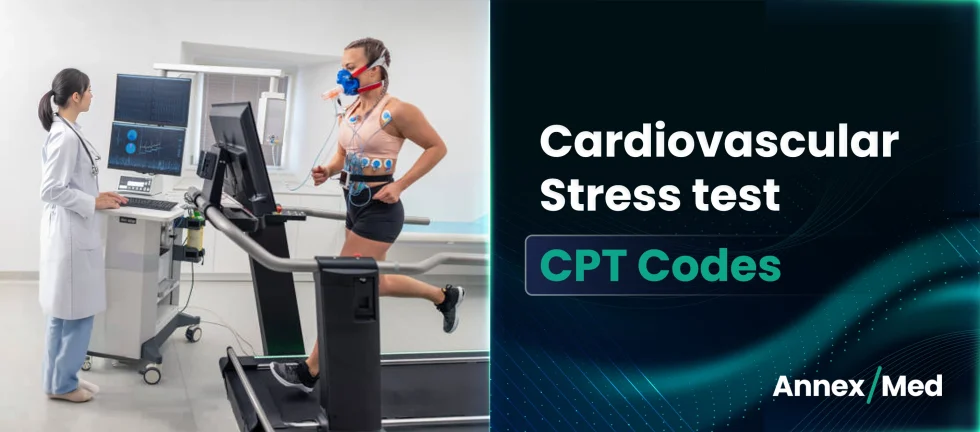
Cardiovascular stress testing helps clinicians evaluate how the heart responds to exercise or pharmacologic stress and can support the assessment of coronary artery disease, exercise tolerance, ischemia, and other cardiac conditions.
From a billing perspective, however, a stress test is not always a single service. Supervision, ECG tracing, technical performance, interpretation, stress echocardiography, and nuclear imaging may be performed by different providers or entities.
That makes CPT selection dependent on two key questions:
What type of cardiovascular stress test was performed, and who furnished each reportable component?
These distinctions determine whether CPT 93015 should be used for a complete stress test or whether 93016, 93017, and 93018 should be reported as separate components. Incorrect component selection or overlapping reporting is a common source of denials and underpayments in cardiology billing.
| About 1 in 20 U.S. adults age 20 and older have coronary artery disease, according to the CDC. Stress testing is one of the diagnostic tools that may be used when evaluating suspected or known coronary artery disease. |
Table of contents
- Cardiovascular Stress Test CPT Codes Quick Reference
- CPT 93015 Complete Cardiovascular Stress Test
- CPT 93016 Stress Test Supervision
- CPT 93017 Stress Test Tracing
- CPT 93018 Stress Test Interpretation and Report
- CPT 93015 vs 93016 vs 93017 vs 93018
- Stress Echocardiography CPT Codes 93350 and 93351
- Nuclear Stress Test CPT Codes 78451 and 78452
- What Is Included in Cardiovascular Stress Testing
- Stress Test Supervision Rules in 2026
- Medical Necessity for Stress Testing
- Prior Authorization and Payer Requirements
- Cardiovascular Stress Test Documentation
- Final Stress Test Coding Check
- Align Stress Test Billing From Performance to Payment
- FAQs
Cardiovascular Stress Test CPT Codes Quick Reference
| CPT Code | Service | Primary Billing Use |
|---|---|---|
| 93015 |
Complete cardiovascular stress test
|
Full-stress test service reported together. |
| 93016 |
Supervision
|
Physician or qualified practitioner supervision reported separately. |
| 93017 |
Tracing and technical performance
|
Technical portion of the test. |
| 93018 |
Interpretation and report
|
Physician interpretation reported separately. |
| 93350 |
Stress echocardiography
|
Stress echo imaging with interpretation and report. |
| 93351 |
Integrated stress echocardiography
|
Stress echo with continuous ECG monitoring and supervision. |
| 78451 |
Myocardial perfusion SPECT
|
Single rest or stress study. |
| 78452 |
Myocardial perfusion SPECT
|
Multiple rest and/or stress studies. |
The main coding decision within the 93015–93018 family is whether the cardiovascular stress test is being reported as a complete service or as individual components.
CPT 93015 Complete Cardiovascular Stress Test
CPT 93015 represents the complete cardiovascular stress-test service when the required supervision, continuous ECG monitoring, technical performance, interpretation, and report are furnished as part of the complete service.
It is commonly used when one physician practice, cardiology group, or other eligible billing entity is responsible for all reportable components of the stress test.
What CPT 93015 includes
The complete service generally incorporates:
- Physician or qualified practitioner supervision
- Continuous ECG monitoring
- Cardiovascular stress-test performance
- ECG tracing
- Interpretation
- Formal report
Because these elements are already represented by 93015, the individual component codes should not also be reported for the same complete test.
Before billing 93015, confirm that the documentation supports the complete service and that the billing entity is entitled to report all of its components.
For a deeper look at code-specific documentation and billing considerations, see our CPT 93015 Billing Guide.
CPT 93016 Stress Test Supervision
CPT 93016 represents the supervision component of cardiovascular stress testing when the supervision service is reported separately rather than through CPT 93015.
This often becomes relevant in hospital-based or split-service arrangements where one practitioner supervises the stress test while another entity provides the technical portion and another practitioner may interpret the study.
Documentation supporting 93016 should make the supervision responsibility clear and may include:
- Supervising practitioner
- Exercise or pharmacologic protocol
- Patient monitoring
- Clinical response during stress
- Any symptoms or changes requiring intervention
CPT 93016 does not represent the ECG tracing or final interpretation. Those functions are addressed through other codes within the stress-test family.
Supervision requirements should also be reviewed against current Medicare, payer, facility, credentialing, and state scope-of-practice rules.
CPT 93017 Stress Test Tracing
CPT 93017 represents the technical performance and tracing portion of the cardiovascular stress test.
This code is commonly relevant when a hospital, diagnostic facility, or testing center furnishes the equipment, technical staff, monitoring, and test execution while professional responsibilities are billed separately.
The medical record should establish the actual test performed and the technical data generated during the study.
Important documentation may include:
- Exercise or pharmacologic protocol
- ECG monitoring
- Heart-rate response
- Blood-pressure response
- Test duration
- Symptoms during testing
- Reason for termination
- Technical tracing data
CPT 93017 should not be treated as the complete cardiovascular stress-test service because it does not represent the separate supervision and interpretation components.
Hospital cardiovascular programs also need to keep facility billing responsibilities clearly separated from professional services.
CPT 93018 Stress Test Interpretation and Report
CPT 93018 represents the physician’s interpretation and formal report for the cardiovascular stress test.
The service requires more than the availability of ECG data. The interpreting practitioner should evaluate the study and document a clinical interpretation.
A stress-test report may include:
- Baseline ECG findings
- ECG changes during stress
- Maximum heart rate achieved
- Blood-pressure response
- Exercise tolerance
- Symptoms
- Arrhythmias
- Evidence of ischemia
- Reason the test ended
- Final impression
The interpretation should stand on its own as a report supporting the professional service.
CPT 93018 is particularly important in split-service arrangements where a test may be performed at one location and interpreted by a cardiologist separately.
CPT 93015 vs 93016 vs 93017 vs 93018
The easiest way to distinguish these four codes is by looking at who performed each part of the stress test.
| Service Component | 93015 | 93016 | 93017 | 93018 |
|---|---|---|---|---|
| Complete service | Yes | No | No | No |
| Supervision | Included | Yes | No | No |
| Technical performance | Included | No | Yes | No |
| ECG Tracing | Included | No | Yes | No |
| Interpretation | Included | No | No | Yes |
| Formal report | Included | No | No | Yes |
Complete-service billing
When the full cardiovascular stress-test service is appropriately furnished and reported together: 93015
Component billing
When responsibilities are separated:
- Supervision → 93016
- Tracing and technical performance → 93017
- Interpretation and report → 93018
The components do not have to be performed by three completely separate organizations. The claim should simply reflect which provider or entity actually furnished and is entitled to report each service.
Modifiers 26 and TC should not be used simply to split CPT 93015, because 93016–93018 already provide the component structure for the cardiovascular stress-test family.
Is One Stress Test Being Split Across Multiple Claims?
AnnexMed helps cardiology teams align supervision, technical performance, interpretation, and reporting with the correct CPT structure before overlapping or missing components affect the claim.
Review Your Stress Test Billing ModelStress Echocardiography CPT Codes 93350 and 93351
When echocardiographic imaging is added to cardiovascular stress testing, the coding pathway changes.
CPT 93350
CPT 93350 describes stress echocardiographic imaging with interpretation and report.
The code focuses on the echocardiography portion rather than representing all stress-test components.
CPT 93351
CPT 93351 represents a more comprehensive stress echocardiography service that includes:
- Stress echocardiographic imaging
- Interpretation and report
- Continuous ECG monitoring
- Physician supervision
| Service | 93350 | 93351 |
|---|---|---|
| Stress echo imaging | Yes | Yes |
| Interpretation/report | Yes | Yes |
| Continuous ECG monitoring | No | Included |
| Physician supervision | No | Included |
The distinction is important because 93351 already includes components that would otherwise need to be evaluated separately.
When qualifying echocardiographic contrast administration is performed, CPT 93352 may also need to be evaluated under applicable coding rules.
Nuclear Stress Test CPT Codes 78451 and 78452
Nuclear stress testing usually combines cardiovascular stress with myocardial perfusion imaging. The imaging and stress-test portions should be evaluated separately.
CPT 78451
CPT 78451 describes a single myocardial perfusion SPECT study performed at rest or stress.
CPT 78452
CPT 78452 describes qualifying multiple myocardial perfusion SPECT studies, such as a rest-and-stress protocol.
| Study Structure | 78451 | 78452 |
|---|---|---|
| Single study | Yes | No |
| Rest only | May apply | No |
| Stress only | May apply | No |
| Rest plus stress | No | May apply |
The imaging code answers what myocardial perfusion study was performed. The 93015–93018 family answers how the cardiovascular stress portion was furnished and reported. These are separate coding decisions and should be evaluated independently.
Need More Than CPT Code Guidance?
If authorization, documentation, component billing, or recurring stress-test claim issues are affecting reimbursement, our cardiology billing team can help you address them.
Explore Our Cardiology Billing ServicesWhat Is Included in Cardiovascular Stress Testing
Not every service performed during a cardiovascular stress test creates an additional billable line.
Medicare NCCI guidance treats certain services as integral to the stress-test procedure, including applicable:
- Needle or catheter insertion
- Infusion or injection work associated with pharmacologic stress
- ECG strips performed as part of the study
The pharmacologic stressing agent itself may have separate HCPCS reporting requirements depending on the drug, payer, and site of service.
The key principle is:
Performed during the stress test does not automatically mean separately billable.
Billing teams should review current NCCI edits before adding ancillary codes to the claim.
Stress Test Supervision Rules in 2026
Supervision rules continue to be important when cardiovascular stress testing is split across providers or settings.
For CY 2026, CMS permanently adopted a definition of direct supervision that permits real-time audio-video supervision for applicable diagnostic tests requiring direct supervision.
However, this should not be interpreted as universal virtual supervision for every stress-test scenario.
Verify:
- Required supervision level
- Qualifications of the supervising practitioner
- Whether virtual direct supervision applies
- Facility credentialing
- State scope-of-practice rules
- Payer-specific requirements
For broader guidance on cardiology coding, documentation, and compliance controls, see our article on Cardiology Coding and Billing Best Practices.
Medical Necessity for Stress Testing
Selecting the correct CPT code does not establish medical necessity by itself.
The record should clearly explain why cardiovascular stress testing was clinically appropriate.
Documentation may need to support:
- Chest pain or other relevant symptoms
- Known or suspected coronary artery disease
- Changes in cardiac status
- Exercise tolerance or limitations
- Relevant cardiac history
- Previous diagnostic testing
- Reason stress imaging was added
- Reason pharmacologic stress was selected instead of exercise
Diagnosis coding should therefore come from the documented clinical indication rather than a fixed CPT-to-ICD-10 crosswalk.
Prior Authorization and Payer Requirements
Prior authorization requirements vary by payer, plan, test type, imaging modality, and site of service.
A standard cardiovascular stress test may have different requirements from:
- Stress echocardiography
- Nuclear myocardial perfusion imaging
- Pharmacologic stress testing
- Other advanced cardiovascular imaging
Authorization should be verified before the service when required, and the approved test should match the procedure ultimately scheduled and performed.
For more detail, see our guide to Prior Authorization Challenges in Cardiology.
Cardiovascular Stress Test Documentation
A strong stress-test record should connect the clinical reason for testing with the actual service billed.
Clinical documentation
- Reason for testing
- Exercise or pharmacologic protocol
- Symptoms
- ECG response
- Heart-rate and blood-pressure response
- Imaging findings where applicable
- Reason for test termination
- Final interpretation
Billing documentation
- Stress-test CPT code
- Supervision furnished
- Technical service performed
- Interpreting practitioner
- Formal report
- Imaging modality
- Site of service
- Authorization when required
The goal is to make the billing structure identifiable from the record without reconstructing the encounter after submission.
Final Stress Test Coding Check
Before releasing a cardiovascular stress-test claim, confirm five decisions:
1. Identify the test performed
Determine whether the encounter involved standard stress testing, stress echo, nuclear perfusion imaging, or a combination.
2. Determine complete versus component billing
Confirm whether 93015 or the applicable 93016–93018 codes reflect the services furnished.
3. Review imaging codes
Evaluate 93350 or 93351 for stress echo and 78451 or 78452 for myocardial perfusion imaging.
4. Check bundled services
Do not separately report services already integral to the stress-test procedure.
5. Validate the entire claim
CPT codes, supervision, medical necessity, authorization, interpretation, and site of service should all describe the same encounter.
When component-billing or documentation inconsistencies recur, a Medical Coding Audit can help identify patterns across providers, sites, and cardiac diagnostic services.
Component billing and multi-provider coordination often create delays when documentation and coding are not tightly aligned. For this challenge, AnnexMed helped an academic health system stabilize rising DNFB within 60 days by improving coding throughput and segmenting claims by complexity.
Align Stress Test Billing From Performance to Payment
Cardiovascular stress testing can involve several distinct responsibilities within one diagnostic encounter. The test may be ordered in a physician practice, performed in a hospital or diagnostic facility, supervised by one practitioner, expanded into echocardiography or nuclear imaging, and interpreted by another cardiologist.
Accurate billing depends on keeping those responsibilities connected to the correct CPT codes throughout the revenue cycle.
AnnexMed supports cardiology practices, diagnostic centers, and hospital cardiovascular programs with cardiology-specific coding, component billing review, documentation validation, prior authorization, claim submission, denial management, and reimbursement follow-up.
By aligning the ordered study with the provider who supervised it, the entity that performed it, the imaging completed, and the practitioner who interpreted it, AnnexMed helps cardiology organizations maintain a clearer path from diagnostic testing to reimbursement.
Make Every Stress Test Component Accountable
AnnexMed connects cardiovascular testing, coding, supervision, documentation, authorization, and reimbursement follow-up within one coordinated cardiology billing workflow.
Talk to a Cardiology Billing SpecialistFAQs
CPT 93015 represents the complete cardiovascular stress-test service when supervision, continuous ECG monitoring, technical performance, interpretation, and reporting are appropriately furnished as one complete service.
CPT 93016 represents supervision, 93017 represents technical performance and tracing, and 93018 represents physician interpretation and report.
Both describe stress echocardiography. CPT 93351 additionally incorporates continuous ECG monitoring and physician supervision, while 93350 represents the stress echocardiographic imaging with interpretation and report.
CPT 78451 describes a single myocardial perfusion SPECT study at rest or stress. CPT 78452 describes qualifying multiple myocardial perfusion studies involving rest and/or stress.
They represent different portions of the encounter and may both be relevant when the documented services and applicable payer rules support reporting.
CMS permits real-time audio-video direct supervision for applicable diagnostic tests requiring direct supervision, subject to the specific service, practitioner qualifications, care setting, state law, and other applicable requirements.