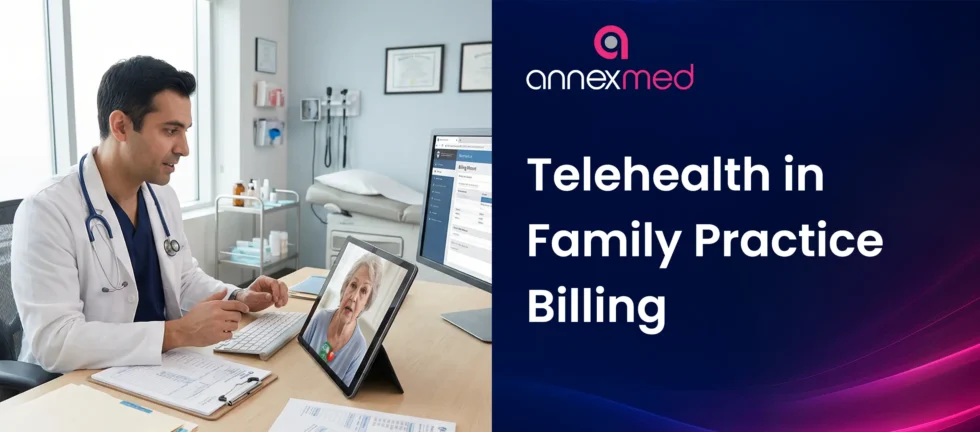
Telehealth has been a mandatory channel of care, having redefined the manner in which providers execute routine care sessions, chronic care follow-ups, and check-ins on their patients. With the payers refining the coverage policies, audit standards, practices have to handle documentation, coding, and billing processes through a more precise operation prism. Remote services have their own specific requirements, and without a well-organized system of billing, some of the practices might experience high-denial rates, delayed payments, and regulatory issues. A cohesive strategy consisting of aligned processes, staffing, and appropriate coding is able to guarantee that telehealth encounters are reflected in revenue meeting the time requirements and being compliant, as well as predictable.
Table of Contents
Billing Requirements for Family Practices
Regulatory awareness is essential when billing telehealth services, as Medicare, Medicaid, and commercial payers apply different coverage rules. While policies vary, several core billing requirements consistently affect family practices and must be addressed to avoid claim disruptions.
Key billing elements that must be accurately captured include:
- Eligible encounter modality, such as audio-visual visits, audio-only consultations, or virtual check-ins
- Patient location and provider location, documented according to payer guidelines
- Patient consent, explicitly recorded for telehealth services
- Time spent, when billing time-based E/M or communication-based services
- Correct place-of-service (POS) codes, typically POS 02 or POS 10, based on payer rules
- Appropriate modifiers, such as 95 or GT, applied according to payer-specific instructions
While several pandemic-era flexibilities remain in place, not all are permanent. Payers continue to revise telehealth policies, making ongoing updates to internal billing references critical. Clearly defined procedures reduce guesswork and help ensure claims remain aligned with payer expectations.
Telehealth Documentation and Coding Issues
Gaps in telehealth documentation in family medicine usually create holes which have a direct effect on approving claims. The providers tend to omit the encounter details like modality, technology employed or verification procedures that the payers regard as vital in remote encounters. The broad clinical mix of the practice found in family medicine also contributes to coding inaccuracies, as selection of E/M level or diagnosis codes do not match. The management of chronic conditions also complicates the management of documentation by ensuring that payers will be looking at in-depth evaluations and not short summaries. Providing structure to telehealth notes would aid in providing assurance that all remote visits capture the clinical reasoning, medical necessity, and encounter factors required to submit clean claims.
How proper documentation supports Reimbursement and Compliance
Proper documentation practices have a direct effect on revenue performance in the context of telehealth provision. Comprehensive, concise notes cause fewer holds of claims, medical-record inquiries, and second reviews. Remote encounters are looked into with more scrutiny by the payers and even slight gaps can be indicative of lack of medical necessity. Correct coding also plays down a compliance exposure as in time-based billing or chronic-care management. In cases where documentation is reliable to capture the complexity, length and modality of each encounter, family practices construct a defensible history that enhances a faster adjudication process, the workload of appeals, and an expansion of compliance initiatives.
Best Practices in Family Practice Billing to reduce Denials
Telehealth billing accuracy improves when practices apply consistent operational controls. The following best practices help reduce avoidable denials while improving workflow efficiency:
- Use standardized telehealth encounter templates to ensure consent, modality, timing, and location are documented consistently
- Maintain payer-specific coding matrices outlining approved CPT codes, modifiers, and eligible service types
- Verify telehealth eligibility before the encounter, especially for audio-only services
- Conduct pre-submission claim reviews to identify missing or incorrect elements before claims are released
- Establish structured feedback loops between clinical and billing teams to correct documentation gaps
These controls help align clinical documentation with billing requirements and reduce downstream rework.
Enhancing Documentation with the right Tech
Technology is a supporting factor in diminishing pressure of administration and improving billing accuracy. Completeness and consistency include automation of critical encounter details that is automated by integrated telehealth platforms. Embedded coding tools assist the providers in directed compliant code penalty and contribute towards the trustworthiness of documentation with E/M requirements. Automated charge capture eliminates lost or double-recorded charges by establishing an electronic pipeline between telehealth sessions and billing platforms. Analytics dashboard enables the practices to track the denial patterns and utilization profiles, which creates a visibility of the gaps in operations. These electronic applications are not standalone meaningful solutions and so they are effective in combination with clear workflows.
Team Strategies for Telehealth Billing
Being an organisation that supports telehealth billing, there should be constant learning that does not stop. Regulations, coverage policies, and codes continue to change regularly and regular training of staff at the billing office and clinicians is used to keep them in harmony with other requirements. Clinicians can use telehealth-specific refreshers on norms of documentation, particularly in regards to medical necessity declaration and time-based encounters. Internal playbooks develop a single standard of operation that minimizes diversification in implementation. Frequent contact between clinical, billing, and administrative teams enhances cooperation and contributes to solving the recurring problems in the context of the whole revenue cycle before they reflect on the results.
Telehealth remains a tactical aspect in the family medical context, yet a successful billing process depends on disciplined processes, proper coding, and effective documentation patterns. An example of family practice in which investment is made in clear working practices, communal and continuous staff education is where consistent reimbursement outcomes are achieved without falling into compliance traps. The change in the payer policies will reduce the accessibility of the telehealth services due to a lack of proactive and deliberate measures, both clinically and financially.
Simplify Your Telehealth Billing Process
Discover practical strategies and expert insights to enhance billing accuracy for telehealth and remote consultations in family practices. Reduce claim denials and accelerate reimbursement with proven best practices tailored to your needs.
FAQs
Payer requirements for telehealth can vary considerably by state, including which services are covered, eligible providers, and reimbursement rates. Staying current with state-specific guidelines is essential for compliant billing.
Yes, distinct CPT and HCPCS codes apply to behavioral health telehealth visits, often with different documentation requirements. Accurate identification and use of these codes ensure proper reimbursement.
Billing across state lines depends on licensure, payer policies, and state regulations. Practices must verify eligibility and documentation criteria to avoid claim rejections.
Proper documentation of patient consent and adherence to HIPAA privacy standards are crucial for telehealth encounters and may impact claim acceptance during audits.
Audio-only visits have specific codes and coverage rules that differ from video consultations. Understanding these distinctions helps maximize valid reimbursement while maintaining compliance.